
Share your experience of gambling and lotteries
Tell us whether you play the lottery or bet, how you play and what you spend. Your answers are combined with other people's and reported only as totals.
Start the gambling and lotteries surveyAbout 5 minutes. No account needed. You can stop at any time.
What gambling covers
Gambling means risking money or something of value on an outcome that depends at least partly on chance, in the hope of winning more. It takes many forms:
- Lotteries: draw tickets, scratch tickets and daily number games.
- Casino games: slot machines, table games such as blackjack and roulette, and poker.
- Sports betting: bets on the result of a game or on events within it, in person or online.
- Online casinos: digital versions of slots and table games.
- Bingo, raffles and charitable gaming.
- Horse racing, where people bet on races at tracks and online.
- Informal betting: office pools, card games with friends and bets on the side.
Some games, such as lotteries and slots, depend entirely on chance. Others, such as poker and sports betting, involve some skill or knowledge, but chance still plays a large part.
How gambling is run in Canada
Under the Criminal Code, gambling is generally illegal in Canada unless it is conducted and managed by a provincial government or licensed by one, with some exceptions. Each province runs its own lottery and gaming corporation, and many run or license casinos and online gambling sites. Charities can hold licensed lotteries and bingo to raise money.
Two recent changes have reshaped the market. In 2021, Parliament changed the Criminal Code to allow provinces to offer betting on single sports events, not only on several games combined. In 2022, Ontario opened a regulated market where licensed private companies can offer online casino games and sports betting, overseen by the province. Other provinces run online gambling through their own corporations. Many websites operating outside provincial rules are also available to Canadians, and how to deal with them is debated.
In the United States, rules vary by state. Many states have legalized sports betting since 2018, and some allow online casinos.
Odds, house edge and payouts
Every gambling game is designed so that, over time, the operator takes in more than it pays out. The house edge is the operator's average share of each bet. For lotteries, a large share of ticket sales goes to provincial governments and to running costs, not to prizes.
Odds describe how likely an outcome is. In sports betting, odds also show how much a winning bet pays. Canadian sites usually show decimal odds, where the number is the total return for each dollar bet.
Example (hypothetical figures)
A bettor places $20 on a hockey team at decimal odds of 2.50. If the team wins, they get back $50: their $20 stake plus $30 profit. If the team loses, they lose the $20. If the true chance of the team winning is 38 percent, the average return on such a bet is 0.38 × $50 = $19, so on average they lose $1 for every $20 bet.
Small-chance prizes can be very large. The odds of winning the top prize in national lottery draws are often in the tens of millions to one. People know this and buy tickets anyway, often for the fun of imagining a win.
Who gambles and why
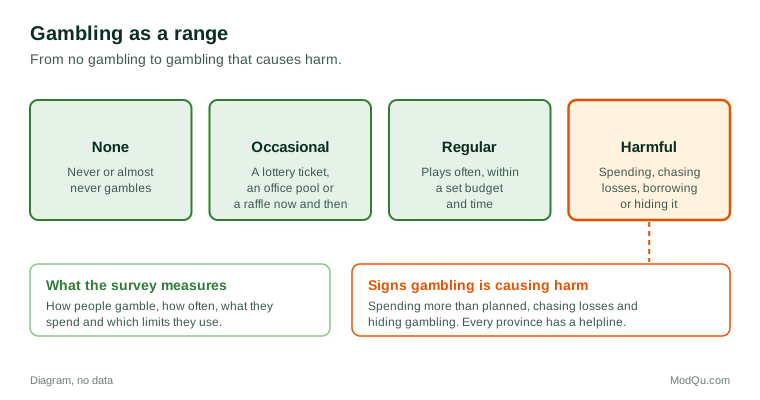
Many adults in Canada gamble at least occasionally, most often by buying lottery tickets. People give different reasons: the chance of a big win, entertainment, socializing, the excitement of a sports game they have money on, or supporting a charity raffle. Some people never gamble for religious, moral or financial reasons.
Example
A group of eight coworkers each put $5 a week into an office lottery pool. One person buys the tickets and keeps a written list of who paid. They have never won more than a small prize, but they say the weekly chat about what they would do with the jackpot is half the fun.
Online sports betting has drawn much attention since 2022, with heavy advertising in some provinces, especially during broadcasts of games. Concern about advertising aimed at young people led Ontario to restrict the use of athletes and celebrities who appeal to minors in gambling ads.
Spending and keeping track
Most people who gamble spend small amounts. Some spend more than they intended, especially on fast games such as slots and in-play sports betting, where bets can be placed many times an hour. Because spending is spread across small bets, people often do not know how much they spend in a month.
Example
A man in his thirties starts betting small amounts on hockey games through an app. Within a few months he is betting on several games a night and on events within games. When he checks his account history, he finds he has deposited far more than he thought. He sets a monthly deposit limit in the app and tells his partner what happened.
In Canada, winnings from lotteries and casual gambling are generally not taxed as income. Professional gamblers can be treated differently.
Responsible gambling and help
Responsible gambling refers to practices that help people gamble within limits, and to the duties of operators to reduce harm. Common tools include:
- Deposit, time and loss limits set in online accounts.
- Reality checks, pop-up reminders of how long someone has been playing.
- Self-exclusion, where a person asks to be barred from casinos or sites for a set period.
- Age checks: the legal age to gamble is 18 or 19 depending on the province.
- Helplines and counselling funded by provinces.
Signs that gambling may be causing harm include spending more than planned, chasing losses, borrowing to gamble, hiding gambling from family, and feeling anxious or low about it. Each province has a free, confidential problem gambling helpline. This page describes gambling in general and is not financial or medical advice.
What people disagree about
Gambling raises long-standing debates: whether governments should profit from gambling, how much advertising should be allowed, whether online betting is too easy to reach, how to balance personal freedom with harm, and whether lottery revenue that pays for public services falls hardest on lower-income players. Because some people under-report gambling, especially losses, surveys on this topic use careful, neutral wording.
Key terms
- House edgeThe operator's average share of each bet over time.
- OddsHow likely an outcome is, and in betting, how much a winning bet pays.
- StakeThe amount of money placed on a bet.
- Single-event bettingBetting on the result of one game, legal in Canada since 2021.
- In-play bettingBetting on events while a game is under way.
- Self-exclusionA person's own request to be barred from gambling venues or sites for a period.
- Chasing lossesGambling more to try to win back money already lost.
- ParlayA bet combining several outcomes, all of which must win for the bet to pay.
Full glossary: casino compliance terms on EditingTests.com.
Gambling and lotteries vocabulary test
How well do you know the language of this topic? Try 8 quick questions. Your score is shown straight away and is not saved.
What the gambling and lotteries survey asks
This survey is part of ModQu's Leisure and Lifestyle survey. The gambling and lotteries part takes about five minutes and covers:
- Whether you have bought a lottery ticket or scratch ticket this year.
- Which other kinds of gambling you take part in, and how often.
- Whether you have placed a bet online, and on which kinds of site.
- How much you spend on gambling in a typical month.
- Whether you use limits or other responsible gambling tools.
- How you feel about gambling advertising.
After that you can choose to continue with other short parts of the Leisure and Lifestyle survey, such as cannabis or tobacco and vaping, or stop.
Ready to take part?
Your answers help show what people really think and do. Results are only ever reported as totals; no one can see your individual answers.
Start the surveyQuestions about this survey
Who can take part?
Adults of legal age.
Do I have to give my name?
No. You may be asked for your age group, region and similar details so results can be broken down, but not your name. ModQu never asks for passwords, card numbers or account numbers.
How are the results used?
Answers are combined into totals and percentages and published in ModQu reports. Individual answers are never shown.
Is the vocabulary test part of the survey?
No. It is optional and separate, and your score is not stored.