
Share your camping and cottage experience
Tell us whether you camp or go to a cottage, how you book and what gear you buy. Your answers are combined with other people's and reported only as totals.
Start the camping and cottages surveyAbout 5 minutes. No account needed. You can stop at any time.
What camping and cottages cover
Camping means staying overnight outdoors, in a tent, trailer, recreational vehicle (RV) or simple shelter. A cottage is a holiday home, often by a lake, used on weekends and in summer. The words differ by region: people in Ontario usually say cottage, people in western Canada often say cabin, Quebecers say chalet, and in parts of Atlantic Canada and the United States people may say camp.
This topic covers:
- Car camping at campgrounds with a site next to the car.
- Backcountry camping, reached on foot, by canoe or by bike.
- RV and trailer camping, including tent trailers, travel trailers and motorhomes.
- Roofed accommodation in parks, such as yurts, cabins and canvas tent-cabins.
- Cottage ownership, rental and shared use.
- Camping gear, from tents and sleeping bags to stoves and coolers.
Kinds of camping
The main kinds of camping differ in comfort, cost and the skills needed.
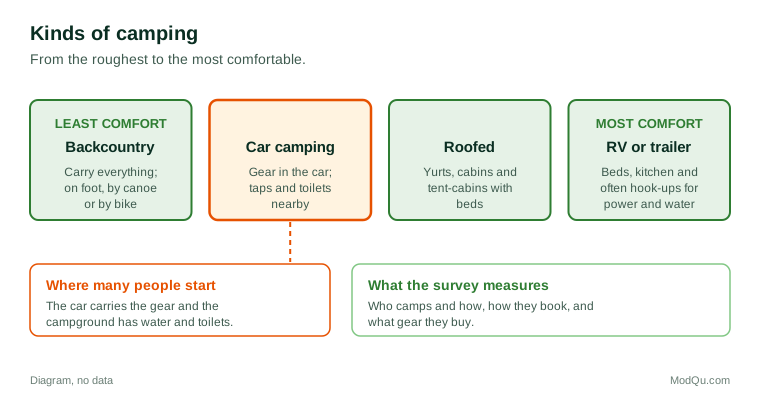
- Backcountry camping needs the most gear and skills: carrying everything, purifying water, storing food away from wildlife and finding the way.
- Car camping is how many people start: the car carries the gear, and the campground usually has water taps, toilets and sometimes showers.
- Roofed accommodation suits people who want to try camping without owning a tent or sleeping on the ground.
- RV and trailer camping brings beds, kitchens and sometimes bathrooms, and often uses sites with electrical, water and sewer hook-ups.
Example
A family who have never camped book a yurt in a provincial park for two nights. They bring sleeping bags, food and a borrowed camp stove. The children love the campfire and the beach. The next summer they buy a tent and book a regular campsite, and the following year they try a short canoe trip to a backcountry site.
Booking campsites
Most campsites in national and provincial parks are booked online through park reservation systems, often months ahead. Parks Canada runs reservations for national parks, and each province runs its own. Popular parks on summer weekends can fill within minutes of the booking window opening. Private campgrounds, some run by families and some by chains, take their own bookings, and some sites are first come, first served.
Rules commonly cover the number of people and tents per site, quiet hours, campfires (which may be banned during dry periods), pets, alcohol in some parks, and how long a stay can last.
Example (hypothetical figures)
A couple books four nights at a provincial park campsite at $48 a night, plus a $13 reservation fee. The total is 4 × $48 + $13 = $205. They also buy firewood at the park for $9 a bundle, two bundles a night, which adds $72. Firewood ends up costing more than a third of what they paid for the site.
Many parks ask people to buy firewood locally rather than bringing it from home, to stop the spread of invasive insects such as the emerald ash borer.
Cottages: owning, renting and sharing
Cottage ownership is a long-standing tradition in parts of Canada, and some cottages have been in the same family for generations. Owning one brings costs beyond the purchase price: property taxes, insurance, maintenance, septic and well systems, docks, boats, and the travel to get there. Rising prices in popular cottage regions have made buying harder for many people.
Other ways to get to a cottage include:
- Renting for a week or weekend, through owners, agencies or online platforms.
- Sharing ownership with siblings or friends, with a schedule of who uses it when.
- Visiting family or friends who own one.
Example
Three siblings inherit their parents' cottage. They agree to share costs equally and split summer weeks by rotation, but soon disagree over repairs and whether to rent it out in the weeks no one uses. They draw up a written agreement covering costs, bookings and what happens if one of them wants to sell their share.
Shared and inherited cottages can raise questions about property and estate law and tax. Those questions are outside the scope of this page; people in that situation usually get professional advice.
Gear and spending
Camping can be cheap or expensive depending on the gear. Many people start with basic or borrowed equipment and upgrade over time. Common purchases include tents, sleeping bags and pads, camp stoves, coolers, lanterns, camp chairs, water filters, backpacks and canoes or kayaks. RVs and trailers are major purchases, and some people rent them for a trip instead.
People buy gear at outdoor specialty stores, sporting goods and general stores, online and second-hand. Renting gear, from tents to canoes, is common for occasional campers. Questions that businesses want answered include what gear people bought this year, how much they spent, and whether they buy new, used or rent.
Cottage life and local communities
Cottage regions change with the seasons. In summer, the population of some small townships rises several times over as seasonal residents arrive, and local businesses such as marinas, general stores, restaurants and trades depend on them. In winter, many cottage roads are not ploughed and many cottages are closed, though more are now winterized for year-round use.
Relations between seasonal and year-round residents are usually good but can be strained over issues such as property taxes, noise, boat traffic, short-term rentals and the cost of housing for local workers. Some cottagers have moved to their cottages full time, especially since remote work became more common, which has changed some communities.
Safety and the outdoors
Camping and cottage life come with safety concerns: drowning and boating accidents, wildfire and campfire rules, wildlife such as bears, ticks that can carry Lyme disease, extreme heat and storms. Parks and public health agencies publish advice on storing food, checking for ticks, wearing life jackets, and following fire bans. Many parks also ask people to leave no trace: pack out garbage, stay on trails and leave natural features as they found them.
Trends and what people disagree about
Recent trends include more interest in camping since the pandemic, roofed and "glamping" options, van life and small campervans, and more competition for park reservations. Debates include whether booking systems are fair when sites sell out in minutes, whether bots and resellers should be stopped, how parks should handle crowding, whether short-term rentals change cottage communities, and how climate change, including wildfire seasons, affects summer plans.
Key terms
- BackcountryRemote areas reached on foot, by canoe or by bike, away from roads.
- Car campingCamping at a site where the car can be parked next to the tent.
- Hook-upA connection at a campsite for electricity, water or sewer for an RV.
- Fire banA temporary rule banning campfires during dry or high-risk conditions.
- Leave no tracePrinciples for reducing the impact of outdoor activities on nature.
- Roofed accommodationCabins, yurts and similar shelters in parks for people without tents.
- Booking windowThe date and time when reservations for a period open.
- PortageCarrying a canoe and gear over land between two waterways.
Full glossary: outdoor recreation management terms on EditingTests.com.
Camping and cottages vocabulary test
How well do you know the language of this topic? Try 8 quick questions. Your score is shown straight away and is not saved.
What the camping and cottages survey asks
This survey is part of ModQu's Leisure and Lifestyle survey. The camping and cottages part takes about five minutes and covers:
- Whether you went camping this year, and what kind of camping.
- How you booked your campsite and how easy it was.
- Whether you own, rent, share or visit a cottage or cabin.
- Which camping gear you bought, rented or borrowed this year, and what you spent.
- What stops you camping or going to a cottage more often.
- Your views on park booking systems and crowding.
After that you can choose to continue with other short parts of the Leisure and Lifestyle survey, such as gambling and lotteries or cannabis, or stop.
Ready to take part?
Your answers help show what people really think and do. Results are only ever reported as totals; no one can see your individual answers.
Start the surveyQuestions about this survey
Who can take part?
Adults.
Do I have to give my name?
No. You may be asked for your age group, region and similar details so results can be broken down, but not your name. ModQu never asks for passwords, card numbers or account numbers.
How are the results used?
Answers are combined into totals and percentages and published in ModQu reports. Individual answers are never shown.
Is the vocabulary test part of the survey?
No. It is optional and separate, and your score is not stored.