
Share how you spend your free time
Tell us how many free hours you have at weekends, what you spend them on and what you would do with more. Your answers are combined with other people's and reported only as totals.
Start the weekend and leisure time use surveyAbout 5 minutes. No account needed. You can stop at any time.
What counts as leisure time
Leisure time, or free time, is usually defined as time not spent on paid work, study, unpaid work such as housework and caring, or personal needs such as sleeping, eating and washing. What is left is time people can, in principle, use as they choose.
The line is not always clear. Cooking can be a chore or a hobby. Walking can be exercise, transport or relaxation. Looking after grandchildren can be caring work or a pleasure. For this reason, time use researchers often ask people both what they were doing and how they felt about it.
Weekends and working patterns around the world
The idea of a weekend, and which days it falls on, varies:
- Saturday and Sunday are the weekend in most countries.
- Friday and Saturday are the weekend in several countries in the Middle East and North Africa, linked to Friday prayers.
- Some countries have moved their weekend in recent years, such as the United Arab Emirates, which changed its official working week in 2022.
- Six-day working weeks remain common in some jobs and countries.
- Shift work, gig work and weekend work mean many people do not have a fixed weekend at all.
- Four-day week trials have taken place in several countries.
Public holidays, annual leave entitlements and school holidays also shape free time, and these differ widely between countries.
Example
A nurse works three 12-hour shifts a week on a rota that changes every month. Their "weekend" might be a Tuesday and Wednesday. They plan time with friends around their rota and find that weekday cinema trips are cheaper and quieter.
What people do with free time
Common uses of free time include:
- Watching television, films and online videos, one of the largest uses of leisure time in many countries.
- Using phones and social media.
- Socializing with family and friends, in person or online.
- Rest and relaxation.
- Sport and exercise.
- Hobbies, such as reading, gardening, crafts, music and games.
- Going out, to restaurants, cafés, cinemas, events and attractions.
- Shopping.
- Outdoor activities, such as walking, cycling and visiting parks.
- Religious and community activities.
- Volunteering.
- Travel and short breaks.
Patterns differ by age, culture, income, health and household. Weekends often mix leisure with chores and errands that could not be done during the week.
Who has the least free time
Free time is not shared equally. Groups that often report less of it include:
- Parents of young children, especially mothers in many countries, who often do more unpaid care and housework.
- People working long hours or several jobs.
- Carers for older or disabled relatives.
- People with long commutes.
- Students who also work.
Retired people and people without work often have more free time, though some face limits from health, money or loneliness. Studies in many countries have found that, on average, women spend more time than men on unpaid work, which reduces their free time.
Example (hypothetical figures)
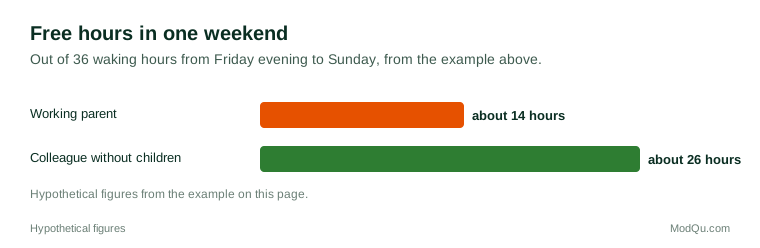
A working parent counts 36 waking hours over a weekend: 32 across Saturday and Sunday after 16 hours of sleep, plus 4 on Friday evening. After 10 hours of chores and errands, 8 hours of childcare and 4 hours of meals, about 14 hours are free. A colleague without children, with the same waking hours, estimates about 26.
Time pressure and wellbeing
Many people say they feel short of time, even when measured free time has not fallen. Researchers sometimes call this time poverty or time pressure. Reasons include:
- Free time broken into small pieces.
- Work messages arriving outside working hours.
- Many commitments competing for the same hours.
- The feeling that free time should be used productively.
Studies have linked having enough free time, and choosing how to use it, with wellbeing, though too much unstructured time can also feel unsatisfying for some people.
How time use is measured
Researchers and statistics offices measure time use in several ways:
- Time use diaries, in which people record what they did in short intervals, often 10 or 15 minutes, over one or more days. Many national statistics offices run time use surveys.
- Survey questions, asking how many hours people spend on activities in a typical week.
- Experience sampling, where people are prompted at random times to say what they are doing and how they feel.
- Device data, such as screen time records, with consent.
Each method has strengths and limits. Diaries are detailed but demanding. Questions about a "typical week" are quicker but rely on memory and can be affected by what people think they should be doing.
Example
A person asked how much time they spend on social media estimates "about an hour a day". When they check their phone's screen time report, it shows nearly three hours. They begin tracking their weekend activities to see where their time goes.
Trends and debates
Current discussions about leisure time include:
- Remote and hybrid work, which has reduced commuting for some and blurred the line between work and home.
- Screen time, and whether it crowds out other activities.
- The four-day week, and whether it improves wellbeing without reducing output.
- Right to disconnect laws, which aim to protect free time from work messages.
- The cost of leisure, as rising prices affect what people can afford to do.
- Access to green space, which differs between neighbourhoods.
What people and businesses want to know
Questions businesses and public bodies want answered include how many free hours people have at weekends and on weekdays, what they spend most free time on, who they spend it with, how much they spend on leisure, whether they feel short of time, and what they would do with more free time.
Key terms
- Leisure timeTime not spent on paid work, unpaid work, study or personal needs.
- Unpaid workWork such as housework and caring that is not paid.
- Time use surveyA survey that records how people spend their time, often with diaries.
- Time diaryA record of activities in short time intervals over a day.
- Time povertyNot having enough free time.
- Experience samplingPrompting people at random times to report what they are doing.
- Shift workWork organized in shifts outside standard hours.
- Four-day weekA working week of four days, often with the same pay.
Full glossary: outdoor recreation management terms on EditingTests.com.
Weekend and leisure time use vocabulary test
How well do you know the language of this topic? Try 8 quick questions. Your score is shown straight away and is not saved.
What the weekend and leisure time use survey asks
This survey is part of ModQu's Leisure and Lifestyle survey. The weekend and leisure time use part takes about five minutes and covers:
- How many free hours you have on a typical weekend, and on a typical weekday.
- Which days you usually have off, and whether this is fixed.
- What you spend most of your free time on, and who with.
- How much you spend on leisure activities in a typical month.
- Whether you feel you have enough free time.
- What you would do with more free time.
After that you can choose to continue with other short parts of the Leisure and Lifestyle survey, such as gambling and lotteries or cannabis, or stop.
Ready to take part?
Your answers help show what people really think and do. Results are only ever reported as totals; no one can see your individual answers.
Start the surveyQuestions about this survey
Who can take part?
Adults.
Do I have to give my name?
No. You may be asked for your age group, region and similar details so results can be broken down, but not your name. ModQu never asks for passwords, card numbers or account numbers.
How are the results used?
Answers are combined into totals and percentages and published in ModQu reports. Individual answers are never shown.
Is the vocabulary test part of the survey?
No. It is optional and separate, and your score is not stored.
Is screen time the same as leisure time?
Not always. Screens are used for work, study, chores and leisure, so time use researchers usually ask what people were doing, not only which device they used.