
Share your social nights out
Tell us whether you have been to karaoke or quiz nights, how often and where you go for social games. Your answers are combined with other people's and reported only as totals.
Start the karaoke and social games surveyAbout 5 minutes. No account needed. You can stop at any time.
What karaoke and social games cover
This topic covers activities people do together for fun in social settings, usually with food and drink:
- Karaoke, singing along to music with the lyrics on a screen.
- Quiz nights, also called pub quizzes or trivia nights, where teams answer questions.
- Bingo, played in halls, bars and themed events.
- Game nights at bars and cafés, with board games, card games or party games.
- Bar games, such as darts, pool, table football and shuffleboard.
- Music bingo and themed quizzes, mixing music and trivia.
- Murder mystery evenings and interactive events.
- Open mic nights, where people perform music, comedy or poetry.
Karaoke around the world
Karaoke developed in Japan in the 1970s and spread widely. The word comes from Japanese for "empty orchestra". The form differs between regions:
- Private karaoke rooms, common in Japan, South Korea (where they are called noraebang), China and other parts of Asia, are rented by the hour for small groups.
- Bar karaoke, common in North America, Europe and Australia, where singers take turns on a stage in front of the whole bar.
- Home karaoke, with machines, apps, games consoles or video platforms. In the Philippines, home karaoke machines are a common part of family gatherings.
- Karaoke at events, such as weddings and parties.
- Mobile and app karaoke, where people record themselves singing and share it.
Example
A group of five friends rent a private karaoke room for two hours to celebrate a birthday. They order snacks through a tablet in the room and take turns choosing songs. The quietest member of the group, who would never sing in a bar, sings three songs.
Quiz nights
Quiz nights are popular in pubs, bars, clubs and community halls in many countries, especially in the United Kingdom, Ireland, Australia, New Zealand and North America. A typical quiz includes:
- Teams of two to six people.
- Rounds on different topics, such as general knowledge, music, sport, film and pictures.
- A quizmaster who reads questions and marks answers.
- A small entry fee, often per person.
- Prizes, such as a bar voucher, a cash pot or a free round of drinks.
- Rules against using phones.
Regular teams often attend the same weekly quiz. Charities and schools also run quiz nights to raise money.
Example (hypothetical figures)
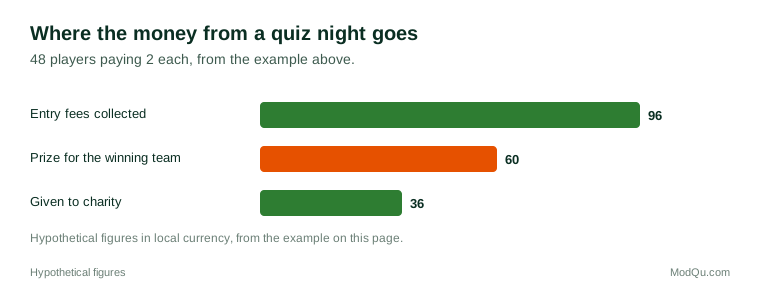
A weekly quiz charges 2 per person in their local currency. Twelve teams of four take part, so 48 people pay 96 in total. The bar puts 60 into a cash prize for the winning team and gives the rest, 36, to a local charity. The winning team shares the prize, receiving 15 each.
Bingo and other games
Bingo has a long history and is played in many forms. In traditional bingo halls, players mark numbers on cards as they are called. Themed bingo events at bars and clubs have become popular with younger adults, often mixing bingo with music, dancing and comedy. In many countries, bingo with cash prizes is regulated as a form of gambling, with licences and age limits, while bingo with small non-cash prizes may be treated differently.
Bar games such as darts and pool are played casually and in leagues. Board game nights at bars and cafés have grown alongside the wider popularity of board games.
Who goes and why
People take part in karaoke and social games for many reasons:
- Spending time with friends in a relaxed setting.
- Meeting new people, for example by joining a quiz team.
- Fun and laughter.
- Competition and testing knowledge.
- Celebrations, such as birthdays and leaving parties.
- Work outings and team-building.
- Something to do besides only eating or drinking.
- Regular routine, such as a weekly quiz with the same team.
These activities often appeal across ages, though venues and formats differ for students, families and older adults.
Costs and spending
Costs for a social games evening usually include:
- Room hire or entry, such as hourly karaoke room fees or quiz entry fees.
- Food and drink, often the largest share.
- Minimum spends, required by some venues for groups.
- Booking fees for popular events.
- Travel.
Many quiz nights and open mic nights are free or cheap to enter, with venues relying on food and drink sales.
Etiquette
Each activity has its own common customs:
- Karaoke: waiting your turn, not choosing very long songs when the list is busy, cheering for other singers, and not criticizing performers.
- Quiz nights: not using phones to look up answers, keeping voices down so other teams cannot hear, and accepting the quizmaster's decisions.
- Game nights: learning rules before starting, sharing games and putting pieces back.
Example
A new team at a quiz night is surprised when the quizmaster deducts points from another team caught using a phone. The regulars explain that the quiz has a strict no-phones rule. The new team returns the following week and finishes in fourth place.
Trends and debates
Current trends include:
- Private karaoke rooms opening in more cities outside Asia.
- Themed and ticketed events, such as music bingo and immersive quizzes.
- App-based quizzes, where teams answer on phones or tablets.
- Alcohol-free social events, as more people drink less or not at all.
- Live-streamed and online quizzes, which grew during the COVID-19 pandemic.
- Noise and licensing issues for venues in residential areas.
What people and businesses want to know
Questions businesses want answered include how often people go to karaoke, quiz nights or other social games, where they go, who they go with, what they spend, what makes a good venue or event, and whether they would try new formats.
Key terms
- KaraokeSinging along to recorded music with lyrics on a screen.
- NoraebangA private karaoke room in South Korea.
- QuizmasterThe person who reads questions and runs a quiz.
- Pub quizA team trivia game held in a pub or bar.
- BingoA game in which players mark numbers on a card as they are called.
- Open micAn event where members of the public perform.
- Minimum spendAn amount a group must spend to book a space.
- Team-buildingActivities meant to help colleagues work well together.
Full glossary: hospitality management terms on EditingTests.com.
Karaoke and social games vocabulary test
How well do you know the language of this topic? Try 8 quick questions. Your score is shown straight away and is not saved.
What the karaoke and social games survey asks
This survey is part of ModQu's Leisure and Lifestyle survey. The karaoke and social games part takes about five minutes and covers:
- Whether you have been to karaoke in the last year, and whether in a bar, a private room or at home.
- Whether you go to quiz nights, bingo or game nights, and how often.
- Where you go for social games, and who you go with.
- How much you spend on a typical night out of this kind.
- What makes a good venue or event for you.
- Which new social game formats you would like to try.
After that you can choose to continue with other short parts of the Leisure and Lifestyle survey, such as gambling and lotteries or cannabis, or stop.
Ready to take part?
Your answers help show what people really think and do. Results are only ever reported as totals; no one can see your individual answers.
Start the surveyQuestions about this survey
Who can take part?
Adults.
Do I have to give my name?
No. You may be asked for your age group, region and similar details so results can be broken down, but not your name. ModQu never asks for passwords, card numbers or account numbers.
How are the results used?
Answers are combined into totals and percentages and published in ModQu reports. Individual answers are never shown.
Is the vocabulary test part of the survey?
No. It is optional and separate, and your score is not stored.
Do I need to be a good singer for karaoke?
No. Most people at karaoke sing for fun, and audiences often cheer for enthusiasm more than skill. Private rooms let groups sing without strangers listening.
How big should a quiz team be?
Many quizzes allow teams of up to six, and some set a maximum to keep the competition fair. Rules are usually announced at the start.