
Share your experience of working hours
Tell us how many hours you work, whether overtime is paid and what you would prefer. Your answers are combined with other people's and reported only as totals.
Start the working hours and overtime surveyAbout 5 minutes. No account needed. You can stop at any time.
How working hours are set
Working hours are set by a mix of law, contracts, collective agreements and custom. Many countries have a standard working week, often around 40 hours, with rules on maximum hours, daily rest and weekly days off. The International Labour Organization's very first convention, adopted in 1919, set an eight-hour day and 48-hour week for industry, and later standards moved toward 40 hours. National rules today vary widely.
Within those limits, hours depend on the job:
- Full-time roles usually follow the standard week for that country or industry.
- Part-time roles have fewer hours, sometimes chosen and sometimes not.
- Shift work covers evenings, nights and weekends in hospitals, factories, transport and retail.
- On-call and zero-hours arrangements leave hours uncertain from week to week.
- Salaried professional roles may list a set number of hours but expect more in practice.
- Self-employed and informal workers set their own hours, often long ones, to earn enough.
What counts as overtime
Overtime is time worked beyond normal or contracted hours. What counts, and how it is paid, depends on the law and the contract. In some countries, hours beyond a daily or weekly limit must be paid at a higher rate, such as one and a half times the normal hourly rate. In others, extra pay depends only on the contract or collective agreement.
Many workers are exempt from overtime rules because of their role or pay level, especially managers and professionals on a salary. For them, extra hours are often unpaid and expected. Some employers offer time off in lieu, meaning extra hours worked now can be taken as time off later.
Common forms of extra hours include:
- paid overtime at a premium rate;
- paid overtime at the normal rate;
- time off in lieu;
- unpaid extra hours, such as finishing tasks after the shift ends or answering emails at night;
- extra shifts picked up voluntarily for more income.
Example (hypothetical figures)
A delivery driver is paid 20 an hour in local currency for a 40-hour week, so a standard week earns 800. One week they work 48 hours, and the 8 extra hours are paid at one and a half times the rate, which is 30 an hour. Their pay that week is 800 plus 240, or 1,040.
Unpaid overtime and hours that are hard to see
A large share of extra work goes unrecorded. Arriving early to set up, staying late to finish, working through lunch, reading emails on the commute and joining calls from home all add hours that may not appear on a timesheet. Remote work has made some of this easier to do and harder to notice.
Example
A teacher's contract lists 37 hours a week. They also plan lessons on Sunday evenings, mark homework at home and run a lunchtime club. When asked to keep a diary for one week, they count 52 hours, but none of the extra time is paid or recorded.
Because of this, surveys often ask about "hours actually worked last week" rather than contracted hours. Asking about one specific recent week is usually more accurate than asking about a typical week.
Wanting more hours or fewer
People's preferences about hours often differ from what they have:
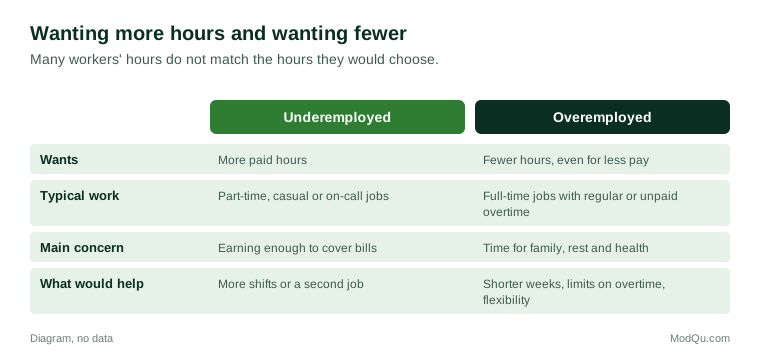
- Underemployed workers want more hours than they get, often in part-time or casual jobs, and struggle to earn enough.
- Overemployed workers work more hours than they want and would accept less pay for more time.
- Some people want the same hours arranged differently, for example over four days instead of five.
Reasons for wanting more hours include low hourly pay, rising living costs and debt. Reasons for wanting fewer include caring duties, health, tiredness, study and a wish for more personal time.
The four-day week
A four-day week can mean different things. One version keeps the same total hours in four longer days, called compressed hours. Another reduces hours, for example to 32, while keeping pay the same, on the idea that people will get the same work done in less time. A third reduces both hours and pay.
Trials of reduced-hours four-day weeks have been run by employers in several countries, often with outside researchers. Results reported by organizers have been positive for many participating firms, but participants are usually volunteers and the trials have mostly involved offices and services, so it is unclear how well the idea works in other sectors such as health care or manufacturing.
Example
A small design studio moves to a four-day week of 32 hours at the same pay. It cuts the number of internal meetings and asks clients to expect replies within one working day. A nearby restaurant considers the same idea but finds it would need to hire more staff to stay open five days.
Health, safety and long hours
Very long hours are linked with tiredness, mistakes and accidents, especially in jobs such as driving, health care and machinery work. Many countries have rules on rest between shifts and maximum weekly hours for this reason, and some industries, such as aviation and road transport, have specific limits. A joint study by the World Health Organization and the International Labour Organization, published in 2021, linked working 55 or more hours a week with higher risk of stroke and heart disease.
What people disagree about
People disagree about whether long hours show commitment or poor planning, whether salaried workers should be paid for extra hours, and whether shorter weeks are practical across the economy. Employers worry about cost and cover; workers worry about pay and workload. There is also debate about whether hours should be measured at all for knowledge work, or whether only results should count.
Questions that employers and policy groups want answered include how many hours people really work, how much overtime is paid, how much is unpaid, and whether people would choose a four-day week.
Key terms
- Standard working weekThe normal full-time hours set by law, contract or custom.
- OvertimeHours worked beyond normal or contracted hours.
- Overtime premiumA higher rate of pay for extra hours, such as time and a half.
- Time off in lieuTime off given later in return for extra hours worked.
- Exempt employeeA worker not covered by overtime pay rules, often salaried.
- UnderemploymentWorking fewer hours than a person wants and is available for.
- Compressed hoursFull-time hours worked in fewer, longer days.
- Shift workWork organized in set periods that may cover nights and weekends.
Full glossary: workforce management terms on EditingTests.com.
Working hours and overtime vocabulary test
How well do you know the language of this topic? Try 8 quick questions. Your score is shown straight away and is not saved.
What the working hours and overtime survey asks
This survey is part of ModQu's Work and Careers survey. The working hours and overtime part takes about five minutes and covers:
- How many hours you worked last week, including unpaid time.
- Whether you are paid for overtime, and how.
- How often you work beyond your contracted hours.
- Whether you would like more hours, fewer hours or the same.
- Whether you would prefer a four-day week, and on what terms.
- How your hours affect your health and family life.
After that you can choose to continue with other short parts of the Work and Careers survey, such as job satisfaction or remote and hybrid work, or stop.
Ready to take part?
Your answers help show what people really think and do. Results are only ever reported as totals; no one can see your individual answers.
Start the surveyQuestions about this survey
Who can take part?
Employees.
Do I have to give my name?
No. You may be asked for your age group, region and similar details so results can be broken down, but not your name. ModQu never asks for passwords, card numbers or account numbers.
How are the results used?
Answers are combined into totals and percentages and published in ModQu reports. Individual answers are never shown.
Is the vocabulary test part of the survey?
No. It is optional and separate, and your score is not stored.
Should I count time spent answering emails at home?
Yes. The survey asks about all the hours you actually worked, including unpaid time, because that is often where the gap between contracted and real hours lies.
Is overtime always paid at a higher rate?
No. It depends on national law, your contract and whether your role is covered by overtime rules. Many salaried workers receive no extra pay.
Does a four-day week mean less pay?
Not necessarily. Some versions keep pay the same for fewer hours, some keep the same hours in four days, and some reduce both hours and pay.