
Share your experience of changing careers
Tell us whether you have changed career, how you did it and what got in the way. Your answers are combined with other people's and reported only as totals.
Start the career changes surveyAbout 5 minutes. No account needed. You can stop at any time.
What a career change is
A career change is a move into a different occupation or field, such as a teacher becoming a software tester, a soldier becoming an electrician, or a retail manager becoming a nurse. It is different from a job change, where someone does similar work for a new employer, and from a promotion within the same line of work.
Career changes can be large or small. Some people move to a closely related field and use most of their existing skills. Others start almost from scratch with new qualifications. Many careers today involve several changes over a working life, although how common this is differs by country, age group and industry.
Why people change careers
The reasons people give usually include one or more of these:
- Dissatisfaction: boredom, stress, poor pay or a lack of meaning in current work.
- Push factors: layoffs, industry decline, automation, injury or health problems that make the old work impossible.
- New interests: a hobby, volunteering or a life event that points to a different path.
- Life changes: having children, caring for relatives, moving country or leaving the armed forces.
- Pay and prospects: moving into a field with better wages or more jobs.
- Age and stage: wanting less physical work later in life, or more flexible work before retirement.
Example
A chef in their late thirties has worked evenings and weekends for 15 years. After the birth of their second child, they want daytime hours. They take a part-time course in food safety and move into a role inspecting restaurant kitchens for a local authority, using their kitchen experience every day.
Common routes into a new career
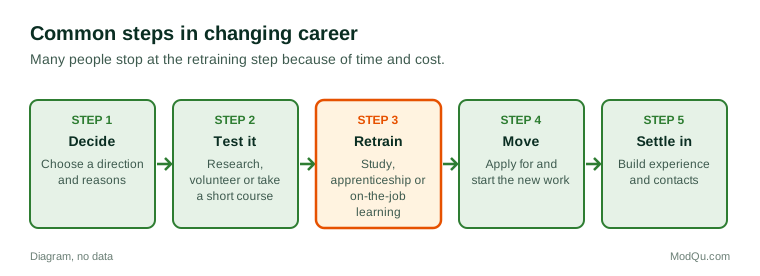
People take different paths depending on the field, their savings and their existing skills:
- Formal study: a degree, diploma or certificate, full-time or part-time.
- Apprenticeships: paid training on the job, common in skilled trades and increasingly in other fields.
- Short courses and bootcamps: intensive training of weeks or months, often in technology.
- Moving within an employer: changing departments and learning on the job.
- Starting at entry level: taking a junior role and working up.
- Self-employment: turning a skill or hobby into a business.
- Recognition of prior learning: getting existing skills and experience formally recognized.
Some careers require a licence or registration, such as nursing, teaching, law, plumbing or electrical work. These routes are usually longer, and the rules differ between countries. People who move country often face a separate challenge: getting qualifications from home recognized.
Costs and trade-offs
Changing careers often means a period of lower income. Course fees, books, equipment, travel and time out of work can add up. A person moving from a senior role to an entry-level job in a new field may earn less for several years.
Example (hypothetical figures)
An office administrator earning 2,800 a month in local currency trains as an electrician through a four-year apprenticeship. In year one they earn 1,600 a month, so they receive 14,400 less over the year than in their old job. They expect to earn more than their old salary once qualified, but they use savings and their partner's income to bridge the gap.
Other trade-offs include:
- losing seniority, benefits or pension rights built up with an employer;
- starting again with less job security;
- strain on family time while studying and working;
- the risk that the new career does not turn out as hoped.
Public programs in some countries help with these costs, through grants for retraining, training accounts, tax relief on course fees or support for unemployed workers who retrain. What is available differs greatly between countries and regions.
What stops people changing careers
Many people say they would like to change careers but have not done so. Common barriers include:
- not being able to afford a drop in income or course fees;
- lack of time because of work and caring duties;
- not knowing which career to choose or how to start;
- fear of failure or of starting again at a junior level;
- age, or concern that employers prefer younger applicants;
- qualifications or experience not recognized in the new field;
- family responsibilities and the need for steady income.
Example
A bank clerk in their fifties wants to become a counsellor. The required training takes three years part-time and involves unpaid placements. They decide to start with a short evening course and volunteer at a helpline to see whether the work suits them before committing to the full program.
Help and advice
People looking to change careers use a range of sources: career counsellors, public employment services, online assessments of interests and skills, informational interviews with people already in the field, professional bodies, training providers and friends and family. Some employers offer internal career support or pay for retraining, especially when roles are being cut.
What people disagree about
People disagree about whether frequent career changes are a sign of adaptability or of insecure work, whether short courses are enough to enter a new field, and who should pay for retraining: the worker, the employer or the state. There is also debate about whether age makes career change harder or whether employers increasingly value varied experience.
Questions that employers, training providers and policy groups want answered include how many people change careers, why, whether they retrained, how long it took and what stopped others.
Key terms
- Career changeMoving into a different occupation or field of work.
- Transferable skillsSkills that are useful across many kinds of work.
- RetrainingLearning new skills or qualifications for a different job.
- ApprenticeshipPaid training on the job, combined with study, leading to a qualification.
- BootcampAn intensive short course, often in technology skills.
- Recognition of prior learningFormal credit for skills and experience gained outside a course.
- Informational interviewA conversation with someone in a field to learn about it.
- Occupational licencePermission required by law to work in some professions.
Full glossary: career counseling terms on EditingTests.com.
Career changes vocabulary test
How well do you know the language of this topic? Try 8 quick questions. Your score is shown straight away and is not saved.
What the career changes survey asks
This survey is part of ModQu's Work and Careers survey. The career changes part takes about five minutes and covers:
- Whether you have changed career in the last five years.
- Why you changed, or why you would like to.
- Whether you retrained, and how: study, apprenticeship, short course or on the job.
- How long the change took and how it affected your income.
- What stopped you, or might stop you, from changing career.
- Where you found help and advice.
After that you can choose to continue with other short parts of the Work and Careers survey, such as job satisfaction or remote and hybrid work, or stop.
Ready to take part?
Your answers help show what people really think and do. Results are only ever reported as totals; no one can see your individual answers.
Start the surveyQuestions about this survey
Who can take part?
Working adults.
Do I have to give my name?
No. You may be asked for your age group, region and similar details so results can be broken down, but not your name. ModQu never asks for passwords, card numbers or account numbers.
How are the results used?
Answers are combined into totals and percentages and published in ModQu reports. Individual answers are never shown.
Is the vocabulary test part of the survey?
No. It is optional and separate, and your score is not stored.
Am I too old to change careers?
People change careers at every age. Age can bring barriers, such as fewer years to recover training costs, but also experience that employers may value.
Do I need a new degree to change careers?
Not always. Some fields require formal qualifications or a licence, while others accept short courses, apprenticeships or on-the-job learning.
What is the difference between a career change and a job change?
A job change means similar work for a new employer. A career change means moving into a different kind of work.
How long does a career change take?
It can take a few months for a move into a related field or several years where new qualifications or a licence are needed.