
Share how you feel about your job
Tell us how satisfied you are with your job, what would improve it and whether you plan to look elsewhere. Your answers are combined with other people's and reported only as totals.
Start the job satisfaction surveyAbout 5 minutes. No account needed. You can stop at any time.
What job satisfaction means
Job satisfaction is how content a person is with their job, taken as a whole or in its parts. It is an attitude: a mix of what people think about their work and how they feel about it.
It helps to separate a few related ideas:
- Overall job satisfaction: a single judgment, such as "All things considered, how satisfied are you with your job?"
- Facet satisfaction: satisfaction with particular parts of the job, such as pay, the work itself, co-workers, the manager, hours or chances for promotion.
- Engagement: how energized, involved and committed people are at work. A person can be satisfied but not very engaged, for example in a comfortable job that does not challenge them.
- Intention to quit: whether a person plans to leave. It is linked to satisfaction but not the same thing, since people may stay in jobs they dislike for security, or leave jobs they like for higher pay.
What drives job satisfaction
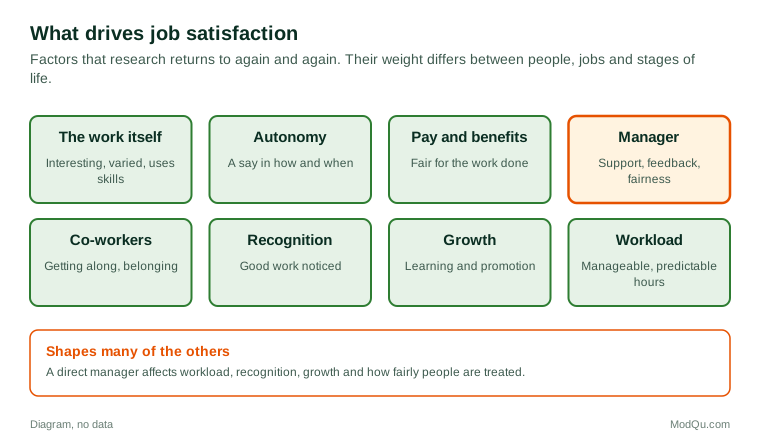
Research on job satisfaction over many decades points to a set of recurring factors. Their weight differs between people, jobs and stages of life.
- The work itself: whether the tasks are interesting, varied and use a person's skills.
- Autonomy: having some say over how, when and where work is done.
- Pay and benefits: whether people feel fairly paid compared with others and with what they contribute.
- Managers: how a direct manager treats people, communicates and supports their work.
- Co-workers and team climate: getting along with others and feeling part of a team.
- Recognition: having good work noticed and appreciated.
- Growth: chances to learn, develop and be promoted.
- Workload and hours: whether the amount of work is manageable and hours are predictable.
- Security: confidence that the job will last.
- Meaning: feeling that the work matters to others or to society.
A well-known older idea, from the psychologist Frederick Herzberg, divided these into hygiene factors, such as pay, conditions and policies, which cause dissatisfaction when they are poor but do not create satisfaction on their own, and motivators, such as achievement, recognition and responsibility, which create satisfaction. Later research has found the split less clear-cut, but the idea that removing problems is not the same as creating satisfaction is still widely used.
Example
A software tester is well paid and has a secure job but finds the work repetitive. When they are moved to a team where they help design new tests and train new staff, their pay does not change, but they say they look forward to work again. A colleague moved to the same team finds the extra responsibility stressful and asks to go back.
The role of managers
When people describe a good or bad job, they often describe their manager. Managers shape many of the factors above: how work is shared out, whether people get feedback and recognition, how fairly decisions are made, and whether staff can raise problems without fear.
Things employees often say make a good manager include clear expectations, regular and honest feedback, fair treatment, support for development, trust to work without close supervision, and backing when things go wrong. Things that drive people away include favouritism, poor communication, micromanagement, being blamed for others' mistakes, and a lack of support when workloads rise.
How job satisfaction is measured
Job satisfaction is usually measured by surveys. Common approaches include:
- a single overall question on a scale, such as from "very dissatisfied" to "very satisfied";
- multi-item scales that ask about each facet of the job;
- employee engagement surveys run by employers, often yearly, with shorter pulse surveys between them;
- exit interviews and exit surveys with people who are leaving;
- national and international surveys that ask workers in many jobs the same questions, allowing comparisons over time and between groups.
Employer-run surveys can be affected by whether staff believe their answers are truly confidential. Independent surveys, in which workers answer about their job without their employer being involved, can give a different picture.
Example (hypothetical figures)
A company's engagement survey finds that 72% of staff say they are satisfied overall. When results are broken down, 85% of office staff are satisfied but only 54% of warehouse staff are. The overall figure looked healthy, but the breakdown shows where the problem is.
Questions that businesses want answered here include which factors most affect satisfaction in different kinds of job, how satisfaction compares across industries, and which changes make people more likely to stay.
Why people leave
Turnover, the rate at which people leave an employer, is costly for organizations, which have to recruit and train replacements. People leave for many reasons, and they are not always the reasons they give in an exit interview.
Common reasons include:
- better pay or benefits elsewhere;
- a poor relationship with a manager;
- lack of growth or promotion;
- burnout and heavy workloads;
- wanting more flexibility, including remote or hybrid work;
- a move, family needs or health;
- a change of career;
- layoffs or the end of a contract, which are involuntary rather than voluntary turnover.
Researchers have found that people often leave after a specific event, such as being passed over for promotion, a reorganization or a hard conversation with a manager, rather than from slow dissatisfaction alone.
Example
A nurse has been unhappy with short staffing for a year but stays because they like their team. When a scheduling change takes away their fixed weekend off, they apply to another hospital the same week. The schedule was the final trigger, not the main reason.
Satisfaction across groups and over a career
Job satisfaction tends to vary between groups of workers. It can differ by occupation, industry, type of contract, age and career stage, and between full-time and part-time workers. Some patterns found in research are that people with more control over their work tend to report higher satisfaction, and that satisfaction can change with life stage, for example when people start families or approach retirement.
Comparisons between groups need care. People may report high satisfaction because they have adjusted their expectations, or low satisfaction in good jobs because their expectations are high. And people in different countries may answer rating questions in different ways.
What people disagree about
There are several debates about job satisfaction:
- Does satisfaction drive performance? There is a link between satisfaction and performance, but how strong it is, and which way it runs, has been debated for decades. Doing well at work may make people satisfied, as well as the other way round.
- Is meaningful work enough? Some argue that jobs seen as meaningful, such as in care work or charities, are used to justify lower pay.
- Whose job is it? Some see satisfaction as mainly the employer's responsibility; others stress that workers choose and shape their jobs.
- Quiet quitting: a term that spread in the early 2020s for doing only what a job requires and no more. Some see it as disengagement; others as a reasonable response to unpaid extra work.
Key terms
- Job satisfactionHow content a person is with their job, overall or in its parts.
- Employee engagementHow energized, involved and committed people are at work.
- TurnoverThe rate at which people leave an employer.
- Intention to quitA person's stated plan to leave their job.
- Pulse surveyA short, frequent survey of employees between larger surveys.
- Exit interviewA conversation with an employee who is leaving, to learn why.
- Hygiene factorsJob features that cause dissatisfaction when poor but do not create satisfaction alone.
- AutonomyHaving some control over how, when and where work is done.
Full glossary: workforce analytics terms on EditingTests.com.
Job satisfaction vocabulary test
How well do you know the language of this topic? Try 8 quick questions. Your score is shown straight away and is not saved.
What the job satisfaction survey asks
This survey is part of ModQu's Work and Careers survey. The job satisfaction part takes about five minutes and covers:
- How satisfied you are with your job overall.
- How satisfied you are with pay, your manager, workload, growth and the work itself.
- What would most improve your job.
- How likely you are to look for a new job this year, and why.
- How you feel about the way your organization is managed.
- Whether you would recommend your employer to a friend.
After that you can choose to continue with other short parts of the Work and Careers survey, such as remote and hybrid work or job searching and hiring, or stop.
Ready to take part?
Your answers help show what people really think and do. Results are only ever reported as totals; no one can see your individual answers.
Start the surveyQuestions about this survey
Who can take part?
Employed adults.
Do I have to give my name?
No. You may be asked for your age group, region and similar details so results can be broken down, but not your name. ModQu never asks for passwords, card numbers or account numbers.
How are the results used?
Answers are combined into totals and percentages and published in ModQu reports. Individual answers are never shown.
Is the vocabulary test part of the survey?
No. It is optional and separate, and your score is not stored.
Will my employer see my answers?
No. ModQu surveys are independent of employers, and your employer is not involved. Results are reported only as totals.