
Share your experience of wellbeing at work
Tell us how stressed you are at work, what support your employer offers and whether you have used it. Your answers are combined with other people's and reported only as totals.
Start the workplace wellbeing surveyAbout 5 minutes. No account needed. You can stop at any time.
What workplace wellbeing means
Workplace wellbeing is the physical, mental and social health of people at work, and how work affects it. It covers more than the absence of illness or injury. It includes whether people feel safe, supported, treated fairly and able to manage their workload, and whether work leaves them with enough energy for the rest of their lives.
The topic has several parts:
- Physical health and safety: injuries, ergonomics, physical strain, shift work and exposure to hazards.
- Mental health: stress, anxiety, depression and burnout, and how work contributes to or eases them.
- Social wellbeing: relationships with colleagues and managers, belonging, and freedom from harassment and discrimination.
- Work-life balance: hours, schedules and the ability to switch off.
- Financial wellbeing: pay, security and money worries, which affect stress.
This page describes the topic for general readers. It does not give medical or mental health advice. People who are struggling can speak to a health professional or a crisis line in their area.
Common sources of work stress
Some stress is part of most jobs and can be manageable. Stress becomes a problem when demands stay high for long periods without enough control, support or recovery. Common sources include:
- Heavy workload and pressure to work long hours;
- Low control over how and when work is done;
- Unclear roles or conflicting demands;
- Poor management, including lack of support or recognition;
- Conflict, bullying or harassment;
- Job insecurity, layoffs and restructuring;
- Emotional demands, such as in health care, social services, policing and customer-facing jobs;
- Unpredictable schedules, shift work and on-call duty;
- Always-on communication, with emails and messages outside working hours.
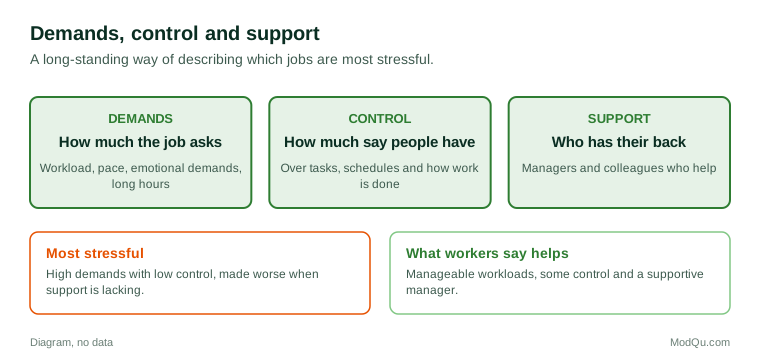
Researchers have long described a combination of high demands and low control as especially stressful, and lack of support from managers and colleagues as making it worse. This idea is often called the demand-control-support model.
Example
A call centre agent handles back-to-back calls with targets for call length and customer ratings. They have little say over their schedule and need permission for breaks. They say the hardest part is not the calls themselves but having no control over their day. When the team is given more say over break times and fewer targets, they report feeling less drained, even though the number of calls stays the same.
Burnout
Burnout is a term for the effects of chronic workplace stress that has not been well managed. The World Health Organization describes it in its classification of diseases as an occupational phenomenon, not a medical condition, with three features:
- feelings of energy depletion or exhaustion;
- increased mental distance from one's job, or feelings of negativity or cynicism about it;
- reduced professional efficacy, meaning feeling less effective at work.
People describe burnout as being worn out, detached and unable to care about work that used to matter to them. It is linked to jobs with high demands, low control, lack of recognition and a mismatch between a person's values and their work. Health professionals can help people tell burnout apart from conditions such as depression, which can have similar signs.
Psychological safety and psychological health and safety
Two related ideas are often confused.
Psychological safety is a team climate in which people feel able to speak up, ask questions, admit mistakes and raise concerns without fear of being punished or embarrassed. It is linked to learning and to better teamwork.
Psychological health and safety is the wider idea that employers should protect workers from psychological harm, as they protect them from physical harm. In Canada, the National Standard of Canada for Psychological Health and Safety in the Workplace, released in 2013, gives organizations a voluntary framework for identifying and reducing psychological hazards. Some provinces have rules covering workplace harassment and violence, and workers' compensation boards in some provinces accept certain claims for work-related mental health injuries.
What employers offer
Employers offer a range of wellbeing support. Common types include:
- Employee assistance programs (EAPs): confidential short-term counselling, usually by phone, video or in person, plus advice on issues such as family, legal, financial and addiction concerns. EAPs are usually provided by an outside company, and employers receive only combined usage figures, not individual details.
- Health benefits that cover counselling, psychologists or other mental health services, often with a yearly maximum.
- Wellness programs: fitness classes, gym discounts, health challenges, nutrition advice and health screenings.
- Flexible work: flexible hours, remote or hybrid options, compressed weeks.
- Paid sick days and mental health days.
- Mental health training for managers and peer supporters.
- Return-to-work programs after illness or injury, with gradual or modified duties.
- Right-to-disconnect policies: Ontario, for example, requires employers with 25 or more employees to have a written policy on disconnecting from work.
What workers say helps
When workers are asked what actually helps their wellbeing, they often name changes to the work itself rather than wellness extras:
- a manageable workload and enough staff;
- some control over schedules and how work is done;
- a supportive manager who notices when people are struggling;
- recognition and fair treatment;
- respect for time off and evenings;
- clear and honest communication, especially during change.
Some workers are sceptical of wellness programs that offer yoga classes or meditation apps while workloads stay high. Others find those programs useful alongside other changes.
Example (hypothetical figures)
An organization of 400 employees provides an EAP and finds that about 32 staff, or 8%, used it in a year. After managers are trained to talk about the EAP and a staff newsletter explains how confidential it is, use rises to 52 staff, or 13%. The employer sees only the totals, not who used it.
Barriers to using support
Many workers do not use the support that is available. Reasons they give include:
- not knowing what is offered;
- worry that the employer will find out, or that it will affect their career;
- stigma around mental health;
- not having time during the workday;
- doubts that the support will help;
- limits on the number of sessions;
- support that does not fit their language, culture or situation.
Example
A construction worker has been sleeping badly and arguing at home since a serious incident on a site. Their employer has an EAP, but they assume it is "for office people" and that their supervisor would hear about it. After a co-worker mentions using it and confirms it is confidential, they call and are referred to a counsellor.
What people disagree about
Workplace wellbeing raises several debates. How much is the employer's responsibility, and how much is personal? Do wellness programs work, or do they distract from problems such as workloads and pay? Should right-to-disconnect rules be stronger? Should employers measure stress through surveys, and how should results be used? And how can the needs of front-line workers, who often cannot work flexibly, be met as well as those of office staff?
Questions that businesses want answered here include how stressed workers are and why, what support they know about and use, and which changes would most improve their wellbeing.
Key terms
- BurnoutExhaustion, detachment and reduced effectiveness resulting from chronic work stress.
- Employee assistance programA confidential service offering short-term counselling and advice to employees.
- Psychological safetyA team climate where people can speak up without fear.
- Work-life balanceHow well work fits with the rest of a person's life.
- Right to disconnectThe idea, sometimes in law, that workers need not respond to work outside working hours.
- PresenteeismBeing at work while unwell or unable to work effectively.
- Return-to-work programA plan to help someone come back to work after illness or injury.
- ErgonomicsDesigning work and equipment to fit the people who use them.
Full glossary: employee assistance programs terms on EditingTests.com.
Workplace wellbeing vocabulary test
How well do you know the language of this topic? Try 8 quick questions. Your score is shown straight away and is not saved.
What the workplace wellbeing survey asks
This survey is part of ModQu's Work and Careers survey. The workplace wellbeing part takes about five minutes and covers:
- How stressed you feel at work, and what causes it.
- Whether you have felt burned out in the past year.
- What wellbeing support your employer offers, as far as you know.
- Whether you have used an employee assistance program or other support, and how helpful it was.
- What stops you using support, if anything.
- What would most improve your wellbeing at work.
After that you can choose to continue with other short parts of the Work and Careers survey, such as job satisfaction or remote and hybrid work, or stop.
Ready to take part?
Your answers help show what people really think and do. Results are only ever reported as totals; no one can see your individual answers.
Start the surveyQuestions about this survey
Who can take part?
Employed adults.
Do I have to give my name?
No. You may be asked for your age group, region and similar details so results can be broken down, but not your name. ModQu never asks for passwords, card numbers or account numbers.
How are the results used?
Answers are combined into totals and percentages and published in ModQu reports. Individual answers are never shown.
Is the vocabulary test part of the survey?
No. It is optional and separate, and your score is not stored.
Will I be asked about my health?
The survey asks general questions about stress and support at work. It does not ask for diagnoses, and you can skip any question.