
Share your experience of looking for work
Tell us where you searched, how many applications you sent and what put you off an employer. Your answers are combined with other people's and reported only as totals.
Start the job searching and hiring surveyAbout 5 minutes. No account needed. You can stop at any time.
How people look for work
People look for work in many situations: leaving school or college, after a layoff, while employed and wanting something better, returning after time away, changing careers, or arriving in a new country. Each affects how they search, how urgently and what they will accept.
A job search usually includes:
- deciding what kind of job, pay, location and arrangement to look for;
- preparing a résumé (often spelled resume) and, for some jobs, a cover letter or portfolio;
- finding openings;
- applying, often many times;
- going through screening, tests and interviews;
- negotiating and accepting an offer.
People who are already employed often look more quietly and selectively. People who are unemployed may apply more widely and accept offers sooner.
Where people search
Common sources of job openings include:
- online job boards, general and specialized;
- employer career pages on company and government websites;
- professional networking sites;
- referrals from friends, family, former colleagues and current employees;
- recruiters and staffing agencies, who are paid by employers to find candidates;
- job fairs and campus recruiting;
- public employment services, such as the federal Job Bank in Canada and provincial employment centres;
- social media, community groups and signs in shop windows.
Many jobs are filled through personal contacts, and some openings are never advertised publicly. This is sometimes called the hidden job market. Employee referrals are valued by many employers because referred candidates are already vouched for.
Example
A recent college graduate applies to dozens of postings on job boards over two months and gets three interviews. Then a former instructor mentions an opening at a firm where a classmate works. The classmate refers them, they are interviewed the following week and receive an offer.
Applications and screening
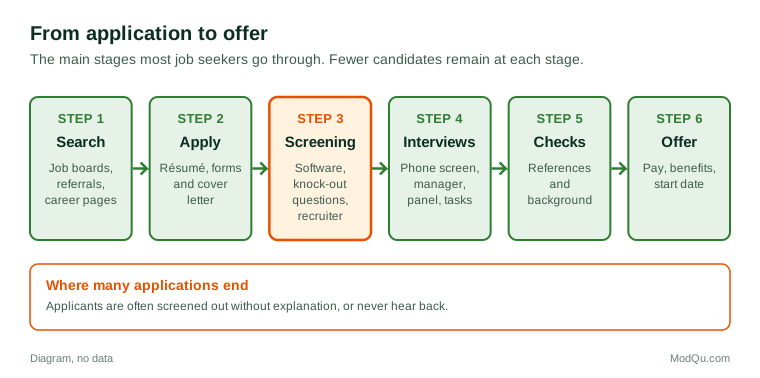
Once someone applies, their application usually passes through screening before any person reads it in full. Many employers use an applicant tracking system (ATS), software that collects applications, filters them by keywords, qualifications or answers to screening questions, and tracks candidates through the process.
Common screening steps include:
- knock-out questions, such as whether the candidate is legally entitled to work in Canada or holds a required licence;
- keyword matching against the job description;
- a recruiter's quick review of the résumé;
- online assessments, such as skills tests, personality questionnaires or recorded video answers.
Job seekers often find screening frustrating. Common complaints include long application forms that repeat what is already in the résumé, being screened out without explanation, and never hearing back at all, often called being ghosted.
Example (hypothetical figures)
A job seeker tracks their search for three months. They send 60 applications, hear back from 12 (20%), have first interviews with 7, second interviews with 3 and receive 1 offer. Of the 48 employers who never replied, 30 had asked them to re-enter their full work history in an online form after uploading a résumé.
Interviews and assessments
Interviews take many forms:
- a short phone or video screen with a recruiter, often about pay expectations and availability;
- interviews with the hiring manager and team members;
- panel interviews, with several interviewers at once;
- structured interviews, in which every candidate is asked the same questions and answers are scored against set criteria, an approach research has generally found to predict job performance better than unstructured conversations;
- behavioural questions, asking how the candidate handled a past situation;
- practical tasks, case studies or work samples;
- reference checks and, for some jobs, background or criminal record checks.
The number of interview rounds varies. Some candidates welcome a thorough process, while others find many rounds and unpaid take-home assignments a burden, especially when they are applying to several employers at once.
Offers and negotiation
A job offer usually sets out the title, pay, benefits, start date, hours, location or remote arrangements, and any probation period. Some offers are conditional on references, background checks or proof of credentials.
Many people do not negotiate their first offer. Others negotiate pay, start date, vacation time, remote days or a signing bonus. Comfort with negotiating differs between people, and some employers have fixed pay scales, especially in the public sector and unionized jobs.
Several Canadian provinces, including British Columbia and Ontario, have passed or introduced laws on pay transparency that require pay ranges in job postings or limit questions about past pay. The details and dates differ by province.
What candidates notice about employers
Job seekers form a view of an employer from every contact during hiring, which is often called the candidate experience. Things candidates say put them off include:
- no pay range in the posting;
- a slow process or no response;
- interviewers who are unprepared, late or rude;
- unclear job descriptions, or a role that changes during the process;
- too many rounds, or large unpaid tasks;
- poor reviews from current or former employees;
- inflexibility on hours or location.
Things that leave a good impression include prompt, honest communication, a clear timeline, respectful interviewers, and feedback after a rejection.
Example
A candidate reaches the final round for two similar roles. The first employer took three weeks to reply after each interview and never mentioned pay. The second gave a pay range in the posting, replied within days and explained each step. When both make offers at similar pay, the candidate accepts the second, saying the hiring process told them how the company treats people.
Questions that businesses want answered here include which channels candidates use, how long they expect a process to take, and which parts of hiring make them more or less likely to accept an offer.
How hiring is changing
Several trends are changing job searching and hiring:
- more remote interviewing and remote jobs open to candidates in a wider area;
- growing use of software to screen and rank applications, with debates about fairness and transparency;
- skills-based hiring, in which some employers drop degree requirements and focus on skills tests;
- pay transparency laws;
- shorter-term and contract work, and job seekers combining several sources of income;
- employers putting more effort into reaching newcomers, people with disabilities and other groups who face barriers in hiring.
People disagree about several of these changes. Some welcome automated screening as faster and more consistent; others worry that it rejects good candidates or repeats past biases. Some think degree requirements are a fair signal of ability; others see them as a barrier that excludes capable people.
Key terms
- Applicant tracking systemSoftware employers use to collect, filter and track job applications.
- Hidden job marketJobs filled without being publicly advertised.
- ReferralA recommendation of a candidate by a current employee or contact.
- Structured interviewAn interview with the same questions for every candidate, scored against set criteria.
- Behavioural questionAn interview question about how a candidate handled a past situation.
- GhostingEnding contact without explanation, for example never replying to an applicant.
- Pay transparencyRules or practices that share pay ranges openly, such as in job postings.
- Probation periodA trial period at the start of a job.
Full glossary: recruitment process outsourcing terms on EditingTests.com.
Job searching and hiring vocabulary test
How well do you know the language of this topic? Try 8 quick questions. Your score is shown straight away and is not saved.
What the job searching and hiring survey asks
This survey is part of ModQu's Work and Careers survey. The job searching and hiring part takes about five minutes and covers:
- Whether you looked for work in the past year, and why.
- Where you searched for jobs and which channels worked best.
- How many applications you sent and how many led to interviews.
- What the interview and assessment process was like.
- What put you off an employer during hiring, and what impressed you.
- Whether you received and accepted an offer, and what decided it.
After that you can choose to continue with other short parts of the Work and Careers survey, such as job satisfaction or remote and hybrid work, or stop.
Ready to take part?
Your answers help show what people really think and do. Results are only ever reported as totals; no one can see your individual answers.
Start the surveyQuestions about this survey
Who can take part?
People who looked for work in the last year.
Do I have to give my name?
No. You may be asked for your age group, region and similar details so results can be broken down, but not your name. ModQu never asks for passwords, card numbers or account numbers.
How are the results used?
Answers are combined into totals and percentages and published in ModQu reports. Individual answers are never shown.
Is the vocabulary test part of the survey?
No. It is optional and separate, and your score is not stored.
Do I need to have found a job to take part?
No. Your experience is useful whether your search was successful, is still going on, or was stopped.