
Surveys · Types and applications
Employee Engagement Surveys: Measuring What Drives Performance
Employee engagement surveys are a standard tool in organisations of all sizes. This article explains what engagement means, how it is measured, what research shows about its links with performance and how to design and use engagement surveys well.
Most large organisations survey their employees regularly, and many now track employee engagement as a key indicator alongside financial results. The premise is that engaged employees work harder, stay longer and serve customers better, and that surveys can show where engagement is low and what would raise it. The research supports this premise in part, but the concept of engagement is contested and the surveys that measure it are often designed and interpreted carelessly. This article explains the concept, the evidence and good practice.
What is engagement?
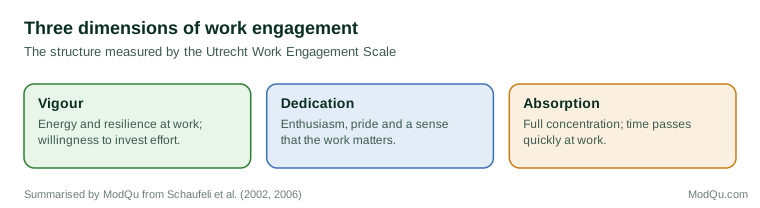
The term was introduced into academic research by Kahn (1990), who described personal engagement as the extent to which people bring their physical, cognitive and emotional selves to their work roles. Later researchers defined work engagement as a positive, fulfilling state of mind characterised by vigour, dedication and absorption (Schaufeli et al., 2002). Figure 1 summarises these three dimensions.
In practice, the term is used loosely. Commercial engagement surveys often combine measures of job satisfaction, commitment to the organisation, willingness to recommend it as an employer and intention to stay. Macey and Schneider (2008) noted that engagement had been defined in many different ways and proposed a framework distinguishing engagement as a trait, a psychological state and a pattern of behaviour. Critics argued that engagement measures often overlap so much with established concepts, such as job satisfaction and organisational commitment, that they add little (Newman & Harrison, 2008).
Engagement, satisfaction and burnout
Engagement is often confused with job satisfaction. Satisfaction is an evaluation of the job: whether people are content with their pay, conditions and colleagues. Engagement is a state of energy and involvement in the work itself. A person can be satisfied but not engaged, content with a comfortable job that does not absorb them. Job satisfaction has its own long research history; Judge et al. (2001) found a moderate relationship between satisfaction and job performance in a large meta-analysis, which suggests that both concepts carry information.
Engagement has also been described as the positive opposite of burnout. Schaufeli et al. (2002) found that engagement and burnout were related but distinct: exhaustion and cynicism, the core of burnout, were negatively related to vigour and dedication, but the measures did not form a single scale. Surveys that measure both can show whether low engagement reflects exhaustion from excessive demands or a lack of resources and meaning, which call for different responses.
How engagement is measured
The most widely used research instrument is the Utrecht Work Engagement Scale, which measures vigour, dedication and absorption with 17 items, or 9 in a shorter version validated across several countries (Schaufeli et al., 2006). Items ask, for example, how often respondents feel bursting with energy at work or are immersed in their work, on a frequency scale from "never" to "always".
Organisational surveys typically include a short engagement index alongside questions on the drivers of engagement: leadership, management, recognition, career development, workload, resources and communication. The job demands–resources model provides a theoretical framework: job resources such as support, feedback and autonomy promote engagement, while excessive demands lead to exhaustion (Bakker & Demerouti, 2007). Saks (2006) found that perceived organisational and supervisor support, rewards and fairness predicted engagement, which in turn predicted job satisfaction, commitment and intention to stay.
Engagement and performance
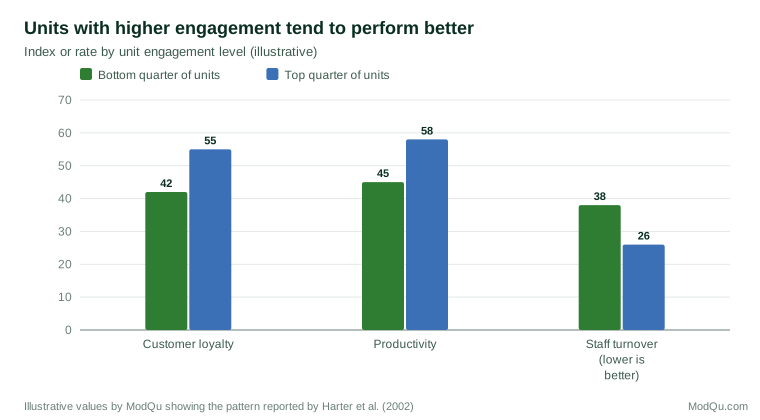
The business case for engagement surveys rests on evidence that engagement is linked to performance. Harter et al. (2002) carried out a meta-analysis of studies of business units, such as branches or stores, and found that units with higher employee engagement and satisfaction had higher customer satisfaction, productivity and profitability and lower turnover and accidents. Figure 2 illustrates the pattern.
At the individual level, Christian et al. (2011) found in a meta-analysis that work engagement was related to both task performance and helpful behaviour beyond formal job duties, even after accounting for job satisfaction and commitment. Rich et al. (2010) found that engagement explained relationships between job characteristics and performance. These associations are not proof of cause and effect: successful units may make employees more engaged, as well as the reverse. But the evidence suggests that engagement is more than a passing fashion.
Designing an engagement survey
Questions. A small number of validated engagement items should be combined with questions about the specific conditions employees experience. Questions should be about things management can influence and should be phrased in terms employees recognise.
Anonymity and confidentiality. Employees answer honestly only if they trust that their answers cannot be traced to them. Results should be reported only for groups above a minimum size, often ten people, and the survey should be run by an independent provider where possible. Ong and Weiss (2000) found that anonymity increased the reporting of sensitive information compared with confidentiality alone.
Response. Organisational surveys typically achieve higher response rates than surveys of the public, but response has fallen over time (Anseel et al., 2010). Employees who are disengaged may be less likely to respond, which inflates engagement scores. Rogelberg and Stanton (2007) reviewed organisational survey nonresponse and recommended comparing respondents with the workforce on known characteristics and following up nonrespondents.
Common method bias. When engagement and its drivers are measured in the same survey, the relationships between them may be inflated because the same people answer both in the same way at the same time (Podsakoff et al., 2003). Linking survey results to outcomes measured separately, such as turnover or customer ratings, gives more convincing evidence.
Analysing results
Engagement surveys produce data at two levels: individuals and the teams or units they belong to. Analysis should respect this structure. Differences between teams can reflect differences in managers, workloads or local conditions, and comparisons between teams need enough respondents in each to be reliable. Multilevel models separate variation between individuals from variation between teams and show which drivers matter at each level.
Key driver analysis, which relates engagement scores to answers about specific conditions, identifies where improvement might have the greatest effect. As with customer surveys, driver analysis shows association, not cause, and results can be unstable when drivers are closely related to one another. Using the same drivers over several survey rounds and checking whether changes in drivers are followed by changes in engagement gives stronger evidence.
Benchmarks from survey providers compare an organisation's scores with those of others. They are useful only if questions, scales and methods are the same, and if the comparison organisations are similar. Changes within the organisation over time are usually more informative than comparisons with external averages.
Annual and pulse surveys
Many organisations combine a full annual survey with shorter pulse surveys sent monthly or quarterly. The annual survey covers engagement and its drivers in depth and provides results for small teams; pulse surveys track a few key items and test whether actions are working. Pulse surveys work best when they are short, sent to rotating samples rather than everyone each time, and followed by visible communication about what is being done. Without these conditions, frequent surveys can become one more source of fatigue and lower response in the annual survey.
Acting on results
Engagement surveys are valuable only if they lead to action. Common practice is to share results with teams, discuss them and agree a small number of changes. Employees who see no change after a survey become sceptical and less likely to respond next time. Following up with a short check on the agreed changes shows employees that the survey has consequences.
An example
A retail chain with 300 stores runs an annual engagement survey. Linking store-level results with sales and staff turnover, it finds that stores in the top quarter for engagement have 30 per cent lower turnover. Driver analysis shows that scores on "my manager gives me useful feedback" vary most between stores. The chain trains managers in feedback, and in the following year engagement rises in the stores where feedback scores improved most (illustrative example).
Conclusion
Employee engagement surveys measure how energised, dedicated and absorbed employees are and what conditions support these states. Research links engagement to performance and retention, though the concept overlaps with older ones and causality is hard to establish. Well-designed surveys use validated measures, protect anonymity, attend to who responds and link results to independent outcomes. Their value depends on what organisations do with the results.
References
Anseel, F., Lievens, F., Schollaert, E., & Choragwicka, B. (2010). Response rates in organizational science, 1995–2008: A meta-analytic review and guidelines for survey researchers. Journal of Business and Psychology, 25(3), 335–349. https://doi.org/10.1007/s10869-010-9157-6
Bakker, A. B., & Demerouti, E. (2007). The job demands-resources model: State of the art. Journal of Managerial Psychology, 22(3), 309–328. https://doi.org/10.1108/02683940710733115
Christian, M. S., Garza, A. S., & Slaughter, J. E. (2011). Work engagement: A quantitative review and test of its relations with task and contextual performance. Personnel Psychology, 64(1), 89–136. https://doi.org/10.1111/j.1744-6570.2010.01203.x
Harter, J. K., Schmidt, F. L., & Hayes, T. L. (2002). Business-unit-level relationship between employee satisfaction, employee engagement, and business outcomes: A meta-analysis. Journal of Applied Psychology, 87(2), 268–279. https://doi.org/10.1037/0021-9010.87.2.268
Judge, T. A., Thoresen, C. J., Bono, J. E., & Patton, G. K. (2001). The job satisfaction–job performance relationship: A qualitative and quantitative review. Psychological Bulletin, 127(3), 376–407. https://doi.org/10.1037/0033-2909.127.3.376
Kahn, W. A. (1990). Psychological conditions of personal engagement and disengagement at work. Academy of Management Journal, 33(4), 692–724. https://doi.org/10.5465/256287
Macey, W. H., & Schneider, B. (2008). The meaning of employee engagement. Industrial and Organizational Psychology, 1(1), 3–30. https://doi.org/10.1111/j.1754-9434.2007.0002.x
Newman, D. A., & Harrison, D. A. (2008). Been there, bottled that: Are state and behavioral work engagement new and useful construct "wines"? Industrial and Organizational Psychology, 1(1), 31–35. https://doi.org/10.1111/j.1754-9434.2007.00008.x
Ong, A. D., & Weiss, D. J. (2000). The impact of anonymity on responses to sensitive questions. Journal of Applied Social Psychology, 30(8), 1691–1708. https://doi.org/10.1111/j.1559-1816.2000.tb02462.x
Podsakoff, P. M., MacKenzie, S. B., Lee, J.-Y., & Podsakoff, N. P. (2003). Common method biases in behavioral research: A critical review of the literature and recommended remedies. Journal of Applied Psychology, 88(5), 879–903. https://doi.org/10.1037/0021-9010.88.5.879
Rich, B. L., Lepine, J. A., & Crawford, E. R. (2010). Job engagement: Antecedents and effects on job performance. Academy of Management Journal, 53(3), 617–635. https://doi.org/10.5465/amj.2010.51468988
Rogelberg, S. G., & Stanton, J. M. (2007). Understanding and dealing with organizational survey nonresponse. Organizational Research Methods, 10(2), 195–209. https://doi.org/10.1177/1094428106294693
Saks, A. M. (2006). Antecedents and consequences of employee engagement. Journal of Managerial Psychology, 21(7), 600–619. https://doi.org/10.1108/02683940610690169
Schaufeli, W. B., Bakker, A. B., & Salanova, M. (2006). The measurement of work engagement with a short questionnaire: A cross-national study. Educational and Psychological Measurement, 66(4), 701–716. https://doi.org/10.1177/0013164405282471
Schaufeli, W. B., Salanova, M., González-Romá, V., & Bakker, A. B. (2002). The measurement of engagement and burnout: A two sample confirmatory factor analytic approach. Journal of Happiness Studies, 3(1), 71–92. https://doi.org/10.1023/A:1015630930326