
Share your view of job security
Tell us how secure you feel at work and how you would cope without pay. Your answers are combined with other people's and reported only as totals.
Start the job security and layoffs surveyAbout 5 minutes. No account needed. You can stop at any time.
What job security means
Job security is the likelihood, and the feeling, that a person will keep their job or find similar work without a long gap. It has two sides. The first is the actual risk, which depends on the type of contract, the employer's finances, the industry and the economy. The second is how secure people feel, which is shaped by news, rumours at work, past experience and how much savings they have.
The two do not always match. Someone in a stable public-sector role may still worry after a friend loses a job. Someone on a short contract in a growing field may feel quite safe because they could find other work quickly.
Contract type is one of the strongest influences:
- Permanent or open-ended contracts usually carry more protection.
- Fixed-term contracts end on a set date unless renewed.
- Temporary and agency work can end at short notice.
- Zero-hours or on-call work offers no guaranteed hours.
- Informal work, common in many countries, has no written contract and little legal protection.
- Self-employment depends on keeping enough clients.
Why layoffs happen
A layoff (also called redundancy or retrenchment) is when an employer ends jobs for reasons that are not about the worker's own performance or conduct. Common reasons include:
- falling sales or loss of a major customer;
- a recession or industry downturn;
- a merger or takeover that duplicates roles;
- moving work to another site or country;
- automation or new technology;
- closing a branch, factory or whole business;
- cuts to public budgets.
Some layoffs are temporary, such as seasonal shutdowns or furloughs, where staff are sent home for a period and expect to return. Others are permanent.
What usually happens during a layoff
The rules on layoffs differ widely by country, by the size of the employer and by the type of contract. In many European countries, employers planning large layoffs must consult worker representatives first and follow selection rules. In the United States, most private-sector employment is "at will", although a federal law requires notice for certain large layoffs and plant closings. In many other countries, labour codes set notice periods and severance based on years of service. Collective agreements with unions may add more protection.
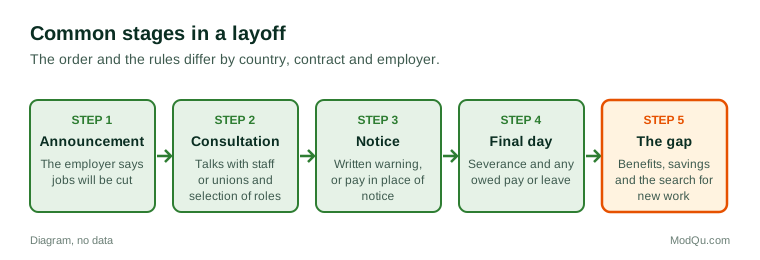
Common elements include:
- Notice: a period of warning before the job ends, or pay in place of notice.
- Severance pay: a lump sum, often linked to length of service.
- Selection: deciding which roles go, sometimes using criteria such as skills, performance or length of service.
- Support: help with job searching, retraining or references, sometimes called outplacement.
- Unemployment benefits: public payments for a limited period in many countries, often depending on past contributions.
Example
A factory worker with 12 years' service is told their plant will close in three months. They receive written notice, a severance payment based on years worked, and a place on a short course about writing a CV. They apply for unemployment benefits the week after their last day.
Savings buffers and coping without pay
How hard a layoff hits depends heavily on savings and other income. A household with two earners and some savings can manage a few months. A single earner with debts and no savings may struggle within weeks. In countries with limited unemployment support, family networks, informal work or borrowing often fill the gap.
Example (hypothetical figures)
A worker's household spends 1,800 a month on rent, food, transport and bills, in local currency. They have 4,500 in savings and expect severance of 3,000. With no other income, their money would cover about four months, since 7,500 divided by 1,800 is a little over four. If they receive unemployment benefits of 900 a month, the same money lasts about eight months.
Surveys often ask how long people could manage without pay. The answer says a lot about how secure a household really is, whatever the contract says.
How people protect themselves
People who worry about their job take a range of steps:
- building an emergency fund;
- keeping their skills and qualifications up to date;
- keeping in touch with contacts in their field;
- taking on side income;
- joining a union or professional body;
- moving to a sector seen as more stable;
- cutting spending or delaying big purchases.
Example
After two rounds of cuts at their company, an office worker starts an evening course in data analysis, updates their professional profile and puts a small amount aside each month. They are not laid off, but they say they no longer feel their job is safe.
Living with insecurity
Insecurity affects people even if they never lose their job. Worry about layoffs is linked with stress, poorer sleep and reluctance to take holidays or speak up. Some workers accept lower pay or worse conditions to keep a job. People in insecure work may also delay major decisions such as buying a home or starting a family.
After a layoff, people report a mix of experiences. Some find better work quickly. Others take a lower-paid job, change career, or move to a new area. Long gaps can make it harder to return to work, and older workers often say they find it harder to be hired again.
What people disagree about
People disagree about how much protection workers should have. Some argue that strong protection makes employers reluctant to hire. Others argue that weak protection shifts risk onto workers and their families. There is also debate about whether governments should support wages during downturns to prevent layoffs, and about how fairly employers choose who goes.
Questions that employers, recruiters and policy groups want answered include how secure people feel, how many have been laid off, how long they could manage without pay and what support helped most.
Key terms
- Job securityThe likelihood and feeling that a job and income will continue.
- LayoffEnding jobs for business reasons rather than the worker's conduct.
- RedundancyAnother word for a layoff, used in many countries.
- Notice periodThe time between being told a job will end and the last day.
- Severance payA payment to a worker whose job is ended, often linked to service.
- FurloughA temporary period of leave, often unpaid or partly paid, with a job kept open.
- Fixed-term contractA job that ends on a set date unless renewed.
- OutplacementHelp given to laid-off workers to find new jobs.
Full glossary: workforce analytics terms on EditingTests.com.
Job security and layoffs vocabulary test
How well do you know the language of this topic? Try 8 quick questions. Your score is shown straight away and is not saved.
What the job security and layoffs survey asks
This survey is part of ModQu's Work and Careers survey. The job security and layoffs part takes about five minutes and covers:
- How secure you feel in your job, and why.
- What type of contract you have.
- Whether you have been laid off in the last five years, and what happened.
- How long you could manage without pay.
- What you have done to protect yourself against job loss.
- What support helped, or would help, after a layoff.
After that you can choose to continue with other short parts of the Work and Careers survey, such as job satisfaction or remote and hybrid work, or stop.
Ready to take part?
Your answers help show what people really think and do. Results are only ever reported as totals; no one can see your individual answers.
Start the surveyQuestions about this survey
Who can take part?
Employees.
Do I have to give my name?
No. You may be asked for your age group, region and similar details so results can be broken down, but not your name. ModQu never asks for passwords, card numbers or account numbers.
How are the results used?
Answers are combined into totals and percentages and published in ModQu reports. Individual answers are never shown.
Is the vocabulary test part of the survey?
No. It is optional and separate, and your score is not stored.
Is a layoff the same as being fired?
No. A layoff ends a job for business reasons. Being fired, or dismissed, usually relates to the worker's own conduct or performance.
Do all laid-off workers get severance pay?
No. It depends on the country's law, the contract, any collective agreement and length of service. Some workers receive none.
Why does the survey ask about savings?
How long a household could manage without pay is one of the clearest measures of how much a layoff would affect it.