
Share your experience of work-life balance
Tell us how your work fits with the rest of your life and what would help. Your answers are combined with other people's and reported only as totals.
Start the work-life balance surveyAbout 5 minutes. No account needed. You can stop at any time.
What work-life balance means
Work-life balance describes how well paid work fits with the other parts of a person's life: family, friends, health, rest, study, faith, hobbies and community. It is not a fixed number of hours. Two people working the same 40-hour week can feel very differently about it, depending on their commute, their caring duties, how tiring the work is and how much control they have over when and where they do it.
People usually describe balance in terms of a few things:
- Time: whether there are enough hours left after work, commuting and household tasks.
- Energy: whether they have the strength to enjoy that time, or are too tired to use it.
- Control: whether they can choose their schedule, take time off when needed and switch off after hours.
- Spillover: how often work worries, messages or tasks spill into evenings, weekends and holidays, and how often home problems spill into work.
Balance changes over a lifetime. A young worker without dependants may accept long hours to build a career. A parent of small children, a person caring for an older relative, or someone with a health condition may need more predictable hours. People nearing retirement often want to reduce their hours gradually.
What upsets the balance
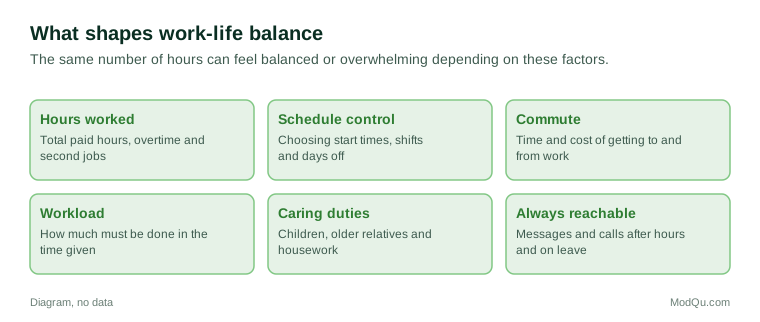
The most common causes of poor balance are long or unpredictable hours, heavy workloads, long commutes and the expectation of being reachable at all times. Shift work, split shifts and schedules that change at short notice make it hard to plan childcare, study or social life. Holding two jobs, or a job plus a side business, adds to the strain.
Home life matters as much as work. Caring for children, older parents or a sick family member takes many hours a week, and that unpaid work is not shared equally in many households. A move, a new baby or a family illness can turn a manageable job into one that no longer fits.
Example
A nurse works 12-hour shifts on a rotating pattern of days and nights. The total hours are similar to a standard week, but the changing pattern means they miss family meals, struggle to sleep after night shifts and cannot sign up for a weekly evening class. They say their balance would improve more from a fixed pattern than from fewer hours.
Flexibility and where people work
For many office workers, the biggest change of recent years has been the spread of remote and hybrid work. Working from home some days removes the commute and can make it easier to fit in school runs, appointments and household tasks. It can also blur the line between work and home, so that people check messages late into the evening and find it hard to stop.
Flexible working takes several forms:
- Flexitime: choosing start and finish times around core hours.
- Compressed hours: working full-time hours in fewer, longer days.
- Part-time and job sharing: working fewer hours, or splitting one role between two people.
- Remote or hybrid work: working from home or another place for some or all of the week.
- Annualized hours: a set number of hours per year, worked more heavily in busy seasons.
Not every job can be done flexibly. Factory, retail, transport, health and hospitality workers often need to be in a fixed place at a fixed time. In those jobs, balance depends more on predictable rosters, fair shift swaps and enough notice of schedule changes.
Example
An accountant moves from five days in the office to three days at home and two in the office. They save about ten hours of travel a week and can collect their child from school. After a few months they notice they are answering emails at 10 p.m. most nights, and they start turning off work notifications after 7 p.m.
Stress, rest and switching off
Poor balance is closely linked to stress. People who feel they never get away from work report more tiredness, poorer sleep and less time for exercise and friends. Over time this can lead to burnout, a state of exhaustion and reduced interest in work that is widely discussed by employers and health bodies. The World Health Organization describes burnout as an occupational phenomenon linked to chronic workplace stress rather than as a medical condition.
Rest needs real breaks: lunch away from the desk, evenings without work messages, weekends off and annual leave that is actually taken. Many workers do not use all their paid leave, either because of workload, worry about falling behind or a workplace culture that discourages it.
Some countries and employers have introduced a "right to disconnect", which limits when employers can expect staff to reply to messages outside working hours. France introduced such a rule for larger employers in 2017, and other countries have followed with laws or agreements of their own. Rules, and how strictly they are applied, differ widely.
What employers and workers try
Employers offer a range of measures meant to improve balance, and workers have their own ways of coping. Common measures include:
- flexible schedules and hybrid work;
- limits on after-hours emails and meetings;
- paid parental leave and carer's leave;
- wellbeing programs, counselling services and mental health days;
- trials of a four-day week with the same pay;
- clearer workloads and more staff during busy periods.
Workers' own strategies include setting fixed finishing times, turning off notifications, blocking time in a calendar, negotiating a later start, changing jobs, or reducing hours and accepting lower pay.
Costs and trade-offs
Better balance often comes with trade-offs. Part-time work means lower pay and, in many countries, lower pension contributions. Turning down overtime may slow promotion. A shorter commute may mean a smaller or more expensive home. Some people choose a less demanding job and accept less money in return for more time.
Example (hypothetical figures)
A worker earning 3,000 a month in local currency for a 40-hour week moves to a 32-hour week at 80% pay, so they now earn 2,400 a month. They lose 600 a month but gain one full day a week, which they use to care for a parent. They say the loss is worth it, but they have stopped saving for a holiday.
What people disagree about
People disagree about who is responsible for balance. Some see it as mainly up to the individual to set limits. Others say it depends on employers' staffing, deadlines and culture, and on public policy such as leave rules and childcare. There is also debate about whether remote work improves balance or makes it worse by keeping work always within reach, and about whether a four-day week works outside office jobs.
Questions that employers and policy groups want answered include how satisfied people are with their balance, how often they work outside normal hours, what would help most, and whether better balance would make them stay in a job.
Key terms
- Work-life balanceHow well paid work fits with family, rest and the rest of life.
- FlexitimeChoosing start and finish times around set core hours.
- Compressed hoursWorking full-time hours in fewer, longer days.
- Hybrid workSplitting the working week between home and a workplace.
- BurnoutExhaustion and loss of interest linked to long-term work stress.
- Right to disconnectA rule limiting when staff must reply to work messages after hours.
- SpilloverWork concerns carrying into home life, or home concerns into work.
- Annual leavePaid days off work each year.
Full glossary: workforce services terms on EditingTests.com.
Work-life balance vocabulary test
How well do you know the language of this topic? Try 8 quick questions. Your score is shown straight away and is not saved.
What the work-life balance survey asks
This survey is part of ModQu's Work and Careers survey. The work-life balance part takes about five minutes and covers:
- How satisfied you are with your work-life balance overall.
- How many hours you work, and how often you work outside your normal hours.
- Whether you can choose when or where you work.
- How often work messages reach you in evenings, weekends or holidays.
- How caring duties and your commute affect your balance.
- What would improve your balance most.
After that you can choose to continue with other short parts of the Work and Careers survey, such as job satisfaction or remote and hybrid work, or stop.
Ready to take part?
Your answers help show what people really think and do. Results are only ever reported as totals; no one can see your individual answers.
Start the surveyQuestions about this survey
Who can take part?
Working adults.
Do I have to give my name?
No. You may be asked for your age group, region and similar details so results can be broken down, but not your name. ModQu never asks for passwords, card numbers or account numbers.
How are the results used?
Answers are combined into totals and percentages and published in ModQu reports. Individual answers are never shown.
Is the vocabulary test part of the survey?
No. It is optional and separate, and your score is not stored.
Is work-life balance the same as working fewer hours?
Not always. Control over when you work, a shorter commute and fewer messages after hours can matter as much as the total number of hours.
Does working from home improve balance?
It depends on the person and the job. It saves travel time for many, but some people find it harder to stop working when their office is at home.
Why do some people not take all their paid leave?
Common reasons include heavy workloads, worry about falling behind, no one to cover their work, and a workplace culture where taking leave is frowned on.