
Share your views on women's sport
Tell us whether you watch women's sport, whether you think there is enough coverage and whether you have been to a women's match. Your answers are combined with other people's and reported only as totals.
Start the women's sport surveyAbout 5 minutes. No account needed. You can stop at any time.
What this topic covers
Women's sport means sport played by women and girls, from grassroots to elite level. This topic covers:
- watching women's sport in person, on television and online;
- playing sport as women and girls;
- media coverage and how it has changed;
- pay, prize money and professional contracts;
- sponsorship and investment;
- the barriers that remain.
Women have competed in some sports for well over a century, but for much of that time they faced bans, little funding and almost no coverage. In some countries women were banned from playing football on club grounds for decades in the twentieth century. Many professional women's leagues are recent.
Watching women's sport
Interest in women's sport has grown. Major women's football, cricket, rugby and basketball events have drawn large crowds and television audiences, and some women's club matches have set attendance records in their countries. Tennis, athletics, gymnastics and swimming have had high-profile women stars for decades.
People who watch women's sport give reasons such as:
- the quality and skill of play;
- following national teams in big tournaments;
- lower ticket prices and a family-friendly atmosphere;
- supporting the growth of the game and equality;
- players who are open and approachable with fans.
Example
A father takes his son and daughter to a women's professional football match because tickets cost a quarter of the men's game. The children get autographs at the end and the atmosphere is relaxed. They buy season tickets the next year, and the son now follows both the men's and women's teams.
People who do not watch often say they are not interested in the sport generally, do not know when matches are on, or cannot find them on television. Lack of coverage and promotion is one of the most common reasons given.
Media coverage
For many years, women's sport received a very small share of sports coverage in newspapers, television and online. Coverage has increased, especially during major tournaments, and some broadcasters now show women's leagues regularly. But many studies of sports media in different countries have found that women's sport still receives far less coverage than men's outside major events.
How women athletes are portrayed has also been studied. Research has found more focus on appearance, family life and emotions in coverage of women athletes than men, though this has been changing.
Pay, prize money and contracts
Pay and prize money for women are lower than for men in most professional sports. Reasons given include lower broadcast and ticket income, fewer sponsors and the shorter history of professional women's leagues. Others argue that lower investment is part of the cause, not only a result.
Some sports have moved towards equal prize money. The four major tennis tournaments pay equal prize money to men and women, and several national football associations have agreed equal match fees for their men's and women's national teams. In many women's leagues, players are still semi-professional, combining sport with other jobs.
Example (hypothetical figures)
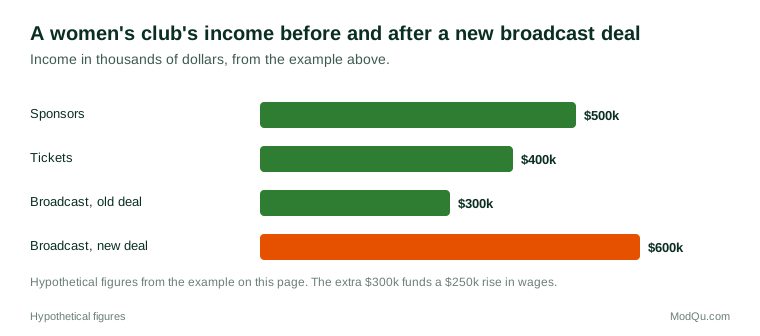
A women's league club earns $1.2 million a year: $500,000 from sponsors, $400,000 from ticket sales and $300,000 from broadcast rights. Its wage bill for 25 players is $750,000, an average of $30,000 per player. A new broadcast deal doubles broadcast income to $600,000, and the club raises the average wage to $40,000, which costs $250,000 more a year.
Playing sport
Girls and women play less sport than boys and men on average in many countries, and the gap often widens in the early teenage years when many girls stop. Reasons include:
- fewer teams and clubs for girls;
- lack of female coaches and role models;
- body image concerns and discomfort with kit or changing rooms;
- worries about being judged;
- caring responsibilities and less free time;
- in some places, cultural or family restrictions;
- safety concerns, such as travelling to training in the dark.
Programs that have increased participation include girls-only sessions, kit that girls are comfortable in, female coaches, social and beginner-friendly formats, and campaigns showing ordinary women exercising.
Sponsorship and investment
Sponsorship of women's sport has increased as brands see growing audiences and positive public attitudes. Some brands now sponsor women's teams and events separately from men's, rather than as part of a combined package. Investors have also bought or founded women's clubs and leagues. Many people working in women's sport say investment is still far below what is needed for facilities, medical support and youth development.
Example
A regional bank sponsors a women's rugby team's shirt for a modest amount. The team reaches a national final that is shown on television, and the bank's logo is seen by a large audience. The bank renews the deal for three years at a higher value and adds a girls' coaching program.
Health and science
Research on women athletes has lagged behind research on men. Topics now getting more attention include injury risks such as knee ligament injuries, which research has found are more common in women in some sports, the effect of the menstrual cycle on training, sports bras and equipment designed for women's bodies, and support for athletes who become mothers.
Fans and audiences
Audiences for women's sport are often described as younger, more family-oriented and more female than audiences for men's sport, though this varies by sport and country. Many people who attend women's matches say they also follow men's sport, while others say they prefer the atmosphere at women's games. Social media has helped women athletes build direct followings, which some brands now value as highly as television audiences.
Questions remain about how to turn interest during major tournaments into regular attendance at league matches. Clubs and leagues have tried scheduling games at larger stadiums, pairing women's and men's matches on the same day, cheaper tickets and stronger promotion.
What people disagree about
People disagree about whether women's sport should receive equal coverage regardless of audience size, whether equal pay should come before or after equal income, whether women's competitions should be played on the same days and venues as men's, how to define eligibility for women's categories, and whether interest will last beyond major tournaments.
Questions that leagues, clubs, broadcasters, sponsors and governing bodies want answered include how many people watch women's sport and how, whether they think coverage is enough, whether they have attended a match, and what would make them watch or play more.
Key terms
- GrassrootsSport at local and community level, including youth and amateur play.
- Semi-professionalPlayers who are paid for sport but also work in other jobs.
- Prize moneyMoney paid to competitors based on results in an event.
- Equal payThe same pay for the same work, such as equal match fees for national teams.
- Broadcast dealAn agreement for a broadcaster to show a competition, in return for payment.
- Role modelA person whose example others look up to and follow.
- Drop-outStopping playing a sport, common among teenage girls.
- Attendance recordThe largest crowd recorded for a type of event.
Full glossary: sports management terms on EditingTests.com.
Women's sport vocabulary test
How well do you know the language of this topic? Try 8 quick questions. Your score is shown straight away and is not saved.
What the women's sport survey asks
This survey is part of ModQu's Sports survey. The women's sport part takes about five minutes and covers:
- Whether you watch women's sport, which sports and how.
- Whether you have attended a women's match or event, and what it was like.
- Whether you think there is enough coverage of women's sport.
- What you think about pay and prize money in women's sport.
- Whether you or women and girls in your household play sport, and what helps or gets in the way.
- Which sponsors of women's sport you can name.
After that you can choose to continue with other short parts of the Sports survey, such as football (soccer) fans or playing team sports, or stop.
Ready to take part?
Your answers help show what people really think and do. Results are only ever reported as totals; no one can see your individual answers.
Start the surveyQuestions about this survey
Who can take part?
Adults.
Do I have to give my name?
No. You may be asked for your age group, region and similar details so results can be broken down, but not your name. ModQu never asks for passwords, card numbers or account numbers.
How are the results used?
Answers are combined into totals and percentages and published in ModQu reports. Individual answers are never shown.
Is the vocabulary test part of the survey?
No. It is optional and separate, and your score is not stored.