
Share your experience of visas and borders
Tell us whether you needed a visa for your last trip, how easy it was to get and how long you waited at the border. Your answers are combined with other people's and reported only as totals.
Start the visas, passports and border crossing surveyAbout 5 minutes. No account needed. You can stop at any time.
What this topic covers
Crossing an international border usually requires a passport and, for many trips, permission to enter from the country being visited. This topic covers the experience of travellers, not legal advice. It looks at:
- Passports: getting and renewing them, costs and waiting times.
- Visas: when they are needed, the main kinds and how people apply.
- Electronic travel authorizations: online permits required by some countries for visitors who do not need a full visa.
- Border checks: queues, automated gates, questions and inspections.
- Problems: refusals, delays, lost passports and confusing rules.
Rules differ widely by country and depend on the traveller's nationality, the purpose of the trip and how long they will stay. Travellers are usually advised to check official government sources before booking.
Passports
A passport is an official document issued by a person's own government that confirms their identity and nationality and allows them to travel abroad. Most modern passports are electronic passports with a chip that stores the holder's details and photo.
Common issues include:
- Cost and waiting time, which vary by country and rise at busy times of year;
- Validity rules: many countries require a passport to be valid for several months after the date of departure, and to have blank pages;
- Children's passports, which usually last fewer years and may need both parents' consent;
- Lost or stolen passports, which must be reported, with an emergency travel document available from embassies and consulates.
How powerful a passport is, meaning how many countries its holder can visit without a visa, varies greatly between nationalities. This affects how easy travel is for people from different countries.
Visas and the main kinds
A visa is permission from a country to enter for a particular purpose and time. Whether one is needed depends on the traveller's nationality and the destination. The main arrangements are:
- Visa-free entry, where travellers can visit for a set period with only a passport.
- Visa on arrival, issued at the airport or border, sometimes for a fee.
- Electronic visa (e-visa), applied for and issued online before travel.
- Consular visa, applied for through an embassy, consulate or visa application centre, often with an appointment, biometrics and supporting documents.
- Regional visas that cover several countries, such as the Schengen visa for many European countries.
Visas also differ by purpose: tourist, business, transit, student, work and family visas each have their own rules.
Electronic travel authorizations
A growing number of countries require visitors who do not need a full visa to apply online for an electronic travel authorization before travelling. Examples include Canada's eTA, the United States' ESTA, Australia's ETA, the United Kingdom's ETA and a similar scheme planned for the Schengen area. The traveller fills in an online form, pays a fee and usually receives an answer quickly.
Travellers sometimes forget these permits, apply on unofficial websites that charge extra fees, or confuse them with full visas.
Example
A traveller books a holiday and only learns at the check-in desk that they needed an online travel authorization. They apply on their phone at the airport and receive approval within an hour, just in time for the flight. On their next trip they check entry rules on the destination government's official website before booking.
Applying for a visa
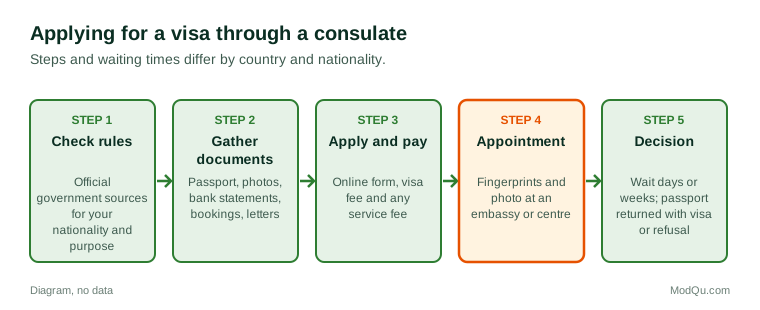
For a consular visa, applicants often need to:
- complete an application form;
- book and attend an appointment;
- give fingerprints and a photo;
- provide documents such as bank statements, proof of accommodation, a return ticket, a letter from an employer, or an invitation;
- pay the visa fee and sometimes a service fee to an application centre;
- wait for a decision, which may take days or weeks.
Figure 1 shows these steps. Waiting times for appointments can be long in busy periods, and travellers from some countries face far more requirements than others.
Example (hypothetical figures)
A family of three applies for tourist visas. The visa fee is 80 dollars per person (240 dollars), the application centre charges a service fee of 25 dollars per person (75 dollars), and travel to the centre in another city costs 60 dollars. The total cost before the trip is 375 dollars, or 125 dollars per person.
At the border
When arriving, travellers go through immigration checks and, separately, customs checks on what they bring. Experiences include:
- Queues that vary from minutes to hours depending on time of day, season and staffing;
- Automated gates that scan electronic passports and faces, available to some nationalities;
- Questions from border officers about the purpose of the visit, where the traveller will stay and when they will leave;
- Biometric checks, such as fingerprints and photos, which some countries take on every entry;
- Customs declarations for goods, cash above certain limits, food and plants;
- Land borders, where travellers by car or bus may face long queues and vehicle searches.
Example
A student travelling overland by bus between two neighbouring countries waits three hours at the land border while every passenger's passport is checked and the bus is searched. On the return trip, a new electronic system has been introduced and the crossing takes forty minutes.
Common problems
Travellers report several common problems:
- not knowing a visa or permit was needed;
- passports that are too close to expiry;
- visa refusals, often without a detailed reason, and lost fees;
- long waits for appointments or decisions;
- unofficial websites charging extra for official permits;
- being refused boarding by an airline because documents do not meet the destination's rules;
- dual nationals unsure which passport to use.
Trends and debates
Trends include more electronic visas and travel authorizations, automated gates, biometric entry and exit systems, and digital travel credentials stored on phones. Debates include the unequal ease of travel for people from different countries, the cost of visas for families and students, the privacy of biometric data, and how border rules affect tourism and family visits.
Questions that businesses want answered here include whether travellers needed a visa, how easy and costly it was to get, how long they waited at the border and how border experiences affect future travel plans.
Key terms
- PassportAn official document from a person's own government confirming identity and nationality for travel.
- VisaPermission from a country to enter for a particular purpose and time.
- Visa on arrivalA visa issued at the airport or border when the traveller arrives.
- E-visaA visa applied for and issued online.
- Electronic travel authorizationAn online permit required by some countries for visitors who do not need a full visa.
- Schengen areaA group of European countries with no regular border checks between them and a shared short-stay visa.
- BiometricsFingerprints, face images and other body features used to confirm identity.
- CustomsThe checks on goods, cash and other items brought into a country.
Full glossary: immigration administration terms on EditingTests.com.
Visas, passports and border crossing vocabulary test
How well do you know the language of this topic? Try 8 quick questions. Your score is shown straight away and is not saved.
What the visas, passports and border crossing survey asks
This survey is part of ModQu's Travel and Hospitality survey. The visas, passports and border crossing part takes about five minutes and covers:
- Whether you needed a visa or travel authorization for your last trip abroad.
- How you applied, how long it took and how easy it was.
- What the passport, visa or permit cost you.
- How long you waited at the border, and whether you used automated gates.
- Whether you have had a visa refused or been refused boarding.
- How visa and border rules affect where you choose to travel.
After that you can choose to continue with other short parts of the Travel and Hospitality survey, such as holiday and leisure travel or air travel, or stop.
Ready to take part?
Your answers help show what people really think and do. Results are only ever reported as totals; no one can see your individual answers.
Start the surveyQuestions about this survey
Who can take part?
Adults who travelled abroad in the last three years.
Do I have to give my name?
No. You may be asked for your age group, region and similar details so results can be broken down, but not your name. ModQu never asks for passwords, card numbers or account numbers.
How are the results used?
Answers are combined into totals and percentages and published in ModQu reports. Individual answers are never shown.
Is the vocabulary test part of the survey?
No. It is optional and separate, and your score is not stored.