
Share your experience of eating out
Tell us how often you eat out, which delivery apps you use and what you spend. Your answers are combined with other people's and reported only as totals.
Start the restaurants and takeout surveyAbout 5 minutes. No account needed. You can stop at any time.
What this topic covers
This topic covers food and drink prepared by someone else and bought to eat in or take away:
- Full-service restaurants, where a server takes the order at the table.
- Casual dining chains and family restaurants.
- Quick-service and fast food restaurants, where people order at a counter, kiosk or drive-through.
- Cafés and coffee shops.
- Pubs and bars that serve food.
- Takeout, picked up by the customer.
- Delivery, by the restaurant's own staff or through food delivery apps.
- Food trucks, markets and food courts.
Fast food as a category has its own page; this page looks at eating out as a whole.
Why and how often people eat out
People eat out for many reasons:
- convenience, when there is no time or energy to cook;
- social occasions with family, friends or colleagues;
- celebrations, such as birthdays and anniversaries;
- trying new food and cuisines;
- a treat at the end of a long week;
- work, such as lunch near the office or business meals;
- travel, when there is no kitchen available.
How often people eat out depends on income, household size, age, where they live and how much they enjoy cooking. Rising menu prices have led many households to eat out less often, choose cheaper places, or switch from dine-in to takeout.
Example
A couple who used to go out for dinner every Friday now alternate: one week they eat at a neighbourhood restaurant, the next they pick up takeout and eat at home. They say they still enjoy the treat but spend about half as much over a month.
How people choose a restaurant
Common factors include:
- type of food and the mood of the group;
- price;
- location and parking;
- reviews and ratings, online and from friends;
- past experience, since many people return to favourites;
- dietary needs: vegetarian, vegan, gluten-free, halal, kosher and allergies;
- atmosphere: quiet, lively, family-friendly or formal;
- wait times and whether reservations are possible.
Many people decide on the spot using a map app or a search, while special occasions are often planned and booked ahead.
Dine-in, takeout and delivery
Each way of eating restaurant food has its own trade-offs:
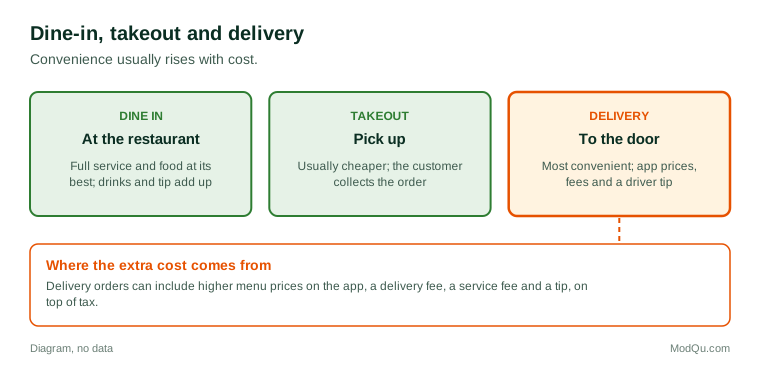
- Dining in offers the full experience, service and food at its best, but costs more with drinks and tip, and takes more time.
- Takeout is usually cheaper, avoids tipping a server in many cases, and lets people eat at home, but the food travels and the customer must pick it up.
- Delivery is the most convenient but often the most expensive, with menu prices that may be higher on apps, plus delivery and service fees and a tip for the driver.
Food delivery apps grew rapidly in recent years. They let people order from many restaurants in one place, track the order and pay in the app. Restaurants pay the apps a commission on each order, which many say cuts into already thin profits. Some restaurants charge higher prices on the apps, offer their own delivery, or encourage customers to order directly.
Example (hypothetical figures)
A family orders dinner through a delivery app. The food costs $48 on the app, compared with $42 when ordered directly from the restaurant. The app adds a $3.99 delivery fee and a $4.80 service fee, and they tip the driver $6. The total is $62.79. Picking up the same order directly would have cost $42 plus tax.
Questions businesses want answered here include which delivery apps people use, how often, how much they spend, and whether they know the price differences between the app and the restaurant.
Tipping
Tipping is a common source of confusion and debate in Canada and the United States. In full-service restaurants, tips are generally expected and form a large part of servers' income. Card machines now often suggest tip amounts, sometimes starting at higher percentages than people are used to, and tip prompts have spread to counters, cafés and takeout.
Debates include:
- what percentage is normal;
- whether to tip on the amount before or after tax;
- whether to tip for takeout and counter service;
- whether service charges should replace tips;
- whether tips should be shared with kitchen staff.
Example
A customer buying a coffee and a muffin at a café counter is shown a screen offering tips of 18, 20 or 25 percent. They feel awkward with the barista watching and press 18 percent, though they would not have tipped on a counter order before. Later they say they would prefer prices that include service.
Prices, value and changes on the menu
Restaurant prices have been affected by higher costs for food, wages, rent and energy. Restaurants respond by raising prices, making portions smaller, shortening menus or adding service charges. Customers respond by ordering fewer drinks or courses, sharing dishes, choosing lunch specials or eating out less often.
Many people value restaurants that offer clear prices, consistent quality and good service. A single bad experience, such as a long wait or a wrong order, can lead some customers not to return.
Allergies, dietary needs and health
People with food allergies, celiac disease and other dietary needs rely on restaurants to give accurate information. Many restaurants mark allergens and dietary options on menus, and staff are trained to answer questions, but the risk of cross-contact in shared kitchens remains. Some provinces require food handler training, and many restaurants post nutrition information. In Ontario, chains with 20 or more locations must post calories on menus.
Example
A parent of a child with a peanut allergy calls a restaurant before a birthday dinner to ask how desserts are made. The manager explains which items are made in a separate area. On the night, the server checks the order with the kitchen, and the family books the same restaurant for the next birthday.
What people disagree about
Opinion is divided on tipping, delivery app fees and commissions, whether restaurants should include all charges in menu prices, whether eating out is good value compared with cooking, and how restaurants should handle staff shortages and wages. These views often differ by age, income and whether people have worked in restaurants themselves.
Key terms
- TakeoutFood bought at a restaurant to eat elsewhere.
- Delivery feeA charge for bringing food to your door.
- Service feeAn extra charge added by a delivery app or restaurant.
- CommissionThe share of each order a delivery app takes from the restaurant.
- GratuityA tip given for service.
- Prix fixeA set menu at a fixed price.
- Cross-contactWhen an allergen gets into food that should not contain it.
- ReservationA table booked in advance.
Full glossary: restaurant chains terms on EditingTests.com.
Restaurants and takeout vocabulary test
How well do you know the language of this topic? Try 8 quick questions. Your score is shown straight away and is not saved.
What the restaurants and takeout survey asks
This survey is part of ModQu's Travel and Hospitality survey. The restaurants and takeout part takes about five minutes and covers:
- How often you eat at restaurants, order takeout or get delivery.
- Which food delivery apps you use, and how often.
- How much you spent on eating out and takeout last week.
- What matters most when you choose a restaurant.
- How you decide how much to tip, and what you think of tip prompts.
- How rising prices have changed how you eat out.
After that you can choose to continue with other short parts of the Travel and Hospitality survey, such as holiday and leisure travel or air travel, or stop.
Ready to take part?
Your answers help show what people really think and do. Results are only ever reported as totals; no one can see your individual answers.
Start the surveyQuestions about this survey
Who can take part?
Adults.
Do I have to give my name?
No. You may be asked for your age group, region and similar details so results can be broken down, but not your name. ModQu never asks for passwords, card numbers or account numbers.
How are the results used?
Answers are combined into totals and percentages and published in ModQu reports. Individual answers are never shown.
Is the vocabulary test part of the survey?
No. It is optional and separate, and your score is not stored.
Do coffee shops and fast food count?
Yes. Any food or drink bought ready to eat, from cafés to fine dining, counts.