
Share your experience of flying
Tell us which airline you flew, what mattered in choosing it and what you paid for extras. Your answers are combined with other people's and reported only as totals.
Start the air travel surveyAbout 5 minutes. No account needed. You can stop at any time.
What this topic covers
This topic covers commercial air travel by passengers:
- Choosing a flight: airline, price, schedule, route and fare type.
- Fares and fees: what a ticket includes and what costs extra.
- The airport: getting there, check-in, security, waiting and boarding.
- On board: seats, space, food, entertainment and service.
- Disruptions: delays, cancellations, lost baggage and overbooking.
- Passenger rights: compensation and complaints.
- Loyalty programs and travel with points.
It includes domestic flights within Canada and international flights. Holiday planning as a whole is covered on the holiday and leisure travel page.
How people choose a flight
People usually weigh several factors when choosing a flight:
- price, often the main factor for leisure travellers;
- direct or connecting flights, since connections add time and risk of missed flights;
- departure and arrival times;
- the airport, since some travellers drive to a smaller or cross-border airport for a lower fare;
- the airline's reputation for reliability and service;
- loyalty points and status;
- what is included, such as baggage and seat choice.
Business travellers, people visiting family and holiday travellers often weigh these differently. A business traveller may pay more for a convenient time and flexible ticket, while a family may choose the lowest fare and accept an early flight.
Example
A student flying home for the holidays compares two options. One is a direct flight for $420. The other connects through another city for $310 but leaves at 6 a.m. and has a 50-minute connection. They choose the direct flight, because missing the connection on a busy travel day would mean losing a day of their visit.
Fares and extra fees
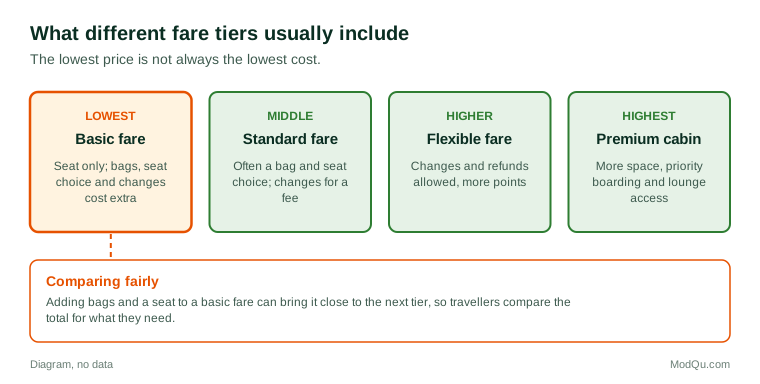
Airlines now sell fares in several tiers. The lowest fare often excludes items that were once included:
- checked baggage, and sometimes a full-size carry-on bag;
- seat selection, so passengers are assigned a seat at check-in;
- changes and cancellations, which may not be allowed or may cost a fee;
- earning points;
- food and drinks on some flights.
Higher fare tiers include more of these, and premium cabins add more space, priority boarding and lounge access. Because of these differences, comparing the base price alone can be misleading. Many travellers find the true cost only at checkout.
Example (hypothetical figures)
A traveller finds a basic fare of $189 one way. Adding a checked bag costs $35, choosing a seat costs $25, and the next fare tier, which includes both plus a free change, costs $259. Adding the bag and seat to the basic fare gives $249. They pay $10 more for the higher tier, because it also allows a change if their plans move.
The airport experience
For many travellers, the airport is the most stressful part of flying. Common concerns include:
- getting to the airport and the cost of parking or transport;
- long lines at check-in, bag drop and security;
- security screening rules on liquids, electronics and other items;
- crowded gates and limited seating;
- food and shopping prices inside the terminal;
- walking distances, especially for older travellers and people with disabilities;
- customs and border lines on return from international trips.
Programs that speed up screening and border crossing are available to approved travellers, such as the NEXUS program for low-risk travellers between Canada and the United States. In Canada, airport security screening is carried out under the Canadian Air Transport Security Authority (CATSA).
Example
A family of four flying on a holiday weekend arrives at the airport two and a half hours before departure. Check-in is quick because they checked in online, but security takes over an hour. They reach the gate as boarding starts and decide they will arrive earlier on their next busy-weekend trip.
Delays, cancellations and passenger rights
Flights can be delayed or cancelled because of weather, mechanical problems, crew shortages, air traffic control or other causes. Baggage can be delayed, damaged or lost. Flights can also be overbooked, so that a passenger with a ticket is refused boarding.
In Canada, the Air Passenger Protection Regulations set minimum airline obligations to passengers for delays, cancellations, denied boarding, lost and damaged baggage, and seating children near a parent. What an airline owes depends on whether the cause was within its control, and whether it was required for safety. Passengers who are not satisfied with an airline's response can complain to the Canadian Transportation Agency. Other countries have their own rules; the European Union, for example, has passenger rights rules for flights to and from its airports.
Many passengers do not know what they are entitled to, or find the process of claiming compensation slow and confusing. Questions that airlines, airports and public bodies want answered include how many travellers had a disruption, whether they claimed, and how they rated the response.
On board
Comfort on board depends on seat width and legroom, the length of the flight, and the cabin. Passengers often comment on:
- the space between rows;
- whether food is included or for sale;
- in-flight entertainment and Wi-Fi;
- how crowded overhead bins are;
- how staff handle problems.
On short flights many people accept less comfort for a lower price. On long flights, more people pay for extra legroom or a premium cabin, or use points to upgrade.
Loyalty programs and points
Airline loyalty programs give points for flying and for spending on partner credit cards. Points can be used for flights, upgrades and other rewards. Frequent flyers may earn status, which brings benefits such as free bags, priority boarding and lounge access. Many travellers earn more points from a credit card than from flying, and some find it hard to use points for the flights they want.
Flying and the environment
Air travel produces greenhouse gas emissions, and some travellers try to fly less, choose direct flights, take trains for shorter trips, or buy carbon offsets. Others feel air travel is necessary in a country as large as Canada, where many communities, especially in the North, are reachable only by air for much of the year. Opinion is also divided on whether fees should be included in advertised fares, how much compensation airlines should pay for delays, and whether new airlines improve competition.
Key terms
- Basic fareThe cheapest fare tier, often without bags, seat choice or changes.
- Connecting flightA trip that requires changing planes on the way.
- LayoverThe time between connecting flights.
- Checked baggageBags handed over at check-in and carried in the hold.
- OverbookingSelling more seats than a plane has.
- Denied boardingBeing refused a seat on a flight you have a ticket for.
- Carbon offsetA payment meant to balance emissions by funding reductions elsewhere.
- StatusA loyalty level that gives frequent flyers extra benefits.
Full glossary: airline customer service terms on EditingTests.com.
Air travel vocabulary test
How well do you know the language of this topic? Try 8 quick questions. Your score is shown straight away and is not saved.
What the air travel survey asks
This survey is part of ModQu's Travel and Hospitality survey. The air travel part takes about five minutes and covers:
- Which airline you flew most recently, and where.
- What mattered most in choosing the flight.
- Whether you paid extra for bags, seats or other extras, and how much.
- How you rate the airport experience, from check-in to boarding.
- Whether you had a delay, cancellation or baggage problem, and how it was handled.
- Whether you belong to an airline loyalty program, and how you use points.
After that you can choose to continue with other short parts of the Travel and Hospitality survey, such as holiday and leisure travel or hotels and short-term rentals, or stop.
Ready to take part?
Your answers help show what people really think and do. Results are only ever reported as totals; no one can see your individual answers.
Start the surveyQuestions about this survey
Who can take part?
People who flew in the last two years.
Do I have to give my name?
No. You may be asked for your age group, region and similar details so results can be broken down, but not your name. ModQu never asks for passwords, card numbers or account numbers.
How are the results used?
Answers are combined into totals and percentages and published in ModQu reports. Individual answers are never shown.
Is the vocabulary test part of the survey?
No. It is optional and separate, and your score is not stored.
Do I need to have flown recently to take part?
The main questions are for people who flew in the last two years, but others can answer questions about their reasons for not flying.