
Share how you book travel
Tell us how you booked your last trip, which sites you use and how much you trust online reviews. Your answers are combined with other people's and reported only as totals.
Start the travel booking sites and apps surveyAbout 5 minutes. No account needed. You can stop at any time.
What this topic covers
This topic covers the websites and apps people use to research and book travel:
- Online travel agencies, which sell flights, hotels, rentals, car hire and packages from many companies in one place.
- Metasearch and comparison sites, which search many sellers and send the traveller elsewhere to book.
- Direct booking on an airline's, hotel's or rental company's own site or app.
- Short-term rental platforms.
- Review sites and the review sections of booking sites.
- Travel planning apps, maps and itinerary tools.
- Travel agents, who also book online on their clients' behalf.
How online booking works
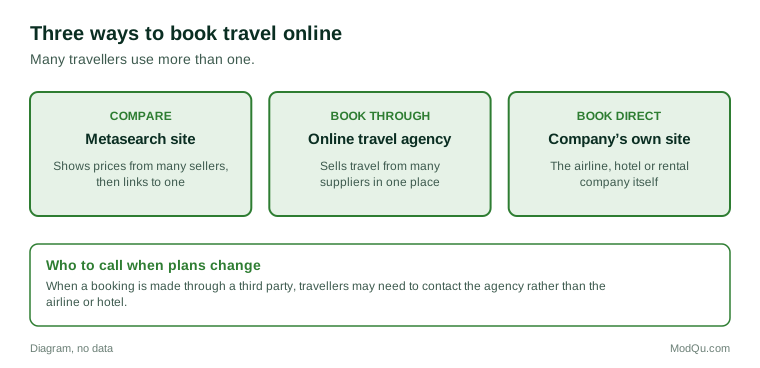
The main kinds of sites work in different ways:
- An online travel agency sells travel from many airlines, hotels and other suppliers. The traveller books and often pays on the agency's site, and the agency earns a commission or a margin.
- A metasearch site shows prices from many sellers side by side, including online agencies and direct sites. The traveller clicks through to book with the seller.
- A direct site belongs to the airline, hotel chain or rental company itself.
Many travellers use more than one: they compare on a metasearch site, read reviews on another, and then book either through an agency or directly.
Example
A traveller planning a weekend in another city searches flights on a comparison site, finds the cheapest option on an online travel agency, then checks the airline's own site. The price is the same, so they book direct, because they have heard changes are easier to make with the airline.
Why people book through a site, or direct
Reasons for booking through an online travel agency include:
- seeing many options at once;
- lower prices or package deals that combine flights and hotels;
- one account for all bookings;
- reward programs offered by the site;
- filters for price, location, ratings and amenities.
Reasons for booking directly include:
- easier changes and cancellations, since the airline or hotel deals with the traveller directly;
- loyalty points and status, which may not apply to third-party bookings;
- better rooms or seat choices, sometimes kept for direct customers;
- special offers for members;
- clear responsibility if something goes wrong.
Questions businesses want answered here include which sites people use, how many they check before booking, and whether they booked their last trip through a site or directly.
Prices, fees and price changes
Prices for flights and hotels change often, depending on demand, the time of booking, the day of the week and how many seats or rooms are left. This is called dynamic pricing. Many travellers believe prices rise if they search the same trip several times, and some clear their browser history or search in private windows. Whether this makes a difference is debated.
Other common features include:
- price alerts that send a message when a fare drops;
- "only one room left" messages, which some travellers find helpful and others see as pressure;
- taxes and fees shown only near checkout;
- non-refundable rates that are cheaper but cannot be cancelled;
- pay later options for hotels.
Example (hypothetical figures)
A hotel shows a non-refundable rate of $160 a night and a flexible rate of $185 for the same room. For a four-night stay, the non-refundable rate saves $100. The traveller chooses the flexible rate because their dates may change, and decides the $100 is worth the freedom to cancel.
In Canada, the Competition Bureau has taken action against "drip pricing", where mandatory fees are added after the first price is shown, and federal law now treats drip pricing as misleading. Airlines selling in Canada must show the full price including taxes and fees.
Reviews and ratings
Reviews are central to how people choose hotels, rentals, tours and restaurants. Travellers typically look at the overall score, the number of reviews, recent comments and photos from guests. Many read negative reviews closely to see whether the complaints matter to them.
Trust in reviews is mixed. Concerns include:
- fake reviews, written by owners or paid writers;
- reviews removed or not published;
- reviews influenced by discounts or requests;
- ratings that are almost all high, making differences hard to see;
- reviews about one-off problems.
Sites use verification, for example allowing reviews only from guests who have stayed, and rules against paid reviews. Regulators in several countries have acted against fake reviews.
Example
A traveller notices that a small hotel has fifty five-star reviews posted within two weeks, all short and similar in wording. They read the few longer reviews from earlier, which mention noise and broken air conditioning, and book another hotel nearby.
When plans change or go wrong
Problems that arise with online bookings include:
- cancelled flights where the traveller is unsure whether to contact the airline or the booking site;
- hotel overbooking, where a reservation is not honoured;
- rentals that do not match the listing;
- refunds that take a long time or are given as credit instead of money;
- customer service that is hard to reach or passes the traveller between companies.
When a booking is made through a third party, responsibility can be unclear. Many travellers say they would book direct for complex trips for this reason.
Example
A couple booked flights through an online agency. When the airline changes the schedule, the airline tells them to contact the agency, and the agency's phone wait is two hours. They eventually get a new flight, and decide to book their next trip directly with the airline.
What people disagree about
Opinion is divided on whether booking sites give better prices than direct, whether dynamic pricing is fair, whether "only one left" messages are honest, how far reviews can be trusted, and whether booking sites should be responsible when a supplier lets a traveller down. Experienced travellers often have firm habits about which sites they use.
Key terms
- Online travel agencyA site that sells travel from many suppliers in one place.
- MetasearchA site that compares prices from many sellers and links to them.
- Direct bookingBooking on the airline's, hotel's or company's own site.
- Dynamic pricingPrices that change with demand and timing.
- Drip pricingShowing a low price first and adding mandatory fees later.
- Non-refundable rateA lower price that cannot be cancelled for a refund.
- Price alertA message sent when the price of a trip changes.
- Verified reviewA review from someone confirmed to have used the service.
Full glossary: travel technology terms on EditingTests.com.
Travel booking sites and apps vocabulary test
How well do you know the language of this topic? Try 8 quick questions. Your score is shown straight away and is not saved.
What the travel booking sites and apps survey asks
This survey is part of ModQu's Travel and Hospitality survey. The travel booking sites and apps part takes about five minutes and covers:
- Whether you booked your last trip through a booking site, directly or through a travel agent.
- Which booking sites and apps you use, and why.
- How many sites you check before booking.
- How much you trust online reviews and ratings.
- Whether you have had a problem with an online booking, and how it was resolved.
- What would make you book direct instead of through a site, or the reverse.
After that you can choose to continue with other short parts of the Travel and Hospitality survey, such as holiday and leisure travel or air travel, or stop.
Ready to take part?
Your answers help show what people really think and do. Results are only ever reported as totals; no one can see your individual answers.
Start the surveyQuestions about this survey
Who can take part?
Adults who booked travel online.
Do I have to give my name?
No. You may be asked for your age group, region and similar details so results can be broken down, but not your name. ModQu never asks for passwords, card numbers or account numbers.
How are the results used?
Answers are combined into totals and percentages and published in ModQu reports. Individual answers are never shown.
Is the vocabulary test part of the survey?
No. It is optional and separate, and your score is not stored.
Do I need to have booked online to take part?
No. If you book by phone or through a travel agent, the survey asks about that too.