
Share your experience of a day out
Tell us which attractions you visited last year, how you booked and how much you spent on the day. Your answers are combined with other people's and reported only as totals.
Start the theme parks and attractions surveyAbout 5 minutes. No account needed. You can stop at any time.
What this topic covers
An attraction is a place people visit for leisure and entertainment, usually paying for entry. This topic covers:
- Theme parks and amusement parks, with rides, shows and themed areas.
- Water parks, indoor and outdoor.
- Zoos, safari parks, aquariums and wildlife parks.
- Museums, galleries and science centres that charge for entry or for special exhibitions.
- Historic sites: castles, palaces, temples, ruins and heritage railways.
- Observation towers, cable cars and boat tours.
- Indoor attractions such as trampoline parks, escape rooms and play centres.
- Seasonal events: festivals, light shows and holiday markets.
It looks at how often people visit, how they choose, how they book, what they spend and what makes a visit good or bad.
Who visits and why
Visitors include families with children, groups of friends, couples, school trips, tourists on holiday and local residents on a weekend day out. Their reasons vary:
- excitement and thrill rides;
- a special occasion, such as a birthday;
- something for children to enjoy and learn from;
- seeing animals, history or culture;
- a must-see sight on a holiday;
- spending time together as a family or group.
Some people visit the same local attraction many times a year with an annual pass; others visit a famous park once in a lifetime.
How people choose an attraction
The factors people weigh include:
- Price of tickets, food, parking and extras;
- Distance and travel time;
- Age suitability: height limits on rides, and whether there is enough for young children and teenagers;
- Reviews and recommendations from friends and online;
- Crowds and queues, and whether school holidays should be avoided;
- Weather, and whether there are indoor areas;
- Accessibility for people with disabilities, older relatives and pushchairs;
- New rides or exhibits, which give people a reason to return.
Tickets, pricing and booking
Ticketing has changed a great deal. Many attractions now sell most tickets online in advance, and some require visitors to book a time slot. Common ticket types include:
- Single-day tickets, sometimes cheaper when bought online or in advance;
- Dynamic pricing, where prices change with expected demand, so a busy Saturday costs more than a quiet weekday;
- Multi-day and multi-park tickets;
- Annual passes or memberships;
- Family tickets and group discounts;
- Combination tickets covering several attractions in a city;
- Concessions for children, students, older adults and people with disabilities and their carers;
- Free entry to some public museums and parks, common in several countries.
Example
A family plans a visit to a theme park during the school holidays. The online price for a Saturday is much higher than for a Tuesday the following week, and tickets bought at the gate cost more again. They book the Tuesday online, which also gives them an earlier entry time.
What a day out really costs
The entry ticket is only part of the cost. Food, drinks, parking, souvenirs, photos, games and paid extras can add a great deal.
Example (hypothetical figures)
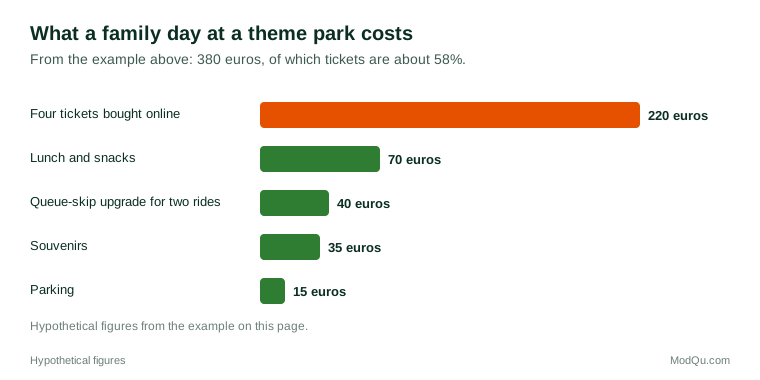
A family of four visits a theme park. Tickets bought online cost 4 × 55 euros, which is 220 euros. Parking is 15 euros, lunch and snacks 70 euros, a queue-skip upgrade for two rides 40 euros, and souvenirs 35 euros. The day costs 380 euros, so the tickets are about 58% of the total.
Figure 1 shows the cost of the day in that example. Some families bring their own food where allowed, set a fixed amount for souvenirs, or choose attractions with free parking to keep costs down.
Queues and crowd management
Long queues are one of the most common complaints at popular attractions. Attractions try to manage them in several ways:
- Timed entry tickets, which spread visitors through the day;
- Virtual queues through an app, which hold a place in line while visitors do other things;
- Paid queue-skip passes, which let visitors use a shorter line for an extra fee;
- Single-rider lines, which fill empty seats on rides;
- Accessibility passes for visitors who cannot wait in a standard queue because of a disability.
Paid queue-skip passes are a frequent subject of debate. Some visitors see them as a fair option for people who want to pay to save time; others feel they make the standard experience worse and favour people with more money.
Example
A couple on holiday visit a busy theme park on a day with long queues. They decide not to buy the queue-skip pass, arrive when the gates open, ride the most popular attractions first and use single-rider lines in the afternoon. They manage all the rides they wanted, though they spend much of the day waiting.
Safety, accessibility and comfort
Visitors expect rides to be safe and well maintained. Ride safety is regulated in many countries through inspection rules and industry standards, though the details differ. Accidents are rare but widely reported when they happen, and they affect public trust.
Other things that shape a visit include:
- clean toilets and baby-changing facilities;
- shade, seating and water fountains, especially in hot weather;
- quiet spaces and sensory-friendly information for visitors with autism or sensory needs;
- step-free routes and accessible rides;
- clear information on height limits and health warnings before queuing.
Trends and debates
Trends in attractions include more online and app-based booking, dynamic pricing, immersive rides and exhibitions using screens and virtual reality, and attractions based on films and games. Debates include rising ticket prices, paid queue-skipping, the welfare of animals in zoos and aquariums, the effect of large numbers of visitors on historic sites, and the environmental impact of water and energy use.
Questions that businesses want answered here include which attractions people visited, how they booked, what they spent on the day and what would make them return.
Key terms
- Theme parkAn amusement park with rides, shows and areas built around themes.
- Annual passA ticket that allows unlimited visits for a year.
- Dynamic pricingPrices that change with expected demand, such as higher prices on busy days.
- Timed entryA ticket that gives a set time to arrive.
- Virtual queueHolding a place in a queue through an app instead of standing in line.
- Queue-skip passA paid upgrade that lets visitors use a shorter line.
- Single-rider lineA queue for people willing to ride alone to fill empty seats.
- ConcessionA reduced price for groups such as children, students or older adults.
Full glossary: amusement ride engineering terms on EditingTests.com.
Theme parks and attractions vocabulary test
How well do you know the language of this topic? Try 8 quick questions. Your score is shown straight away and is not saved.
What the theme parks and attractions survey asks
This survey is part of ModQu's Travel and Hospitality survey. The theme parks and attractions part takes about five minutes and covers:
- Which theme parks, zoos, museums or other attractions you visited in the last year.
- How you chose where to go, and who you went with.
- How you booked tickets: online in advance, at the gate, with a pass or a combination ticket.
- How much you spent on the day, including food, parking and extras.
- How you felt about queues, crowds and paid queue-skip options.
- What would make you visit again or choose a different attraction.
After that you can choose to continue with other short parts of the Travel and Hospitality survey, such as holiday and leisure travel or air travel, or stop.
Ready to take part?
Your answers help show what people really think and do. Results are only ever reported as totals; no one can see your individual answers.
Start the surveyQuestions about this survey
Who can take part?
Adults.
Do I have to give my name?
No. You may be asked for your age group, region and similar details so results can be broken down, but not your name. ModQu never asks for passwords, card numbers or account numbers.
How are the results used?
Answers are combined into totals and percentages and published in ModQu reports. Individual answers are never shown.
Is the vocabulary test part of the survey?
No. It is optional and separate, and your score is not stored.
When is the quietest time to visit a theme park?
Weekdays outside school holidays are usually quieter, and queues are often shortest just after opening and in the last hours before closing. Many attractions publish crowd or price calendars that show expected busy days.
Can I bring my own food?
It depends on the attraction. Some allow picnics or have picnic areas, while others allow only snacks and water. Check the attraction's own rules before the visit.