
Share your experience of family holidays
Tell us how many family trips you took last year, what mattered most and what your last trip cost. Your answers are combined with other people's and reported only as totals.
Start the family holidays surveyAbout 5 minutes. No account needed. You can stop at any time.
What this topic covers
A family holiday is a leisure trip taken by parents or carers with children. It may include grandparents, other relatives or friends. This topic covers:
- how often families travel and for how long;
- how they choose destinations and types of holiday;
- how they plan, book and pay;
- what they spend and how they budget;
- the child-friendly services they value;
- the stresses and problems of travelling with children.
Family holidays range from a weekend with relatives to a long trip abroad. Many families also take day trips and short breaks rather than one long holiday.
Kinds of family holiday
Common kinds of family holiday include:
- Beach holidays at resorts, campsites or rented apartments.
- Visiting relatives, often the most common kind of family trip, especially for families with relatives in another region or country.
- Camping and caravan holidays.
- City breaks with museums, parks and attractions.
- Theme park holidays.
- All-inclusive resorts, where meals, drinks and activities are included in one price.
- Activity holidays: skiing, hiking, cycling or water sports.
- Road trips in the family car or a rented campervan.
- Cruises, some designed for families.
What families look for
Families weigh many things when choosing a holiday. The most common are:
- Cost and whether the trip fits the budget;
- Timing: school holiday dates, which often mean higher prices;
- Travel time: shorter journeys with young children;
- Accommodation: space, separate bedrooms, a kitchen, cots and high chairs;
- Activities for different ages: something for toddlers, older children, teenagers and adults;
- Safety: pools with lifeguards, safe beaches and child-safe rooms;
- Food: children's menus and options for allergies or dietary needs;
- Health care nearby;
- Kids' clubs and babysitting, so adults can have some time to themselves.
Example
A family with a two-year-old and a nine-year-old choose between a city break and a beach resort. The nine-year-old wants to see a science museum; the parents worry the toddler will not cope with long days of sightseeing. They choose a beach apartment an hour from a city, with one day trip to the museum and the rest of the week at the beach.
Planning and booking
Families often plan earlier than other travellers, because school holidays are fixed and family-sized rooms sell out. Common habits include:
- booking months in advance to get suitable rooms and flights;
- comparing package holidays with booking flights and accommodation separately;
- reading reviews by other families;
- asking friends and family for recommendations;
- booking flexible or cancellable options in case a child is ill;
- paying in instalments or a deposit first.
Package holidays, which combine travel and accommodation, are popular with families in many countries because they are simple and, in some places, come with legal protections if the company fails.
Budgets and spending
Family holidays can be one of the largest items in a household's yearly spending. Prices during school holidays are often much higher than at other times, which some parents find frustrating. Rules on taking children out of school during term time differ between countries, and in some places parents can be fined.
Example (hypothetical figures)
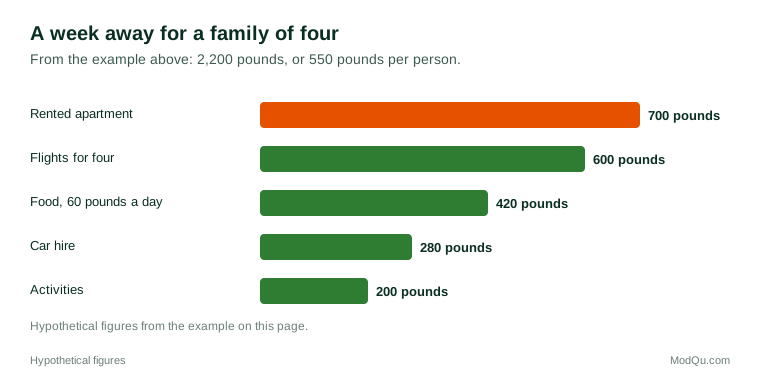
A family of four plans a week away. Flights cost 4 × 150 pounds, which is 600 pounds, and a rented apartment 700 pounds. Food is budgeted at 60 pounds a day for 7 days (420 pounds), activities 200 pounds and car hire 280 pounds. The total is 2,200 pounds, or 550 pounds per person.
Figure 1 shows how that budget is divided. Ways families keep costs down include travelling just before or after peak weeks, self-catering, staying with relatives, choosing closer destinations, camping, and using family tickets for attractions.
Child-friendly services
Families value services that make travel with children easier:
- Family seating on planes and trains, so children sit with their parents.
- Priority boarding and security lanes for families with young children.
- Baby equipment: cots, high chairs, bottle warmers and pushchair hire.
- Kids' clubs with supervised activities.
- Family rooms with separate sleeping areas.
- Children's menus and flexible mealtimes.
- Changing facilities and quiet spaces at airports and attractions.
- Accessible facilities for children with disabilities.
Example
Parents of a seven-year-old with autism plan their first holiday abroad. They contact the airport in advance to arrange a quieter route through security and a lanyard that signals to staff that their child may need extra help. They choose a small hotel with a quiet pool. They say the preparation made the journey much calmer than they feared.
Common problems
Families describe several common problems:
- high prices in school holidays;
- delays and long journeys with tired children;
- children becoming ill on holiday;
- not being seated together on flights without paying extra;
- accommodation that does not match the description, such as a missing cot;
- different interests between children of different ages, and between children and adults;
- parents feeling the holiday is hard work rather than a rest.
Trends and debates
Trends in family holidays include multi-generational trips with grandparents, more self-catering and short breaks, travel closer to home, and more families travelling with older children who bring phones and want Wi-Fi. Debates include the cost of travel during school holidays, whether parents should be allowed to take children out of school for trips, charges for seating families together, and how to make travel easier for children with disabilities.
Questions that businesses want answered here include how many family trips people take, what matters most when choosing, how much they spend and which child-friendly services they would pay for.
Key terms
- Package holidayA trip that combines travel and accommodation, sold together for one price.
- All-inclusiveA holiday where meals, drinks and many activities are included in the price.
- Self-cateringAccommodation with a kitchen, where guests cook their own meals.
- Kids' clubA supervised activity programme for children at a hotel or resort.
- Peak seasonThe busiest and usually most expensive time to travel, such as school holidays.
- Family roomA hotel room designed for parents and children, often with separate sleeping areas.
- Multi-generational tripA holiday that includes grandparents, parents and children.
- Travel cotA portable bed for a baby or toddler.
Full glossary: travel tourism terms on EditingTests.com.
Family holidays vocabulary test
How well do you know the language of this topic? Try 8 quick questions. Your score is shown straight away and is not saved.
What the family holidays survey asks
This survey is part of ModQu's Travel and Hospitality survey. The family holidays part takes about five minutes and covers:
- How many family holidays you took last year, and what kinds.
- What mattered most when choosing your last family trip.
- How you planned and booked it, and how far in advance.
- How much your last family trip cost, and how you budgeted.
- Which child-friendly services you used or would pay for.
- What problems you had, and what would make family travel easier.
After that you can choose to continue with other short parts of the Travel and Hospitality survey, such as holiday and leisure travel or air travel, or stop.
Ready to take part?
Your answers help show what people really think and do. Results are only ever reported as totals; no one can see your individual answers.
Start the surveyQuestions about this survey
Who can take part?
Parents and carers of children.
Do I have to give my name?
No. You may be asked for your age group, region and similar details so results can be broken down, but not your name. ModQu never asks for passwords, card numbers or account numbers.
How are the results used?
Answers are combined into totals and percentages and published in ModQu reports. Individual answers are never shown.
Is the vocabulary test part of the survey?
No. It is optional and separate, and your score is not stored.
How far in advance do families usually book?
Many families book several months ahead, especially for school holidays, because family rooms and seats together on flights sell out first. Last-minute deals exist but rarely suit fixed school dates.
Do children need their own passport?
In most countries, yes. Children usually need their own passport for international travel, and some countries ask for a consent letter when a child travels with only one parent.
What is the hardest part of travelling with young children?
Parents often mention long journeys, disrupted sleep and mealtimes, and packing everything a young child needs. Breaking up journeys and choosing accommodation with a kitchen help many families.