
Share your experience of travelling alone
Tell us whether you have travelled alone recently, why you did it and what worried you. Your answers are combined with other people's and reported only as totals.
Start the solo travel surveyAbout 5 minutes. No account needed. You can stop at any time.
What this topic covers
Solo travel means taking a trip without a companion. It may mean travelling entirely alone, joining a group tour as a single traveller, or travelling alone to meet people at the destination. This topic covers:
- who travels alone and why;
- the kinds of solo trips people take;
- how solo travellers plan, book and choose accommodation;
- the extra costs of travelling alone;
- safety concerns and how people manage them;
- loneliness, meeting people and enjoying time alone.
Who travels alone and why
Solo travellers come from every age group and background. They include students and young adults, people between jobs, people who are single, divorced or widowed, people whose partners do not want to travel, and people who simply prefer it. The reasons they give include:
- Freedom: choosing where to go, what to do and when, without compromise.
- No one to go with: friends and family are busy, cannot afford it or have different interests.
- Personal growth: building confidence and independence.
- Rest: time alone to recharge.
- Special interests: a hobby, course, event or pilgrimage that others do not share.
- Meeting new people: solo travellers often find it easier to talk to strangers.
- Life changes: a milestone birthday, retirement, a break-up or bereavement.
Example
A woman in her sixties, recently retired and widowed, wants to see a country she and her husband had always planned to visit. Her friends cannot take the time off, so she joins a small-group tour for solo travellers. She says she felt nervous on the first day but enjoyed the company of others while having her own room.
Kinds of solo trips
Solo trips take many forms:
- City breaks of a few days, often with museums, food and walking.
- Long journeys through several countries.
- Group tours for solo travellers, which offer company and organized plans.
- Retreats, such as yoga, wellness or religious retreats.
- Active trips: hiking, cycling, diving or surfing, often with a guide or group.
- Volunteering and courses, such as language schools.
- Business trips extended with leisure days, sometimes called bleisure.
- Visits to friends and family, travelling alone to get there.
Planning and choosing where to stay
Solo travellers often plan differently from groups. They may give more weight to:
- Location: central, well-lit areas close to transport.
- Reviews from other solo travellers, especially on safety and friendliness.
- Accommodation type: hostels and guesthouses for meeting people, hotels for privacy, and women-only floors or dormitories in some places.
- Arrival times: avoiding arriving late at night in an unfamiliar place.
- Flexibility: booking cancellable rooms and keeping plans open.
The extra costs of travelling alone
Travelling alone can cost more per person, because shared costs fall on one person. The best-known example is the single supplement: an extra charge for one person in a room or cabin priced for two. Taxis, rental cars and private tours also cost the same for one person as for two.
Example (hypothetical figures)
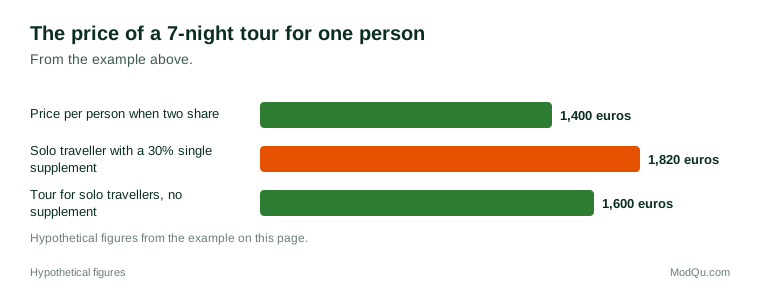
A 7-night tour costs 1,400 euros per person based on two people sharing a room. A solo traveller pays a single supplement of 30%, which is 420 euros, so the tour costs them 1,820 euros. A tour company that runs trips for solo travellers charges 1,600 euros with no supplement, saving them 220 euros.
Figure 1 compares the prices in that example. Ways solo travellers reduce costs include choosing tours with no single supplement, booking single rooms in guesthouses or hostels, sharing transport with other travellers, and travelling in the off-season when supplements are sometimes reduced or waived.
Safety concerns and how people manage them
Safety is the most common worry about travelling alone. Concerns vary with the traveller's gender, age, ethnicity, sexual orientation, disability and destination. Common worries include:
- theft, scams and being targeted as a lone tourist;
- harassment or assault, a particular worry for many women;
- getting ill or injured with no one to help;
- getting lost or stranded, especially at night;
- local laws and attitudes that affect some groups of travellers.
Common ways solo travellers manage these risks include:
- checking official government travel advice for the destination;
- sharing their plans and live location with someone at home;
- keeping copies of passports and documents, and carrying a spare bank card;
- arriving in daylight and using licensed taxis or ride apps;
- buying travel insurance that covers medical emergencies;
- trusting their instincts and leaving situations that feel wrong;
- joining walking tours or group activities in the evening.
Example
A young man travelling alone for the first time loses his wallet on a crowded bus. Because he had kept a spare card and cash in his backpack and copies of his passport on his phone, he can carry on. He says the experience made him more careful but did not put him off travelling alone.
Loneliness and meeting people
Many solo travellers enjoy time alone, but some feel lonely, especially at mealtimes or in the evenings. Ways people meet others include:
- staying in hostels or guesthouses with shared spaces;
- joining free walking tours, cooking classes and day trips;
- using apps and online groups for travellers;
- eating at the bar or at shared tables;
- volunteering or taking courses.
Others choose to embrace being alone, reading at dinner, keeping a journal or using the time to rest. Some travellers say eating alone in restaurants was the part that took most getting used to.
Trends and debates
Trends in solo travel include more tour operators offering trips with no single supplement, accommodation designed for solo travellers, and growing numbers of older solo travellers. Debates include whether single supplements are fair, how safe particular destinations are for women and minority groups, and how much travel advice should differ for solo travellers.
Questions that businesses want answered here include how many people travel alone, why they do it, what worries them, what they pay extra and what services would make solo travel easier.
Key terms
- Solo travelTaking a trip without a companion.
- Single supplementAn extra charge for one person using a room or cabin priced for two.
- Group tourAn organized trip with a guide, travelling with others.
- BleisureAdding leisure days to a business trip.
- Travel advisoryOfficial government advice about safety and risks in a country.
- Live location sharingLetting a trusted person see where your phone is in real time.
- Travel insuranceCover for costs such as medical emergencies, cancellations and lost bags.
- RetreatA trip focused on rest, wellness, reflection or a particular practice.
Full glossary: travel tourism terms on EditingTests.com.
Solo travel vocabulary test
How well do you know the language of this topic? Try 8 quick questions. Your score is shown straight away and is not saved.
What the solo travel survey asks
This survey is part of ModQu's Travel and Hospitality survey. The solo travel part takes about five minutes and covers:
- Whether you have travelled alone in the last two years, and what kind of trip it was.
- Why you travelled alone.
- Where you stayed, and how you chose it.
- Whether you paid a single supplement or other extra costs.
- What worries you about solo travel, and what you do to stay safe.
- Whether you felt lonely, and how you met other people.
After that you can choose to continue with other short parts of the Travel and Hospitality survey, such as holiday and leisure travel or air travel, or stop.
Ready to take part?
Your answers help show what people really think and do. Results are only ever reported as totals; no one can see your individual answers.
Start the surveyQuestions about this survey
Who can take part?
Adults who travel.
Do I have to give my name?
No. You may be asked for your age group, region and similar details so results can be broken down, but not your name. ModQu never asks for passwords, card numbers or account numbers.
How are the results used?
Answers are combined into totals and percentages and published in ModQu reports. Individual answers are never shown.
Is the vocabulary test part of the survey?
No. It is optional and separate, and your score is not stored.
Is solo travel more expensive?
Often a little, because rooms, taxis and private tours cost the same for one person as for two. Hostels, single rooms in guesthouses and tours with no single supplement can reduce the difference.
How do solo travellers stay in touch with home?
Many share their itinerary and live location with a trusted person, agree regular check-in times and carry a local SIM card or eSIM so they have mobile data.