
Share your views on insurers
Tell us how much you trust insurance companies and what has shaped your view. Your answers are combined with other people's and reported only as totals.
Start the trust in insurance companies surveyAbout 5 minutes. No account needed. You can stop at any time.
Why trust matters in insurance
When people buy most products, they get what they paid for straight away. With insurance, they pay now for a promise that may only be tested years later, at a stressful time. If people do not believe insurers will pay fairly, they may not buy cover they need, may buy only the cheapest option, or may be tempted to exaggerate claims.
Trust affects whether people buy insurance at all, how much they buy, whether they stay with an insurer, and whether they recommend it.
What drives distrust
People who distrust insurers commonly mention:
- Refused or reduced claims, especially when they did not understand the exclusion that applied.
- Small print: long policy documents with complex terms.
- Price rises at renewal and lower prices for new customers.
- Slow claims: delays, repeated requests for documents, and changing contacts.
- Stories in the media and from friends about bad experiences.
- Feeling treated as a suspect during a claim.
- Sales pressure for add-ons and extended warranties.
The figure below shows the moments in the customer journey where trust is often won or lost.
Example
A homeowner's kitchen floods from a burst pipe. The claim takes four months, with three different handlers, and the insurer offers less than the repair quotes. They complain and the offer is increased, but they say they will switch insurer at renewal and tell friends about the experience.
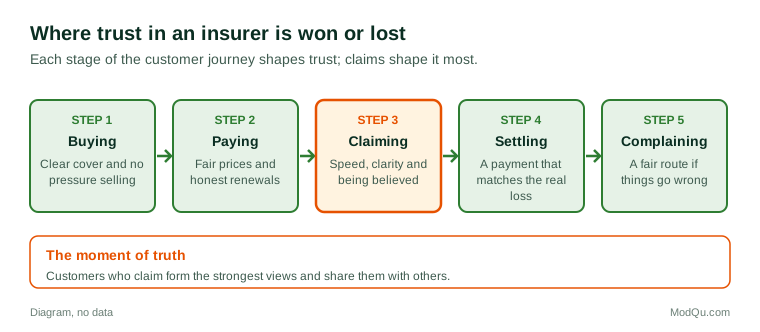
Claims: the moment of truth
Most customers never claim in a given year, so their view of an insurer is shaped by price and marketing. People who do claim form strong views. A fair, quick and clear claims process can turn a customer into a supporter; a poor one can lose them and others they talk to.
Things customers say make claims feel fair include:
- one contact person who keeps them updated;
- clear explanations of what is and is not covered, and why;
- quick payments for urgent needs, such as temporary accommodation;
- being believed, with checks that feel proportionate;
- a settlement that reflects the real cost of repair or replacement.
Trust differs by product and country
Trust is not the same across all insurance. People tend to have more confidence in products they understand and use often, and less in those where claims are rare and complex. Trust also differs by country, shaped by history, regulation, how insurance is sold and whether there have been scandals.
Example
In one household, both partners trust their car insurer, having had two quick claims after minor accidents. Neither trusts life insurance, having heard a relative's claim was refused over an undisclosed condition. Their trust depends on the product, not on insurance as a whole.
Fraud and the insurer's side
Insurers point out that some claims are fraudulent or exaggerated, and that the cost of fraud raises premiums for everyone. Checks on claims are partly a response to this. The challenge is to detect fraud without making honest customers feel accused. Clear rules, explaining why information is needed, and fast handling of simple claims are ways insurers try to balance this.
What builds trust
Research and industry experience point to several things that tend to build trust:
- simple, plain-language policies and summaries;
- transparent pricing, including showing last year's price at renewal;
- high claims acceptance rates and published claims data;
- quick, respectful claims handling;
- independent reviews and ratings;
- strong rules and a working complaints system;
- mutual or cooperative ownership, which some customers see as more trustworthy.
Complaints and ombudsmen
When customers disagree with an insurer, they usually complain to the insurer first. If that does not resolve it, many countries have a free independent ombudsman or complaints body that can review the case and, in some places, order the insurer to pay. Published complaint data can show which insurers attract the most complaints relative to their size.
Example (hypothetical figures)
A traveller's claim for 1,200 of medical costs is refused because the insurer says the condition existed before the trip. The traveller provides records showing it began during the trip. The insurer still refuses, so they take the case to the ombudsman, which rules in their favour, and the insurer pays the full 1,200 plus a small amount for the trouble caused.
Technology and trust
New technology cuts both ways. Fast app-based claims and instant payouts can build confidence. But automated decisions, use of personal data to set prices, and chatbots that cannot handle complex cases can reduce it. Customers often say they want speed for simple things and a human for difficult ones.
Trust and switching
Low trust does not always lead people to switch. Many stay with an insurer they do not particularly trust because they assume others are no better. When people do switch, price is often the stated reason, but a poor claims experience is a common trigger. Insurers with high trust scores tend to keep customers longer and spend less on winning new ones.
What people disagree about
Some argue that distrust of insurers is mainly due to misunderstanding of what policies cover, and that better education would fix it. Others say the industry's practices, such as complex terms and loyalty pricing, are the real cause. There is also debate about whether stronger regulation or more competition does more to improve trust.
Questions that businesses want answered include how much people trust insurers in general and their own insurer, what has shaped their view, how claims experiences change trust, which features build confidence, and whether they have complained.
Key terms
- Claims acceptance rateThe share of claims an insurer pays.
- Small printDetailed terms and conditions in a policy.
- OmbudsmanAn independent body that handles complaints customers cannot settle with a company.
- Mutual insurerAn insurer owned by its policyholders rather than shareholders.
- Fraudulent claimA claim based on a loss that did not happen or was deliberately exaggerated.
- Policy summaryA short document listing the main features, limits and exclusions.
- Customer journeyThe stages a customer goes through, from buying to claiming.
- Net promoter scoreA measure of how likely customers are to recommend a company.
Full glossary: insurance claims terms on EditingTests.com.
Trust in insurance companies vocabulary test
How well do you know the language of this topic? Try 8 quick questions. Your score is shown straight away and is not saved.
What the trust in insurance companies survey asks
This survey is part of ModQu's Insurance survey. The trust in insurance companies part takes about five minutes and covers:
- How much you trust insurance companies in general, and your own insurer.
- What has most shaped your view: claims, prices, news or friends.
- Whether you have had a claim refused or reduced, and why.
- Whether you have complained, and how it was resolved.
- Which changes would make you trust insurers more.
- Whether you would choose an insurer for trust over a lower price.
After that you can choose to continue with other short parts of the Insurance survey, such as car insurance or home and tenant insurance, or stop.
Ready to take part?
Your answers help show what people really think and do. Results are only ever reported as totals; no one can see your individual answers.
Start the surveyQuestions about this survey
Who can take part?
Adults.
Do I have to give my name?
No. You may be asked for your age group, region and similar details so results can be broken down, but not your name. ModQu never asks for passwords, card numbers or account numbers.
How are the results used?
Answers are combined into totals and percentages and published in ModQu reports. Individual answers are never shown.
Is the vocabulary test part of the survey?
No. It is optional and separate, and your score is not stored.
What can I do if I disagree with a claim decision?
Complain to the insurer first. If that does not resolve it, many countries have a free ombudsman or complaints body.
Why do insurers ask so many questions during a claim?
To confirm what happened and that it is covered, and to detect fraud. They should explain why information is needed.