
Share your experience of travel loyalty programs
Tell us which programs you belong to, whether you have used points for a trip and whether loyalty affects where you book. Your answers are combined with other people's and reported only as totals.
Start the travel loyalty and frequent flyer programs surveyAbout 5 minutes. No account needed. You can stop at any time.
What this topic covers
A travel loyalty program is a membership scheme that rewards customers for using the same travel company again. The best known are airline frequent flyer programs, which give miles or points for flights, but there are also programs run by hotel groups, car rental companies, rail operators, cruise lines and online travel agencies. Credit cards linked to travel programs are an important part of this topic too.
This topic covers:
- which programs people belong to and how active they are;
- how they earn points, from travel and from everyday spending;
- how they use points and whether they find it easy;
- the value they place on elite status and its perks;
- whether loyalty affects where and how they book.
How earning works
Members earn points or miles in several ways:
- Flights and stays: usually based on the price paid or the distance flown, and on the fare class.
- Partner airlines and hotels: many airlines belong to alliances, so flights with partner airlines can earn points in one program.
- Co-branded credit cards: cards that earn travel points on everyday spending, often with sign-up bonuses.
- Shopping and dining partners: earning points by shopping through a portal or at partner shops.
- Car rentals, rail and other travel services.
- Transfers from general credit card reward schemes into airline or hotel programs.
For many members, especially those who do not travel often, more points come from everyday credit card spending than from travel itself.
How people use points
Points can be spent, or redeemed, in several ways:
- Award flights: free or reduced-price flights, though taxes and fees are often still charged.
- Free hotel nights.
- Upgrades to a higher cabin or a better room.
- Shopping, gift cards and experiences, usually at lower value per point.
- Paying part of a fare with points and the rest with money.
- Donating points to charity.
People often say the hardest part is finding award seats on the dates and routes they want, especially during school holidays. Points can also expire if an account is inactive for a period, and programs can change how many points are needed, a change often called devaluation.
Example
A couple collect airline points for three years, mostly through a credit card. When they try to book a holiday flight in the school summer break, there are no award seats on their dates. They book flights for the following spring instead, when award seats are available, and pay only the taxes and fees.
What points are worth
Points do not have a fixed cash value. The same number of points can be worth very different amounts depending on how they are used. Travellers often estimate the value of a point by comparing the cash price of a trip with the points and fees needed.
Example (hypothetical figures)
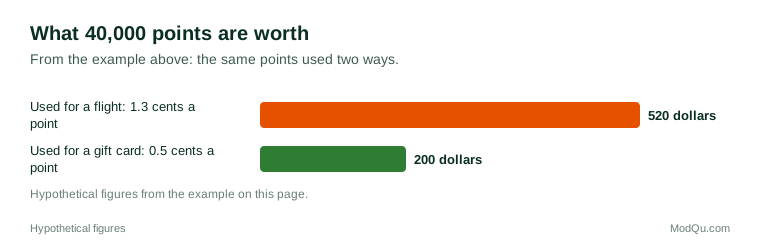
A flight costs 600 dollars in cash, or 40,000 points plus 80 dollars in taxes and fees. The points save 520 dollars, so each point is worth 1.3 cents (520 ÷ 40,000). The same 40,000 points could buy a 200-dollar gift card, which is worth only 0.5 cents per point.
Figure 1 compares the two uses of points in the example.
Elite status and tiers
Most programs have status tiers, such as silver, gold and platinum, earned by travelling a certain amount in a year. Status brings perks that can include:
- priority check-in, security and boarding;
- extra baggage allowance;
- airport lounge access;
- seat selection and upgrades;
- room upgrades, late check-out and free breakfast at hotels;
- dedicated customer service lines;
- bonus points on each trip.
Business travellers are the main holders of top status, but some leisure travellers aim for it too. Some people book flights or stays with their program's airline or hotel group even when cheaper options exist, to keep their status. This behaviour is a major reason companies run loyalty programs.
Example
A consultant who flies every week chooses the same airline whenever possible to keep top-tier status. When their job changes and they fly only a few times a year, they lose the status within a year. They now book whichever airline is cheapest and say they do not miss the lounges as much as they expected.
Does loyalty change where people book?
Loyalty programs aim to make customers choose the same company again. Whether they succeed depends on the traveller:
- Frequent business travellers often say status strongly affects their choice.
- Occasional leisure travellers usually say price, timing and convenience matter more.
- Points collectors may plan trips around maximizing the value of points.
- People in places served by only one or two airlines may use one program because there is little choice.
Many members belong to several programs but are active in only one or two. Survey research often explores how far loyalty overrides price and what perks matter most.
Common complaints
Members' complaints about loyalty programs include:
- difficulty finding award seats or rooms;
- high taxes and fees on award flights;
- frequent changes to rules, point values and status requirements;
- points expiring;
- complex rules that are hard to understand;
- poor value for non-travel redemptions;
- feeling that occasional travellers are not rewarded.
Trends and debates
Trends in travel loyalty include programs earning more from credit card partnerships than from travel, more programs basing points on spending rather than distance, and more personalized offers. Debates include whether programs are fair to occasional travellers, whether they encourage unnecessary flights, and how regulators in some countries view their transparency and consumer protection.
Questions that businesses want answered here include which programs people belong to, how they earn and use points, the value they place on status and whether loyalty overrides price when they book.
Key terms
- Frequent flyer programAn airline loyalty scheme that rewards travel with miles or points.
- Points or milesThe units members earn and spend in a loyalty program.
- RedemptionExchanging points for a flight, stay, upgrade or other reward.
- Award seatA seat on a flight that can be booked with points.
- Elite statusA higher membership tier with extra perks, earned by frequent travel.
- Airline allianceA group of airlines that share benefits and let members earn and use points across partners.
- Co-branded credit cardA credit card linked to a travel company's loyalty program.
- DevaluationA change that makes points worth less, such as raising the points needed for rewards.
Full glossary: airline loyalty programs terms on EditingTests.com.
Travel loyalty and frequent flyer programs vocabulary test
How well do you know the language of this topic? Try 8 quick questions. Your score is shown straight away and is not saved.
What the travel loyalty and frequent flyer programs survey asks
This survey is part of ModQu's Travel and Hospitality survey. The travel loyalty and frequent flyer programs part takes about five minutes and covers:
- Which airline, hotel or other travel loyalty programs you belong to.
- How you earn points: travel, credit cards or other partners.
- Whether you have used points for a trip, and how easy it was.
- Whether you have elite status, and which perks you value most.
- Whether loyalty affects where you book, compared with price and convenience.
- What frustrates you most about travel loyalty programs.
After that you can choose to continue with other short parts of the Travel and Hospitality survey, such as holiday and leisure travel or air travel, or stop.
Ready to take part?
Your answers help show what people really think and do. Results are only ever reported as totals; no one can see your individual answers.
Start the surveyQuestions about this survey
Who can take part?
Adults who travel.
Do I have to give my name?
No. You may be asked for your age group, region and similar details so results can be broken down, but not your name. ModQu never asks for passwords, card numbers or account numbers.
How are the results used?
Answers are combined into totals and percentages and published in ModQu reports. Individual answers are never shown.
Is the vocabulary test part of the survey?
No. It is optional and separate, and your score is not stored.
Is it worth joining a loyalty program if I rarely travel?
Joining is usually free, so many occasional travellers join to collect points on the trips they do take. Check whether points expire after a period without activity.
Why do award flights still cost money?
Points usually cover the fare, but taxes, airport charges and sometimes carrier fees must still be paid in cash. These vary a great deal between airlines and routes.