
Share your experience of taxis
Tell us how often you use a taxi, whether you prefer taxis or ride-hailing apps and how you usually pay. Your answers are combined with other people's and reported only as totals.
Start the taxis surveyAbout 5 minutes. No account needed. You can stop at any time.
What this topic covers
A taxi is a vehicle with a driver that carries passengers for a fare. This topic covers:
- the different kinds of taxi services around the world;
- how often people use taxis and for what;
- how people choose between taxis, ride-hailing apps and other transport;
- how fares are set, and how people pay;
- safety, trust and service quality;
- accessibility for passengers with disabilities.
Kinds of taxi around the world
Taxi services take many forms:
- Street-hail taxis: licensed cabs that can be flagged down on the street or found at taxi ranks.
- Private hire or minicabs: cars that must be booked in advance by phone or app, rather than hailed. Many countries separate these legally from street-hail taxis.
- Ride-hailing services: app-based platforms that connect passengers with drivers, often using their own cars.
- Shared taxis and minibus taxis: vehicles that follow routes and pick up several passengers, important in many African, Middle Eastern, Latin American and Asian cities.
- Motorcycle taxis, common in parts of Asia, Africa and Latin America.
- Auto-rickshaws and tuk-tuks: three-wheelers widely used in South and Southeast Asia and elsewhere.
- Accessible taxis: vehicles adapted for wheelchair users.
When and why people use taxis
People use taxis for many reasons:
- Getting home late at night when public transport has stopped;
- Airport and station trips with luggage;
- Medical appointments and hospital visits;
- After drinking alcohol, to avoid driving;
- When public transport is slow or unavailable;
- Bad weather;
- Business travel;
- For people who do not drive, including older adults and people with disabilities.
How often people use taxis varies widely. In some cities taxis or shared taxis are part of daily commuting; in others most people use them only a few times a year.
Example
An older woman who stopped driving after an eye condition uses a local taxi firm twice a week for shopping and appointments. She prefers phoning the same company because the drivers know her and help with her shopping bags, even though an app might sometimes be cheaper.
Taxis compared with ride-hailing apps
Ride-hailing apps changed the market in many cities. Passengers compare the two on:
- Price: apps are sometimes cheaper, but surge pricing can make them more expensive at busy times;
- Booking: apps show the car's location, estimated arrival and price before booking;
- Payment: apps take payment automatically; taxis increasingly accept cards, but some still prefer cash;
- Availability: taxis at ranks are immediately available at airports and stations; apps depend on drivers nearby;
- Driver knowledge: licensed taxi drivers in some cities must pass detailed tests of local roads;
- Safety features: apps record the trip and driver details; licensed taxis have regulated drivers and vehicles;
- Accessibility: availability of wheelchair-accessible vehicles varies on both.
Many people use both depending on the situation. In some cities, traditional taxis are now also booked through apps.
How fares work
Fares are set in different ways:
- Metered fares regulated by local authorities, often with a starting charge, a rate per kilometre and a waiting time charge;
- Fixed fares for certain routes, such as airports;
- Negotiated fares, agreed before the journey, common for auto-rickshaws and in places without meters;
- App prices, calculated in advance, often with surge or dynamic pricing at busy times;
- Extra charges for luggage, night travel, holidays, tolls or extra passengers.
Example (hypothetical figures)
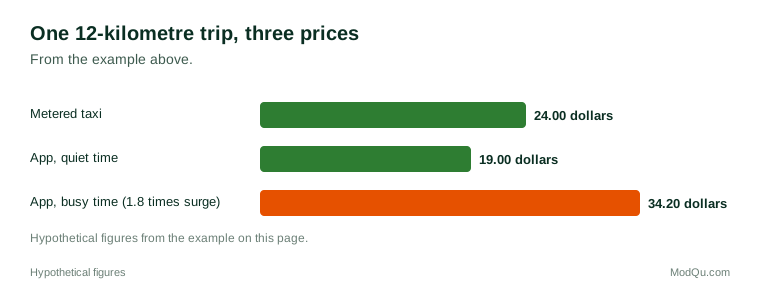
A 12-kilometre trip in a metered taxi costs a starting charge of 3.00 dollars, 1.60 dollars per kilometre (19.20 dollars) and 1.80 dollars for 6 minutes of waiting in traffic, a total of 24.00 dollars. The same trip on an app is quoted at 19.00 dollars at a quiet time, but 34.20 dollars at a busy time with a 1.8 times surge multiplier.
Figure 1 compares the fares in that example.
Payment and tipping
Payment methods differ between countries and between taxis and apps: cash, card, contactless, mobile wallets, in-app payment and account billing for businesses. Some passengers say they have been told the card machine was not working, which is a common complaint.
Tipping customs also vary. In some countries rounding up or tipping a percentage is expected; in others tipping taxi drivers is unusual.
Safety, service and trust
Passengers' concerns include:
- Personal safety, especially for women travelling alone at night;
- Unlicensed drivers posing as taxis, particularly at airports;
- Overcharging and long routes;
- Driving standards and vehicle condition;
- Refusals to take short trips, card payments or passengers with guide dogs or wheelchairs.
Licensing rules, driver checks, visible identification, fixed airport fares and app trip-sharing features are common ways of building trust. Regulation varies widely between and within countries.
Example
A traveller arriving late at an airport is approached by a man offering a "taxi". Remembering advice from their government's travel page, they ignore him and go to the official taxi rank, where a sign shows fixed fares to the city centre.
Trends and debates
Trends include app booking for traditional taxis, electric taxi fleets, and trials of driverless taxis in a few cities. Debates include how to regulate ride-hailing compared with taxis, drivers' pay and employment status, the number of taxi licences, surge pricing, accessible vehicle requirements, and the effect of ride-hailing on traffic and public transport.
Questions that businesses want answered here include how often people use taxis, why, how they compare taxis with apps, how they pay, and what affects their trust and satisfaction.
Key terms
- Taxi rankA place where taxis wait for passengers.
- Street hailFlagging down a taxi on the street.
- Private hireA car with a driver that must be booked in advance rather than hailed.
- Ride-hailingBooking a car and driver through an app.
- MeterA device that calculates the fare from distance and time.
- Surge pricingHigher app prices during periods of high demand.
- Shared taxiA vehicle that carries several unrelated passengers, often along a route.
- Accessible taxiA taxi adapted for passengers who use wheelchairs.
Full glossary: ride sharing platforms terms on EditingTests.com.
Taxis vocabulary test
How well do you know the language of this topic? Try 8 quick questions. Your score is shown straight away and is not saved.
What the taxis survey asks
This survey is part of ModQu's Cars and Getting Around survey. The taxis part takes about five minutes and covers:
- How often you use a taxi, and for what kinds of trips.
- Whether you prefer taxis or ride-hailing apps, and why.
- How you usually book and pay.
- What you think of fares, including meters, fixed fares and surge pricing.
- Whether you have had a safety concern or problem with a taxi.
- Whether you tip, and how much.
After that you can choose to continue with other short parts of the Cars and Getting Around survey, such as buying a car or electric vehicles, or stop.
Ready to take part?
Your answers help show what people really think and do. Results are only ever reported as totals; no one can see your individual answers.
Start the surveyQuestions about this survey
Who can take part?
Adults.
Do I have to give my name?
No. You may be asked for your age group, region and similar details so results can be broken down, but not your name. ModQu never asks for passwords, card numbers or account numbers.
How are the results used?
Answers are combined into totals and percentages and published in ModQu reports. Individual answers are never shown.
Is the vocabulary test part of the survey?
No. It is optional and separate, and your score is not stored.
Are taxis or ride-hailing apps cheaper?
It depends on the city, the time and the trip. Apps are often cheaper at quiet times but can cost more during surge pricing, while taxi fares are usually regulated and more predictable.
Can taxis refuse passengers with guide dogs?
In many countries, licensed taxis and private hire drivers are legally required to carry assistance dogs unless they have a medical exemption, though rules and enforcement vary.
Why do airport taxis often have fixed fares?
Many airports and cities set fixed fares to city centres to make prices predictable for visitors and reduce overcharging. Extra charges for luggage or night travel may still apply.
Should I tip a taxi driver?
Customs differ by country. In some places rounding up the fare or adding a percentage is expected, while in others tipping is unusual. Local guidance can help visitors decide.