
Share your experience of sports betting
Tell us whether you have bet on sport in the last year, how you place bets and how much you bet. For adults aged 18 and over. Your answers are combined with other people's and reported only as totals.
Start the sports betting surveyAbout 5 minutes. No account needed. You can stop at any time.
What this topic covers
Sports betting means staking money on the outcome of a sporting event or on something that happens during it. This topic is for adults and covers:
- how betting works, including odds and common types of bet;
- where and how people bet: shops, apps, websites and informal bets with friends;
- how much people bet and how they keep track;
- how laws and regulation differ between countries;
- advertising and sponsorship by betting companies;
- gambling harm and the tools available to limit it.
This page describes betting and its risks. It does not give betting advice or encourage gambling.
How betting works
A bookmaker (or betting operator) offers odds on outcomes. The odds show how much a winning bet pays and reflect the bookmaker's view of how likely each outcome is, plus a margin for the bookmaker. Odds are shown in different formats around the world:
- Decimal odds (for example 2.50), common in Europe, Australia and many other places, show the total return per unit staked, including the stake.
- Fractional odds (for example 3/2), traditional in the United Kingdom and Ireland, show the profit relative to the stake.
- American odds (for example +150 or −200), used in the United States, show how much you win on a stake of 100 or how much you must stake to win 100.
Because the bookmaker builds in a margin, the odds on all outcomes of an event add up to slightly more than a 100% chance. Over many bets, this margin means that bettors as a group lose money, which is how bookmakers make a profit.
Example (hypothetical figures)
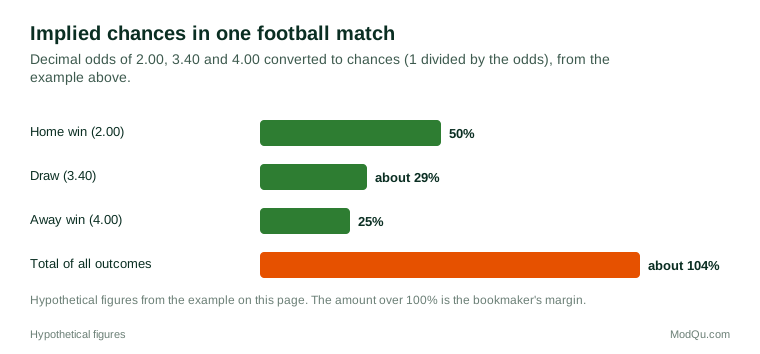
A football match has three outcomes. A bookmaker offers decimal odds of 2.00 on the home team, 3.40 on a draw and 4.00 on the away team. Converting each to an implied chance (1 divided by the odds) gives 50%, about 29% and 25%, which add up to about 104%. The extra 4% is the bookmaker's built-in margin.
Types of bet
Common types of bet include:
- Match result: who will win, or whether it will be a draw.
- Handicap or point spread: one team is given a head start, so both sides have similar odds.
- Over/under: whether the total goals or points will be above or below a number.
- Accumulators or parlays: several bets combined into one, which pays much more if all win but loses if any one loses.
- Player bets (sometimes called props): for example who scores first or how many points a player scores.
- In-play or live betting: bets placed while the game is in progress, with odds changing every moment.
- Futures: bets on events far ahead, such as who will win a league.
Many apps now let users build their own combined bets within a single match. In-play betting and fast, repeated bets are among the features that concern researchers most, because they can encourage people to bet more and more often.
How people bet
People bet in several ways:
- through apps and websites of licensed betting operators;
- in betting shops and at race tracks;
- through lotteries and pools run by state or national bodies in some countries;
- informally, with friends or colleagues, such as office sweepstakes;
- through betting exchanges, where bettors bet against each other rather than against a bookmaker;
- through unlicensed or offshore sites, where local law does not allow betting or offers fewer options.
Example
A man in his twenties opens a betting app after a sign-up offer of free bets. At first he places small bets on his team's matches. Within a year he has accounts with three operators, bets on leagues he has never watched, and places live bets during matches. When he adds up his deposits and withdrawals, he finds he has lost much more than he thought.
Laws and regulation
Rules vary widely:
- Some countries allow licensed operators and regulate them closely, as in the United Kingdom and Australia.
- Some allow betting only through a state or national monopoly.
- In the United States, sports betting has been legalized state by state since a 2018 Supreme Court decision, so rules differ between states.
- Some countries ban most or all gambling, including for religious reasons.
Regulators may set minimum ages (often 18, sometimes 21), require identity and age checks, limit advertising, require tools such as deposit limits and self-exclusion, and fund support services.
Advertising and sponsorship
Betting operators are major sponsors of sports teams, leagues and broadcasts in many countries, and advertise heavily on television and social media. Some countries have restricted betting adverts during live sport, banned betting sponsors on shirts or limited sign-up offers. Supporters of these limits say constant advertising normalizes betting, especially for young people; others say advertising is legitimate for a legal product.
Gambling harm
For most people who bet, it is an occasional, low-stakes activity. For some, it leads to serious harm: debt, relationship breakdown, lost jobs, mental health problems and crime. Signs that public health bodies describe include betting more than one can afford, chasing losses, borrowing to bet, hiding betting from family and feeling restless when not betting.
Tools and support available in many countries include:
- deposit, loss and time limits set within an account;
- self-exclusion, where a person asks to be blocked from betting sites or shops for a set period;
- blocking software and bank card gambling blocks;
- helplines, counselling and support groups.
Example
A woman notices her partner checking scores late at night and finds several betting apps on his phone. Together they look at his statements and find monthly losses he had not mentioned. He sets up a gambling block with his bank and registers for a national self-exclusion scheme, and they contact a free support service.
What people disagree about
People disagree about how much betting should be advertised, whether in-play betting should be limited, whether operators should check whether customers can afford their losses, whether betting sponsorship should be allowed in sport, and how much responsibility lies with individuals versus operators. There is also debate about the risks of match-fixing linked to betting.
Questions that regulators, sports bodies, broadcasters, researchers and operators want answered include how many people bet, how often and how, how much they spend, how they view betting advertising and how many experience problems.
Key terms
- OddsNumbers showing how much a winning bet pays and the implied chance of an outcome.
- BookmakerA company or person who accepts bets and sets odds.
- MarginThe amount built into odds that gives the bookmaker a profit over many bets.
- AccumulatorSeveral bets combined into one; all must win for it to pay.
- In-play bettingBets placed while a match is in progress.
- Self-exclusionA person's request to be blocked from betting for a set period.
- Deposit limitA cap a customer sets on how much they can put into a betting account.
- Chasing lossesBetting more to try to win back money already lost.
Full glossary: gaming regulation terms on EditingTests.com.
Sports betting vocabulary test
How well do you know the language of this topic? Try 8 quick questions. Your score is shown straight away and is not saved.
What the sports betting survey asks
This survey is part of ModQu's Sports survey. The sports betting part takes about five minutes and covers:
- Whether you have bet on sport in the last year, and on which sports.
- How you place bets: apps, websites, shops, exchanges, lotteries or with friends.
- Roughly how much you bet in a typical month, and whether you keep track.
- Which types of bet you use, such as match results, accumulators or in-play bets.
- What you think of betting advertising and sponsorship in sport.
- Whether betting has ever caused problems for you or someone you know.
After that you can choose to continue with other short parts of the Sports survey, such as football (soccer) fans or playing team sports, or stop.
Ready to take part?
Your answers help show what people really think and do. Results are only ever reported as totals; no one can see your individual answers.
Start the surveyQuestions about this survey
Who can take part?
Adults aged 18 and over.
Do I have to give my name?
No. You may be asked for your age group, region and similar details so results can be broken down, but not your name. ModQu never asks for passwords, card numbers or account numbers.
How are the results used?
Answers are combined into totals and percentages and published in ModQu reports. Individual answers are never shown.
Is the vocabulary test part of the survey?
No. It is optional and separate, and your score is not stored.
Is this survey only for people who bet?
No. Adults who do not bet can answer too, especially the questions about advertising and sponsorship.
Where can I get help with gambling?
Many countries have free, confidential gambling helplines and self-exclusion schemes. A local health service or regulator can point you to them.