
Share your views on self-driving cars
Tell us whether you would ride in a car with no driver, what worries you and when you think such cars will be common. Your answers are combined with other people's and reported only as totals.
Start the self-driving cars surveyAbout 5 minutes. No account needed. You can stop at any time.
What "self-driving" means
"Self-driving car" is used loosely for several different things, which is one reason the topic causes confusion. It can mean:
- a car with driver-assistance features, such as adaptive cruise control and lane-keeping, which help a human driver who stays in charge;
- a car that can drive itself in some conditions, such as on a highway in slow traffic, but needs a human ready to take over;
- a vehicle that can drive itself with no human driver at all, within a defined area, such as a driverless taxi.
The terms autonomous vehicle (AV) and automated driving system are generally used for the last two. Driver-assistance features are usually called advanced driver-assistance systems (ADAS).
The levels of automation
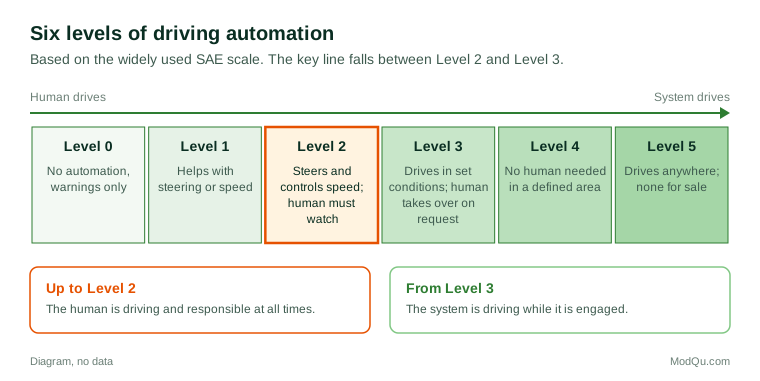
A widely used scale from SAE International, an engineering standards body, describes six levels of driving automation:
- Level 0: no automation. The human does all the driving, though the car may give warnings.
- Level 1: driver assistance with one task, such as steering or speed. Adaptive cruise control is an example.
- Level 2: partial automation. The car can steer and control speed at the same time, but the human must watch the road at all times and be ready to take over. Many systems sold today are Level 2.
- Level 3: conditional automation. The car drives itself in set conditions, and the human may look away, but must take over when the car asks.
- Level 4: high automation. The vehicle drives itself with no human needed, but only within a defined area or set of conditions, called its operational design domain.
- Level 5: full automation, able to drive anywhere a human could, in any conditions. No Level 5 vehicles exist for sale.
The key line is between Level 2 and Level 3. Up to Level 2, the human is driving and responsible. From Level 3, the system is driving while it is engaged.
Example
A driver uses a Level 2 highway system on a long trip. It keeps the car centred and adjusts speed to the car ahead. After an hour they find themselves checking their phone, assuming the car will handle anything. The system gives a warning and then disengages at a construction zone where the lane lines disappear. They take over in time, and afterwards say they had not understood that they were still the driver.
Where driverless vehicles operate today
Driverless vehicles are being tested and used in limited ways:
- Robotaxis: driverless ride-hailing services operate in a number of cities, mainly in parts of the United States and China, within mapped areas and often with remote support staff.
- Shuttles: low-speed shuttles on fixed routes have been tested on campuses, in business parks and in some Canadian cities.
- Trucking: automated trucks are being tested, mostly on highways, often with a safety driver on board.
- Delivery robots: small sidewalk robots deliver food and parcels in some areas.
- Mining, ports and farms: automated vehicles are used on private sites where conditions are controlled.
In Canada, Transport Canada sets vehicle safety standards and has published guidance for testing automated vehicles, while provinces regulate drivers and road use. Ontario, for example, runs a pilot program that allows automated vehicle testing on its roads under conditions. Rules are still being developed across Canada and elsewhere.
Trust and what worries people
Public opinion on self-driving cars is mixed and often cautious. When people are asked whether they would ride in a car with no driver, answers depend on how the question is put, what experience people have had, and recent news. The concerns people raise most often are:
- Safety: whether the vehicle can handle unexpected situations, such as a child running into the road, a police officer directing traffic, or debris on the highway.
- Weather: snow, ice, heavy rain and fog that cover lane markings and confuse sensors, a major issue in Canada.
- Hacking and cybersecurity: fear that someone could take control of a vehicle remotely.
- Loss of control: discomfort with not being able to steer or stop.
- Privacy: the large amounts of data the cars collect about where people go.
- Who is responsible when something goes wrong.
People also differ in what level of safety they would accept. Some say a self-driving car should be at least as safe as an average human driver. Others want it to be far safer, because they find a crash caused by a machine harder to accept than one caused by a person.
Example
An older adult who no longer drives at night says a driverless car would let them visit family in the evening. Their adult child, who drives for a living, says they would not get in one until they have seen it handle a snowstorm. When both take a demonstration ride on a sunny day, the parent is reassured and the child is not.
Liability, insurance and law
If a driverless vehicle causes a crash, who is responsible? With human drivers, liability usually rests with the driver and their insurer. With automated vehicles, it may shift toward the maker of the vehicle or the software, the operator of a robotaxi fleet, or the owner who failed to install an update.
Insurers, lawmakers and courts in many countries are working through these questions. Related issues include what data a vehicle must record before a crash, how traffic laws apply to a car with no driver, and how police issue a ticket to one.
Effects on jobs, cities and travel
If self-driving vehicles become common, they could change much more than the act of driving.
- Jobs: truck, taxi, delivery and bus drivers are among the many jobs that could be affected, while new jobs may appear in fleet operations, remote support and maintenance.
- Road safety: supporters argue that automated vehicles could reduce crashes caused by human error, such as distraction, impairment and fatigue. How large the benefit would be is still uncertain.
- Mobility: people who cannot drive, including some older adults and people with disabilities, could travel more independently.
- Traffic and land use: cheaper, easier car trips could increase driving and empty vehicles circling, or shared fleets could reduce car ownership and the need for parking.
- Transit: driverless shuttles might help transit reach low-density areas, or robotaxis might draw riders away from transit.
When will they be common?
Predictions about self-driving cars have often been too optimistic. The technology has made steady progress in limited areas, but handling every road, every kind of weather and every unusual event has proven harder than many expected.
People's guesses about when such vehicles will be common vary widely, from a few years to several decades, and some think fully driverless cars for private owners may never be common. Questions that businesses want answered here include how people's willingness to ride changes after a first experience, which uses they would accept first, and what would build trust.
Example
A commuter says they would not buy a self-driving car, but would happily take a driverless shuttle between the train station and their office park on a fixed route. For them, a slow vehicle on a short, known route feels very different from a car on the highway.
Key terms
- Autonomous vehicleA vehicle that can drive itself without a human driver in some or all conditions.
- ADASAdvanced driver-assistance systems that help a human driver, such as lane-keeping.
- Adaptive cruise controlA system that keeps a set speed and adjusts to the car ahead.
- Level 2 automationThe car steers and controls speed, but the human must watch at all times.
- Operational design domainThe conditions and area in which an automated system is designed to work.
- RobotaxiA driverless vehicle that carries paying passengers.
- LidarA sensor that uses laser light to measure distances and map surroundings.
- DisengagementWhen an automated system hands control back to a human.
Full glossary: autonomous vehicles terms on EditingTests.com.
Self-driving cars vocabulary test
How well do you know the language of this topic? Try 8 quick questions. Your score is shown straight away and is not saved.
What the self-driving cars survey asks
This survey is part of ModQu's Cars and Getting Around survey. The self-driving cars part takes about five minutes and covers:
- Whether you would ride in a car with no driver, and in what situations.
- What worries you most about self-driving cars.
- Which driver-assistance features your current vehicle has, and how you use them.
- Who you think should be responsible when an automated vehicle crashes.
- When you think self-driving cars will be common where you live.
- What would make you trust them more.
After that you can choose to continue with other short parts of the Cars and Getting Around survey, such as buying a car or electric vehicles, or stop.
Ready to take part?
Your answers help show what people really think and do. Results are only ever reported as totals; no one can see your individual answers.
Start the surveyQuestions about this survey
Who can take part?
Adults.
Do I have to give my name?
No. You may be asked for your age group, region and similar details so results can be broken down, but not your name. ModQu never asks for passwords, card numbers or account numbers.
How are the results used?
Answers are combined into totals and percentages and published in ModQu reports. Individual answers are never shown.
Is the vocabulary test part of the survey?
No. It is optional and separate, and your score is not stored.
Do I need to know about the technology to take part?
No. The survey asks for your views and experience, not technical knowledge.