
Share your experience of side income
Tell us whether you have a second job or side income, what it is and why you do it. Your answers are combined with other people's and reported only as totals.
Start the second jobs and side income surveyAbout 5 minutes. No account needed. You can stop at any time.
What counts as a second job or side income
A second job is paid work held in addition to a main job. Side income is a wider term that covers any regular earnings beyond a main job, including self-employed work, a small business, selling goods or renting out property or belongings. In some countries this is called moonlighting, multiple jobholding or having a "side hustle".
The boundary between a main job and a side job is not always clear. A person may have two part-time jobs of similar size, or a small business may grow until it becomes the main source of income. In many lower-income countries, combining several sources of income is the normal way households earn a living rather than an extra.
Common kinds of side work
Side income takes many forms:
- A second employed job, such as weekend retail, evening bar work or night shifts.
- Freelance or contract work in a person's own field, such as writing, design, accounting or translation.
- Platform and app-based work, including delivery, ride-hailing, small tasks and online jobs.
- Selling goods, such as crafts, baked goods, second-hand items or products bought to resell.
- Teaching and tutoring, including music lessons, language classes and coaching.
- Renting out a room, a parking space, equipment or a vehicle.
- Content creation, such as videos or posts that earn advertising or sponsorship money.
- Farm, market and seasonal work, common in rural areas and at harvest time.
Example
A hospital porter works full-time on weekdays and drives for a delivery app on Saturday evenings. The app work pays less per hour than the hospital job, but the porter can choose when to log on and stop when they have earned enough for the month's car payment.
Why people do it
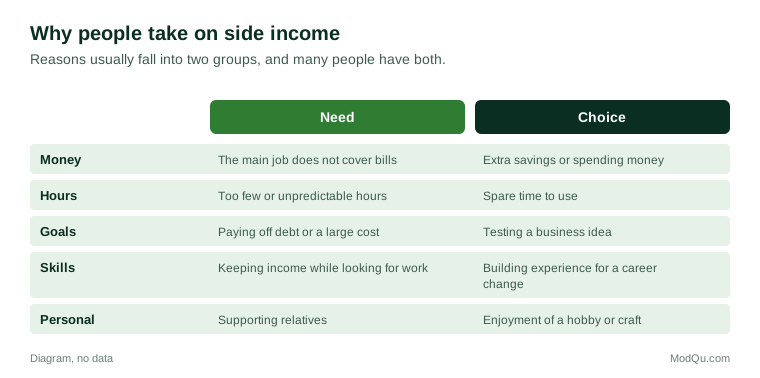
The reasons people give tend to fall into two groups. Some take side work because they need the money. Others do it because they want to.
Reasons of need include:
- the main job does not pay enough to cover bills;
- hours in the main job are too few or unpredictable;
- paying off debt or saving for a large cost such as school fees;
- rising living costs;
- supporting relatives.
Reasons of choice include:
- building skills or experience for a career change;
- testing a business idea before leaving a job;
- doing something enjoyable, such as music or crafts;
- meeting people outside work;
- extra savings or spending money.
Many people have both kinds of reason at once.
Time, energy and money
Side work adds hours to the week. People with two jobs often have little free time, and some report tiredness, less sleep and less time with family. Travel between jobs adds more time. Platform work can involve waiting time without pay.
Side work also has costs. A delivery driver pays for fuel and vehicle wear. A craft seller pays for materials, market fees or selling-site fees. A freelancer may need software, equipment or insurance. The amount earned after these costs can be much lower than the amount received.
Example (hypothetical figures)
A person sells handmade candles online. In one month they receive 600 in sales, in local currency. Materials cost 180, selling-site fees and postage cost 120, and they spend about 30 hours making, packing and posting. Their earnings after costs are 300, or about 10 an hour, before any tax.
Rules, contracts and tax
Several kinds of rules may apply to side income, and they differ by country and employer:
- Employment contracts may require staff to ask before taking other work, or ban work for competitors.
- Working-time rules in some countries limit total weekly hours, which can apply across two jobs.
- Tax: side income is usually taxable. Self-employed people may need to register, keep records and file their own tax return. Some countries have small allowances for occasional income; others do not.
- Social contributions: side income may affect pension, health or social insurance contributions.
- Licences and permits: selling food, driving passengers or renting rooms may need a licence or local permission.
- Benefits: earning extra may affect public benefits in some systems.
Example
A government office worker wants to start a weekend photography business. Their contract says they must declare outside work, so they tell their manager, who agrees as long as it does not involve clients who deal with the office. The worker then registers as self-employed to report the income.
When side income becomes the main income
For some, a side business grows enough to replace the main job. Common signs include steady customers, income that covers basic bills and enough demand to fill a working week. Others decide side income is not worth the effort and stop, especially if costs rise or the main job becomes more demanding. People who rely on several small sources of income can find it hard to get a loan or a mortgage, because lenders often prefer one steady wage.
What people disagree about
Views of side income differ. Some see it as a sign of energy and enterprise. Others see the need for two jobs as a sign that main jobs do not pay enough. Employers differ on whether side work helps staff develop or distracts them. There is also debate about how platform work should be classified and protected.
Questions that employers, recruiters and policy groups want answered include how many people have side income, what kind of work it is, why they do it, how many hours it takes, and whether they would give it up if their main job paid more.
Key terms
- Second jobPaid work held in addition to a main job.
- Side incomeRegular earnings from any source beyond a main job.
- MoonlightingAn informal word for working a second job, often in the evening.
- FreelanceSelf-employed work for several clients, usually by the project.
- Platform workPaid tasks found and managed through an app or website.
- Non-compete clauseA contract term limiting work for competitors.
- Self-assessmentFiling your own tax return to report income not taxed at source.
- Net earningsWhat is left from income after costs are paid.
Full glossary: contingent workforce management terms on EditingTests.com.
Second jobs and side income vocabulary test
How well do you know the language of this topic? Try 8 quick questions. Your score is shown straight away and is not saved.
What the second jobs and side income survey asks
This survey is part of ModQu's Work and Careers survey. The second jobs and side income part takes about five minutes and covers:
- Whether you have a second job or side income.
- What kind of work or activity it is.
- Why you do it: need, choice or both.
- How many hours a week it takes and how much it earns after costs.
- Whether your employer knows, and any rules that apply.
- Whether you would stop if your main job paid more.
After that you can choose to continue with other short parts of the Work and Careers survey, such as job satisfaction or remote and hybrid work, or stop.
Ready to take part?
Your answers help show what people really think and do. Results are only ever reported as totals; no one can see your individual answers.
Start the surveyQuestions about this survey
Who can take part?
Working adults.
Do I have to give my name?
No. You may be asked for your age group, region and similar details so results can be broken down, but not your name. ModQu never asks for passwords, card numbers or account numbers.
How are the results used?
Answers are combined into totals and percentages and published in ModQu reports. Individual answers are never shown.
Is the vocabulary test part of the survey?
No. It is optional and separate, and your score is not stored.
Does selling a few items online count as side income?
The survey asks about regular earnings. Occasionally selling unwanted things is different from buying or making goods to sell, which is closer to running a small business.
Do I need to tell my employer about a second job?
It depends on your contract and local law. Some contracts require you to ask first or ban work for competitors.
Will the survey ask how much I earn?
It may ask for a range, which you can skip. Ranges help show how much side income adds without asking for exact amounts.