
Share your experience of playing team sport
Tell us whether you play a team sport, which one, where and how much it costs you. Your answers are combined with other people's and reported only as totals.
Start the playing team sports surveyAbout 5 minutes. No account needed. You can stop at any time.
What this topic covers
A team sport is one in which players work together in a team against another team. The most widely played around the world include football (soccer), basketball, volleyball, cricket, rugby, field and ice hockey, baseball and softball, handball and netball. Popularity varies a great deal by country: cricket in South Asia, ice hockey in northern countries, netball in parts of the Commonwealth, and volleyball across much of Asia and the Americas.
This topic is about adults who play, not just watch. It covers:
- which sports people play and how often;
- where they play: clubs, leagues, workplaces, universities or informal games;
- what it costs;
- why people play, and why they stop;
- the role of volunteers, coaches and officials.
Ways to play
Adults play team sports in several settings:
- Community clubs, often run by volunteers, which may have several teams by age and level.
- Recreational leagues, sometimes organized by private companies or local councils, where teams sign up for a season.
- Workplace and social leagues, where colleagues or friends form a team.
- University and college teams.
- Masters or veterans' competitions for older players, often over 35 or 40.
- Pick-up games, informal games in parks, courts and beaches where anyone can join.
- Walking or adapted versions, such as walking football or wheelchair basketball, designed for older players or people with disabilities.
Example
A group of colleagues forms a mixed volleyball team for a weekday evening league at a local sports centre. None has played since school. After the first season they finish second from bottom but keep playing, and two of them join a weekend club to improve.
Why adults play
People give a range of reasons for playing team sport:
- Fitness and health: regular exercise that feels less like a chore than going to a gym.
- Social contact: meeting friends, making new ones and belonging to a group.
- Competition: the enjoyment of winning and improving.
- Routine: a fixed time each week that others depend on.
- Identity: being part of a club with a long history, or playing a sport tied to one's culture.
The team aspect matters to many players. Knowing that the team needs eleven, or five, or six players makes it harder to skip a session than when exercising alone.
What it costs
Costs vary from almost nothing for a pick-up game to a significant amount for clubs and leagues with paid facilities. Common costs include:
- club membership or league registration fees;
- match fees, sometimes per game, to pay for referees and facilities;
- kit, footwear and protective equipment;
- travel to away games;
- social costs such as end-of-season events.
Example (hypothetical figures)
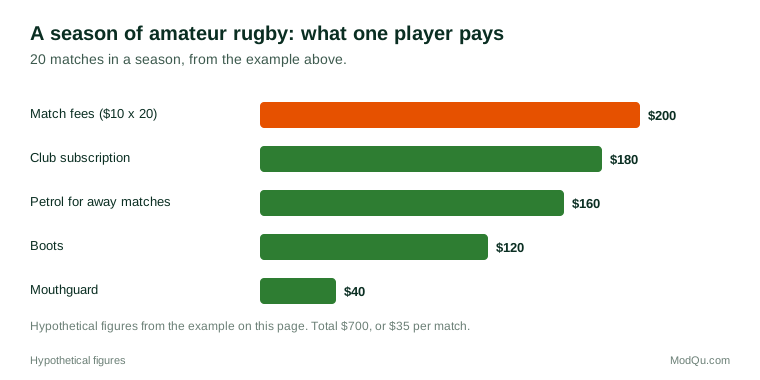
An amateur rugby player pays a $180 annual club subscription and $10 match fees for 20 matches ($200). New boots cost $120 and a mouthguard $40. Petrol for away matches adds about $160 over the season. The total is $700 for the year, or $35 per match.
Costs are a barrier for some people, particularly in sports that need expensive equipment or ice and pitch hire, such as ice hockey. Many clubs offer reduced fees for students, unemployed people or families.
Why people stop playing
Participation in team sport usually falls in the late teens and early twenties, when people leave school, start work or move away. It falls again when people have children. Common reasons people give for stopping include:
- lack of time, because of work or family;
- injury or fear of injury;
- moving to a new area and not knowing a club;
- the team folding because too few players are left;
- feeling not good enough, or that the level is too competitive;
- costs rising.
Some people return later through social leagues, veterans' teams or walking versions of their old sport.
Example
A former basketball player stopped at 26 after a knee injury and the birth of her first child. At 41, a friend invites her to a recreational league for players over 35, with shorter games and no full-court pressing. She joins and now plays every Tuesday.
Volunteers, coaches and officials
Amateur team sport in most countries depends on volunteers who coach, manage teams, keep the clubhouse running, wash kits and organize fixtures. Referees and umpires are often in short supply, partly because of abuse from players and spectators. Clubs that lose key volunteers can struggle to continue.
Who plays and who does not
Survey research in several countries has found that men play team sports more than women, younger adults more than older ones, and people with higher incomes more than those with lower incomes. The gap between men and women has narrowed in some sports, with strong growth in women's football, rugby and cricket. People with disabilities and people from some ethnic minority groups often report fewer opportunities to play.
Trends
Recent trends in many countries include:
- more flexible, short formats, such as five-a-side football or three-on-three basketball;
- apps for finding pick-up games and filling teams;
- growth in women's and mixed leagues;
- walking and adapted versions for older or disabled players;
- pressure on public facilities as councils cut budgets or sell playing fields.
Health and social benefits
Public health bodies, including the World Health Organization, recommend that adults do regular physical activity each week, and team sport is one way to meet that goal. Players often say the social side matters as much as the exercise: the team chat, the drink after the match and the sense of being missed when absent. Some studies have linked team sport with better mental well-being than exercising alone, though people who choose team sport may differ in other ways too.
Injuries are part of the picture. Contact sports such as rugby and hockey carry a higher risk of injury than non-contact sports, and older players often take longer to recover. Many adults choose formats with less contact or shorter games as they get older.
What people disagree about
People disagree about how competitive adult recreational sport should be, whether public money should go to community sport or to elite sport, whether casual formats are replacing traditional clubs, and how to deal with abuse of referees. Players also disagree about whether mixed-gender teams work well in sports with physical contact.
Questions that clubs, leagues, governing bodies and sportswear brands want answered include how many adults play, which sports, how often, what they pay, what would make them play more and what makes them stop.
Key terms
- Recreational leagueAn organized competition for amateur teams, usually focused on fun and fitness.
- Pick-up gameAn informal game where anyone present can join.
- Match feeA charge per game, often used to pay referees and facility costs.
- Masters or veteransCompetitions for older players, usually over a set age.
- Walking footballA version of football with no running, for older or less mobile players.
- RegistrationSigning up with a club or league so you are allowed to play in its competitions.
- FixtureA scheduled match.
- Volunteer coachAn unpaid person who trains and manages a team.
Full glossary: sports management terms on EditingTests.com.
Playing team sports vocabulary test
How well do you know the language of this topic? Try 8 quick questions. Your score is shown straight away and is not saved.
What the playing team sports survey asks
This survey is part of ModQu's Sports survey. The playing team sports part takes about five minutes and covers:
- Whether you play a team sport now, and if so which one and how often.
- Where you play: a club, a league, work, university or informal games.
- How much you pay in a year, including fees, kit and travel.
- Why you play, or why you stopped.
- What would make you play more, or start again.
After that you can choose to continue with other short parts of the Sports survey, such as football (soccer) fans or running and marathons, or stop.
Ready to take part?
Your answers help show what people really think and do. Results are only ever reported as totals; no one can see your individual answers.
Start the surveyQuestions about this survey
Who can take part?
Adults.
Do I have to give my name?
No. You may be asked for your age group, region and similar details so results can be broken down, but not your name. ModQu never asks for passwords, card numbers or account numbers.
How are the results used?
Answers are combined into totals and percentages and published in ModQu reports. Individual answers are never shown.
Is the vocabulary test part of the survey?
No. It is optional and separate, and your score is not stored.