
Tell us about mental health support
Tell us which kinds of support you have used, what helped and what made it hard to get help. Your answers are combined with other people's and reported only as totals.
Start the mental health and wellbeing surveyAbout 5 minutes. No account needed. You can stop at any time.
What mental health and wellbeing mean
Mental health is more than the absence of illness. It includes how people feel, think and cope with daily life, their relationships and their sense of purpose. Wellbeing describes how satisfied people are with their lives and how well they function overall.
Mental health can change over time. Stress at work, money worries, loneliness, illness, grief and major life changes can all affect it. Some people live with diagnosed conditions such as depression, anxiety disorders, bipolar disorder or post-traumatic stress disorder, which may need ongoing treatment.
Everyday ways people look after their mental health
Before seeking professional help, many people use everyday strategies:
- physical activity, time outdoors and regular sleep;
- talking with friends, family or a partner;
- limiting alcohol and screen time;
- hobbies, creative activities and volunteering;
- faith and spiritual practices;
- mindfulness, meditation and breathing exercises;
- setting boundaries at work and taking time off.
These habits help many people but are not a substitute for professional care when symptoms are severe or persistent.
Types of professional support
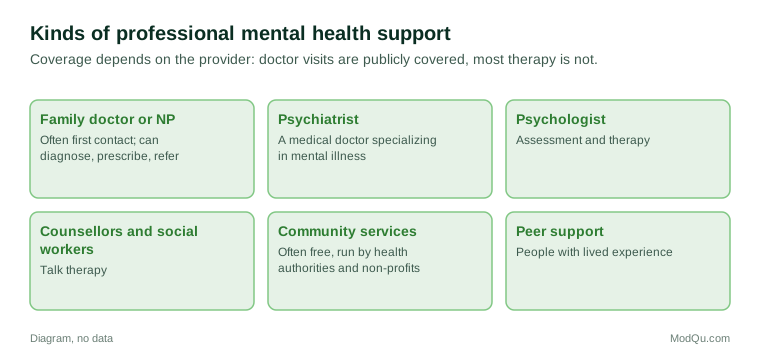
People can get support from several kinds of professional:
- family doctors and nurse practitioners, often the first point of contact, who can diagnose, prescribe and refer;
- psychiatrists, medical doctors who specialize in mental illness;
- psychologists, who assess and provide therapy;
- registered counsellors, psychotherapists and social workers, who provide talk therapy;
- community mental health services, often free, run by health authorities and non-profit organizations;
- peer support workers, who have lived experience of mental health challenges.
In Canada, visits to doctors and psychiatrists are covered by provincial plans, but sessions with psychologists and counsellors in private practice are usually not. They are paid by workplace benefits or out of pocket, which affects who can access them.
Example (hypothetical figures)
An employee's benefits plan covers 80% of psychology fees up to $1,000 a year. Sessions cost $250, so the plan pays $200 per session and the limit is reached after five sessions. The employee pays $50 for each of those five sessions, then the full $250 for every session after that. Many people stop therapy when their coverage runs out, even if they would benefit from continuing.
Apps and online support
Mental health apps offer meditation, mood tracking, cognitive behavioural therapy exercises and sometimes access to therapists by text or video. Online therapy services have grown, offering appointments without a waiting room. Some provinces offer free online programs.
People value apps for being available at any time and private. Concerns include quality, privacy of personal data and whether apps help with more serious problems.
Example
A university student uses a free meditation app during exam season and finds it helps them sleep. When their low mood lasts into the summer, they book an appointment through their campus counselling centre, saying the app helped them recognize that they needed more support.
Workplace programs
Many employers offer employee assistance programs (EAPs) that provide a few free, confidential counselling sessions, often by phone or video. Some benefit plans have increased coverage for psychology and therapy. Workplace programs also include mental health training for managers, flexible work, and policies on workload and time off.
Employees often do not know these programs exist, worry that using them will not be confidential, or find the number of free sessions too small.
Barriers to getting help
Common barriers people describe include:
- cost of private therapy;
- waiting lists for public services and specialists;
- stigma, or worry about what others will think;
- not knowing where to start;
- finding the right fit, including a therapist who understands their culture, language or identity;
- time, especially for parents and shift workers;
- distance, for people in rural and remote areas.
Example
A farmer in a rural area has felt overwhelmed for months. The nearest counsellor is two hours away. A friend tells him about a free phone counselling service for farmers in his province. He calls it from his truck after work, which is the first time he has spoken to anyone about how he feels.
Talking about mental health
Public attitudes toward mental health have changed. Campaigns, public figures sharing their experiences and workplace programs have made it easier for many people to talk openly. Even so, many people still hide mental health problems from employers, family or friends. Men, older adults and some cultural communities may face particular stigma.
Young people's mental health
Parents, schools and health systems are paying close attention to young people's mental health. Concerns include anxiety, social media pressures, bullying, academic stress and long waits for youth services. Many schools and post-secondary institutions have expanded counselling and wellness programs.
Crisis support
For people in crisis, immediate help is available. In Canada, people can call or text 9-8-8, the Suicide Crisis Helpline, at any time. Emergency departments and local crisis lines also provide urgent support.
What service providers and employers want to know
Health systems, employers, insurers and app developers want to understand how people look after their mental health, which services they use, what helps, what gets in the way, and how much people would pay or wait for support.
Key terms
- WellbeingHow satisfied people are with their lives and how well they function.
- PsychologistA professional trained to assess mental health and provide therapy.
- PsychiatristA medical doctor who specializes in mental illness and can prescribe medicine.
- PsychotherapyTalk therapy to help people understand and manage thoughts, feelings and behaviour.
- Cognitive behavioural therapyA structured therapy that works on the links between thoughts, feelings and actions.
- Employee assistance programA confidential workplace counselling and support service.
- Peer supportHelp from people with lived experience of similar challenges.
- StigmaNegative attitudes or beliefs that discourage people from seeking help.
Full glossary: community psychiatry terms on EditingTests.com.
Mental health and wellbeing vocabulary test
How well do you know the language of this topic? Try 8 quick questions. Your score is shown straight away and is not saved.
What the mental health and wellbeing survey asks
This survey is part of ModQu's Health and Wellness survey. The mental health and wellbeing part takes about five minutes and covers:
- How you would rate your mental health and wellbeing at the moment.
- What you do day to day to look after your mental health.
- Which kinds of support you have used in the last year, such as counselling, apps or workplace programs.
- How you paid for professional support, if you used it.
- What, if anything, stopped you from seeking help.
- What would make support easier to get.
After that you can choose to continue with other short parts of the Health and Wellness survey, such as access to family doctors or virtual care and telehealth, or stop.
Ready to take part?
Your answers help show what people really think and do. Results are only ever reported as totals; no one can see your individual answers.
Start the surveyQuestions about this survey
Who can take part?
Adults.
Do I have to give my name?
No. You may be asked for your age group, region and similar details so results can be broken down, but not your name. ModQu never asks for passwords, card numbers or account numbers.
How are the results used?
Answers are combined into totals and percentages and published in ModQu reports. Individual answers are never shown.
Is the vocabulary test part of the survey?
No. It is optional and separate, and your score is not stored.
Do I have to answer questions about my mental health?
No. Every question is optional, and you can stop at any time.
I need help now. What should I do?
ModQu does not provide health care. In Canada, call or text 9-8-8 at any time, contact your local crisis line, or call 9-1-1 in an emergency.