
Share your view of managers and leaders
Tell us how you rate your manager, the feedback you get and your trust in leaders. Your answers are combined with other people's and reported only as totals.
Start the managers and leadership surveyAbout 5 minutes. No account needed. You can stop at any time.
Managers and leaders: the difference
In most organizations there are two levels of leadership that employees deal with. The first is the direct manager or supervisor: the person who assigns work, approves leave, gives feedback and conducts reviews. The second is senior leadership: the owners, directors or executives who set the direction of the whole organization, decide on budgets and jobs, and speak for it in public.
Employees usually know their direct manager well and judge them on daily behaviour. Senior leaders are often more distant, and employees judge them on decisions, announcements and whether what they say matches what happens. A person can like their manager and distrust senior leadership, or the other way round.
In small businesses the two roles are often the same person. In large organizations there may be several layers between a front-line worker and the top, and messages can change as they pass down the chain.
What managers are expected to do
A manager's job varies by sector, but most roles include:
- Planning and assigning work: deciding who does what and by when.
- Supporting staff: removing obstacles, providing tools and training, and covering gaps.
- Feedback and reviews: telling people what is going well and what needs to change.
- Decisions on people: hiring, scheduling, leave, pay recommendations, promotions and, sometimes, discipline.
- Communication: passing information up and down, and explaining decisions made higher up.
- Fairness and safety: treating staff consistently, dealing with conflict and acting on complaints.
Many managers are promoted because they were good at their previous job, not because they were trained to manage people. Some organizations provide management training; many do not.
What employees value in a manager
When people describe a good manager, they tend to mention the same qualities, whatever the country or industry:
- clear expectations, so people know what is wanted;
- regular, honest and useful feedback;
- fairness in giving out work, shifts and opportunities;
- trust, meaning the manager does not watch every step;
- support when things go wrong at work or at home;
- recognition, including a simple thank-you;
- willingness to listen and to pass concerns upward.
Poor management is often described in terms of the opposite: unclear goals, favouritism, criticism in public, taking credit for others' work, being unreachable, or controlling every small task. People often say they leave a manager rather than a job.
Example
A warehouse worker has had three supervisors in two years. The first posted the rota late every week, so planning childcare was hard. The second fixed the rota a month ahead and explained changes in person. The work and pay stayed the same, but the worker says the second supervisor made them want to stay.
Feedback and performance reviews
Feedback is one of the main ways employees experience their manager. It can be informal, such as a quick comment after a task, or formal, such as an annual or half-yearly performance review with ratings and goals.
Common approaches include:
- Annual reviews with a rating that may affect pay or bonus.
- Regular one-to-one meetings, often weekly or monthly, to discuss work and problems.
- 360-degree feedback, where colleagues, direct reports and sometimes customers give views as well as the manager.
- Ongoing check-ins in place of a single yearly review.
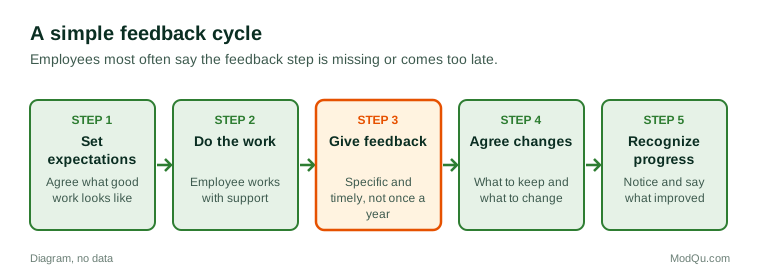
Many employees say they get too little feedback, or that it comes too late to be useful. Others find formal reviews stressful because ratings feel fixed in advance or tied to quotas. The quality of feedback depends on whether it is specific, timely and linked to something the person can change.
Example
An office worker receives a "meets expectations" rating with no comments in their annual review. They had no one-to-one meetings during the year. A colleague in another team, with a manager who meets them every two weeks, gets the same rating but knows exactly what to work on to move up a grade.
Trust in senior leadership
Trust in senior leaders rests on a few things: whether they explain decisions honestly, whether they keep promises, whether they treat staff fairly during difficult times, and whether their own behaviour matches the rules they set. Pay gaps between leaders and staff, sudden restructures and announcements that staff hear first in the news can all damage trust.
Leaders communicate through town-hall meetings, emails, internal newsletters and visits to sites. Employees often say they want fewer polished messages and more direct answers, especially about job security, pay and strategy.
Example (hypothetical figures)
A company of 400 staff runs an anonymous survey. Of those who answer, 300 rate their direct manager as good or very good, but only 160 say they trust senior leadership. Comments mention a reorganization that was announced by email with no chance to ask questions.
Leadership styles
Writers on management describe many leadership styles. Some common labels are:
- Directive: the leader decides and gives clear instructions.
- Participative or democratic: the leader asks for input before deciding.
- Coaching: the leader focuses on developing people's skills.
- Hands-off or delegating: the leader gives wide freedom and steps in only when needed.
- Servant leadership: the leader sees their main role as supporting the team.
Most managers mix styles depending on the situation. A directive approach may suit an emergency, while a coaching approach may suit a new employee learning a role. Expectations also differ between cultures and workplaces: in some, staff expect managers to give clear orders; in others, they expect to be consulted.
What people disagree about
There is wide disagreement about how much a manager should be involved in staff's work, whether managers should be friends with their team, and how much of an organization's success is due to its leaders. People also differ on whether remote work makes good management harder, and on whether performance ratings help or harm.
Questions that employers and HR teams want answered include how employees rate their manager, how often they get useful feedback, how much they trust senior leaders, and whether their manager affects their decision to stay.
Key terms
- Direct managerThe person an employee reports to day to day.
- Senior leadershipExecutives or directors who run the whole organization.
- Performance reviewA formal meeting to assess an employee's work, often yearly.
- One-to-oneA regular private meeting between a manager and one employee.
- 360-degree feedbackFeedback gathered from colleagues, reports and managers, not only the boss.
- MicromanagementClose control of every small task an employee does.
- DelegationGiving a task and the authority to do it to someone else.
- Span of controlThe number of people who report directly to one manager.
Full glossary: human resources terms on EditingTests.com.
Managers and leadership vocabulary test
How well do you know the language of this topic? Try 8 quick questions. Your score is shown straight away and is not saved.
What the managers and leadership survey asks
This survey is part of ModQu's Work and Careers survey. The managers and leadership part takes about five minutes and covers:
- How you rate your direct manager overall.
- How often you get feedback, and how useful it is.
- Whether you have regular one-to-one meetings.
- How much you trust senior leaders, and why.
- How fairly work, shifts and opportunities are shared.
- Whether your manager affects your decision to stay or leave.
After that you can choose to continue with other short parts of the Work and Careers survey, such as job satisfaction or remote and hybrid work, or stop.
Ready to take part?
Your answers help show what people really think and do. Results are only ever reported as totals; no one can see your individual answers.
Start the surveyQuestions about this survey
Who can take part?
Employees.
Do I have to give my name?
No. You may be asked for your age group, region and similar details so results can be broken down, but not your name. ModQu never asks for passwords, card numbers or account numbers.
How are the results used?
Answers are combined into totals and percentages and published in ModQu reports. Individual answers are never shown.
Is the vocabulary test part of the survey?
No. It is optional and separate, and your score is not stored.
Why do people say they leave managers, not jobs?
Because daily experience at work depends so much on the direct manager: how work is shared, how feedback is given and whether problems are dealt with fairly.
Are good managers born or trained?
Both views are held. Many organizations now offer management training because people are often promoted for technical skill rather than for managing people.
Is my answer about my manager anonymous?
Yes. ModQu does not ask for your name or your employer's name, and results are reported only for groups of people.