
Share your experience of insurance renewals
Tell us how your last renewal price changed and what you did about it. Your answers are combined with other people's and reported only as totals.
Start the insurance prices and renewals surveyAbout 5 minutes. No account needed. You can stop at any time.
How insurers set prices
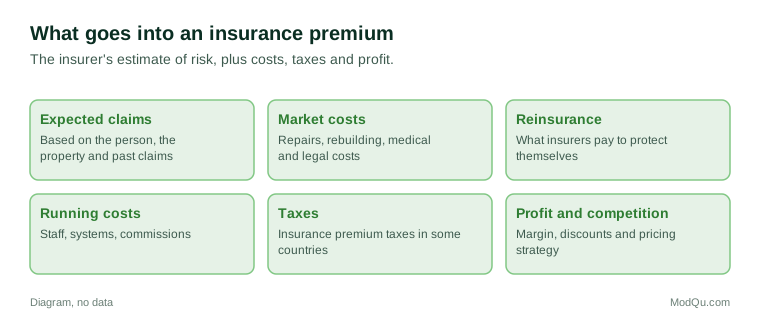
An insurance premium reflects the insurer's estimate of the risk of a claim, plus its costs and profit. To estimate risk, insurers use information about the person and what is being insured. For car insurance this can include age, driving history, the car, where it is kept and how far it is driven. For home insurance, it can include the location, building type, rebuilding cost and claims history.
Other influences on price include:
- Claims costs across the market, such as repair costs, medical costs and legal costs.
- Weather and disasters, which raise costs for home insurance in affected areas.
- Reinsurance: the insurance that insurers themselves buy, which can rise after major disasters.
- Taxes on insurance premiums in some countries.
- Competition between insurers.
The figure below shows what goes into a typical premium.
Why renewal prices go up
People often see their premium rise at renewal even without making a claim. Reasons can include:
- higher repair, rebuilding or medical costs;
- more claims in the area, such as thefts or floods;
- changes to the insurer's view of risk;
- the end of an introductory discount from the first year;
- in some markets, price walking: gradually raising prices for loyal customers who are unlikely to shop around.
Price walking has been criticized because it means long-standing customers can pay much more than new customers for the same cover.
Example (hypothetical figures)
A homeowner has used the same insurer for six years. Their premium has risen from 280 to 520 with no claims. A comparison site shows a similar policy from the same insurer offered to new customers at 310. When they phone and say they will leave, the insurer offers 360.
What people do at renewal
When the renewal notice arrives, people tend to do one of four things:
- Accept the new price, often because it is easier.
- Shop around on comparison sites or with brokers.
- Negotiate with the current insurer, often by asking for a better price or threatening to leave.
- Change the cover, for example raising the excess or dropping extras to lower the price.
Many policies renew automatically if the customer does nothing, which suits people who value convenience but can lead to paying more than necessary.
Example
A driver gets a renewal quote that is 20% higher. They check two comparison sites and find a similar policy for less. Before switching, they call their insurer, who matches the price. They stay, but set a reminder to check again next year.
Ways people lower premiums
Common ways people reduce what they pay include:
- raising the voluntary excess;
- paying annually instead of monthly;
- improving security, such as approved locks or alarms;
- bundling several policies with one insurer;
- removing cover they do not need;
- for car insurance, adding an experienced named driver, limiting mileage or using a telematics box that tracks driving.
Each choice has trade-offs. A higher excess, for example, means paying more when something does go wrong.
Rules on renewal pricing
Some countries have introduced rules to address loyalty penalties. Measures include:
- requiring renewal notices to show last year's premium next to this year's;
- banning insurers from charging renewing customers more than new customers for the same policy;
- making it easier to cancel automatic renewal;
- requiring insurers to review whether long-standing customers are getting fair value.
Where such rules exist, the gap between new and existing customers has narrowed, though some say new customer prices have risen as a result.
The rising cost of cover in high-risk areas
In some regions, prices for home insurance have risen sharply because of more frequent storms, floods, wildfires or subsidence. In the most exposed areas, some insurers have stopped offering cover. This affects homeowners' ability to sell or get a mortgage, and has led some governments to create shared schemes or insurers of last resort.
Example
A family lives near a river that has flooded twice in ten years. Their renewal quote doubles and excludes flood damage. They find cover through a government-backed scheme that shares flood risk across insurers, at a higher but manageable price.
Telematics and data-driven pricing
Insurers increasingly use data to set prices, from telematics boxes and phone apps that record driving, to detailed property data. Supporters say this lets careful customers pay less. Critics worry about privacy, about people being priced out because of where they live, and about prices based on data customers cannot see or challenge.
Reading a renewal notice
A renewal notice usually shows the new premium, the cover, the excess and any changes to terms. Some also show the previous year's price. Points worth checking include whether the cover has changed, whether the excess has gone up, whether payment will be taken automatically, and the date by which the customer must act to cancel. People who pay monthly may also find that the yearly cost includes interest. Comparing the notice line by line with last year's policy shows whether a higher price comes with any change in cover.
Example
A pet owner's renewal notice shows a higher premium and, in smaller print, a new excess for older pets. They had not noticed the change until they compared the two years' documents side by side.
What people disagree about
Some argue that loyal customers should never pay more than new ones. Others say discounts for new customers are part of normal competition. There is also disagreement about how much risk-based pricing is fair, especially when it raises prices for people in areas they cannot easily leave.
Questions that businesses want answered include how renewal prices changed, whether people noticed, whether they shopped around or negotiated, what made them stay or switch, and how they feel about loyalty pricing.
Key terms
- PremiumThe price paid for an insurance policy.
- RenewalContinuing a policy for another period, usually a year.
- Price walkingRaising prices for loyal customers at each renewal.
- Automatic renewalA policy that continues unless the customer cancels.
- Voluntary excessAn extra amount the customer agrees to pay toward a claim in return for a lower premium.
- TelematicsTechnology that records driving behaviour to help set car insurance prices.
- ReinsuranceInsurance bought by insurers to protect themselves against large losses.
- Insurer of last resortA scheme that offers cover when private insurers will not.
Full glossary: personal lines insurance terms on EditingTests.com.
Insurance prices and renewals vocabulary test
How well do you know the language of this topic? Try 8 quick questions. Your score is shown straight away and is not saved.
What the insurance prices and renewals survey asks
This survey is part of ModQu's Insurance survey. The insurance prices and renewals part takes about five minutes and covers:
- How your last renewal price compared with the year before.
- Whether you noticed the change and read the renewal notice.
- Whether you shopped around, negotiated or accepted the price.
- Whether you switched insurer, and why.
- What changes you made to lower the price, if any.
- How you feel about new customers paying less than loyal ones.
After that you can choose to continue with other short parts of the Insurance survey, such as car insurance or home and tenant insurance, or stop.
Ready to take part?
Your answers help show what people really think and do. Results are only ever reported as totals; no one can see your individual answers.
Start the surveyQuestions about this survey
Who can take part?
Adults with any insurance policy.
Do I have to give my name?
No. You may be asked for your age group, region and similar details so results can be broken down, but not your name. ModQu never asks for passwords, card numbers or account numbers.
How are the results used?
Answers are combined into totals and percentages and published in ModQu reports. Individual answers are never shown.
Is the vocabulary test part of the survey?
No. It is optional and separate, and your score is not stored.
Can I negotiate my renewal price?
Many people do. Insurers sometimes offer a lower price to customers who say they are considering leaving.
Is it worth switching every year?
It depends on prices and cover. Comparing each year helps you see whether your price is in line with the market.