
Share your experience of a religious diet
Tell us how easy it is to find food that meets your religious practice and how much you trust labels. Your answers are combined with other people's and reported only as totals.
Start the halal, kosher and religious diets surveyAbout 5 minutes. No account needed. You can stop at any time.
What religious diets involve
Many religions have rules or customs about food. Practice varies greatly within each faith, between communities and between individuals. Some of the most widely followed practices include:
- Islam: halal means permitted. Pork and alcohol are not permitted, and meat must come from animals slaughtered according to Islamic rules. Many Muslims fast from dawn to sunset during Ramadan.
- Judaism: kosher means fit or proper. Rules include not eating pork or shellfish, not mixing meat and dairy, and slaughter and preparation by set methods, often under the supervision of a rabbi.
- Hinduism: many Hindus avoid beef, and many are vegetarian. Some avoid onion and garlic, and fasting days are common.
- Jainism: strict vegetarianism, often avoiding root vegetables and eating before sunset, based on the principle of non-harm.
- Sikhism: many Sikhs avoid meat slaughtered in ritual ways, and community kitchens (langar) serve vegetarian food.
- Buddhism: many Buddhists, especially monks and nuns in some traditions, are vegetarian.
- Christianity: some traditions include fasting periods such as Lent, or avoiding meat on certain days. Some groups, such as Seventh-day Adventists, encourage vegetarian diets.
- Rastafari: many follow an "ital" diet based on natural, often vegetarian, food.
Practice ranges from strict observance of every rule to following some rules, at some times, in some places.
Why certification matters
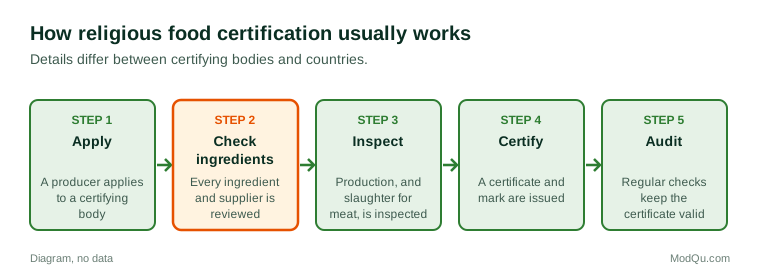
For processed food, restaurant meals and meat, people often cannot see how food was made. Certification gives assurance that a product meets religious requirements. A certifying body inspects ingredients, production and, for meat, slaughter, and allows approved products to carry its mark.
Certification is offered by many organizations, often with different standards. For halal, for example, bodies may differ on methods of slaughter, stunning before slaughter and the use of certain ingredients. For kosher, different certifying agencies and communities may accept or reject particular certifications. Some countries have government-linked halal authorities; elsewhere, certification is private.
Finding certified food
How easy it is to find suitable food depends on where people live. In countries where most of the population follows a religious diet, most food may already meet the rules. In other places, people rely on specialist shops, certified sections of supermarkets, community butchers and online orders.
Common difficulties include:
- few certified products in local shops, especially fresh meat;
- higher prices for certified products;
- unclear labels, especially on ingredients such as gelatine, emulsifiers, flavourings and enzymes;
- uncertainty about which certification marks are reliable;
- cross-contamination during production or cooking.
Example
A Muslim family moves to a small town where the supermarket has no halal meat. They travel to a city 50 kilometres away once a month to buy meat from a halal butcher and freeze it. For processed food, they check ingredients for gelatine and alcohol-based flavourings, and use an online community list of products that others have checked.
Trust in labels
Trust is central to religious diets. People need to rely on others for information they cannot check themselves. Trust can be damaged by cases of mislabelling, fraud, or products found to contain forbidden ingredients. Many people say they trust a certification mark more if it is known in their community or recommended by their religious leaders.
Example (hypothetical figures)
A community group asks 200 members which halal marks they trust. 150 say they trust the mark used by their local mosque's network, 90 say they trust a national mark, and 40 say they trust any halal label. Several members trust more than one mark, so the totals add up to more than 200.
Eating out, travel and workplaces
Eating out can be harder than shopping. People following religious diets may ask about ingredients, cooking oils, shared fryers and utensils, and whether meat is certified. Some restaurants are fully certified; others offer certified options; many offer none.
At work, school, hospitals and in travel, people rely on institutions providing suitable meals. Airlines often offer special meals, such as Muslim, Hindu or kosher meals, which must usually be requested in advance. Schools and workplaces vary in what they provide.
Example
A Jain office worker attends a conference where lunch includes a vegetarian option. The dish contains potatoes and onions, which they do not eat. They bring their own food for the remaining days and email the organizer to suggest asking about dietary needs in more detail on the registration form.
Fasting periods
Religious fasting affects food shopping and eating patterns. During Ramadan, Muslims who fast eat before dawn and after sunset, and shopping, cooking and social meals change accordingly. Lent, Yom Kippur, Navratri, Ekadashi and other periods involve different forms of fasting or abstaining. Food sellers and employers increasingly plan around these times.
What people disagree about
Religious diets raise a number of debates. Some concern animal welfare and slaughter methods, including whether animals should be stunned before slaughter; some countries require stunning, with or without religious exemptions. Others concern labelling, such as whether certified meat should always be labelled for all consumers. Within religious communities, people differ on how strict to be, which certifications to trust and how to balance rules with modern food production.
Questions that food brands, grocers, restaurants and certification bodies want answered include how many people follow a religious diet, how easy it is to find certified food, how much they trust labels, and what would make eating out easier.
Key terms
- HalalPermitted under Islamic law, including food and drink.
- HaramForbidden under Islamic law.
- KosherFit or proper under Jewish dietary law.
- CertificationFormal confirmation by an independent body that a product meets a standard.
- Certification markA symbol on packaging showing a product has been certified.
- Cross-contaminationContact between permitted and non-permitted food or equipment.
- GelatineA protein made from animal parts, used to set foods, which may not meet religious rules.
- FastingGoing without some or all food for a period, often for religious reasons.
Full glossary: food safety terms on EditingTests.com.
Halal, kosher and religious diets vocabulary test
How well do you know the language of this topic? Try 8 quick questions. Your score is shown straight away and is not saved.
What the halal, kosher and religious diets survey asks
This survey is part of ModQu's Food and Drink survey. The halal, kosher and religious diets part takes about five minutes and covers:
- Whether you follow a religious diet, and which practices.
- How easy it is to find certified or suitable food where you live.
- Which certification marks you trust, and why.
- Whether you pay more for certified food.
- How easy it is to eat out, at work, at school or while travelling.
- What would make following your diet easier.
After that you can choose to continue with other short parts of the Food and Drink survey, such as eating habits or coffee, tea and beverages, or stop.
Ready to take part?
Your answers help show what people really think and do. Results are only ever reported as totals; no one can see your individual answers.
Start the surveyQuestions about this survey
Who can take part?
Adults who follow a religious diet.
Do I have to give my name?
No. You may be asked for your age group, region and similar details so results can be broken down, but not your name. ModQu never asks for passwords, card numbers or account numbers.
How are the results used?
Answers are combined into totals and percentages and published in ModQu reports. Individual answers are never shown.
Is the vocabulary test part of the survey?
No. It is optional and separate, and your score is not stored.
Why does the survey ask about prices?
Certified products often cost more, and knowing how much more helps shops and producers understand what stops people buying them.
Is halal food only about meat?
No. Halal rules also cover ingredients such as gelatine, alcohol-based flavourings and some additives, as well as how food is prepared.
Do I have to say which religion I follow?
No. The question is optional, and you can describe your dietary practice without naming a faith.
Can vegetarians who are not religious take part?
This survey focuses on religious diets. Vegetarian and plant-based eating is covered in a separate topic.
Does the survey say which certifications are valid?
No. It asks about your experience and trust, not which bodies are correct.