
Share how food prices affect you
Tell us what your household spends on food and how you have changed what you buy. Your answers are combined with other people's and reported only as totals.
Start the food prices and grocery budgets surveyAbout 5 minutes. No account needed. You can stop at any time.
Why food spending matters
Food is a necessity, so households cannot stop buying it when money is tight. They can only change what they buy, where they buy it and how much they waste. The share of income spent on food is much higher for poorer households than for richer ones, and much higher in lower-income countries than in high-income ones. This means that rising food prices hit some households far harder than others.
A household's food spending includes groceries for meals at home, and often food bought away from home: lunches at work, snacks, street food, takeaway and restaurant meals. Surveys usually ask about these separately.
Why food prices change
Food prices are affected by many factors, often at the same time:
- Weather and harvests: droughts, floods and poor harvests reduce supply.
- Energy costs: fuel for farming, transport, processing and refrigeration.
- Fertilizer and animal feed prices.
- Labour costs on farms, in factories and in shops.
- Exchange rates, especially for imported food.
- Trade restrictions and conflict, which can cut supply from major producing regions.
- Disease in crops or livestock.
- Packaging, processing and retail margins.
The Food and Agriculture Organization of the United Nations publishes a monthly Food Price Index tracking world prices of major food commodities such as cereals, oils, dairy, meat and sugar. Prices in shops do not move exactly with world prices, because transport, processing and retail costs make up much of the final price.
How households budget for food
Households take different approaches:
- a fixed weekly or monthly food budget;
- shopping until the money runs out, then making do;
- planning meals and writing a shopping list;
- buying in bulk when money comes in, such as on payday;
- buying daily from markets or small shops as needed.
How people shop also depends on income timing. People paid daily or weekly may buy small amounts often. People paid monthly may do one large shop. Those without a car or near only small shops often pay more per item.
Example
A family paid monthly does one large shop at a discount supermarket on payday and buys fresh bread, milk and vegetables from a local shop during the month. By the last week before payday, the budget is usually tight, and meals rely more on rice, pasta, beans and eggs.
What people do when prices rise
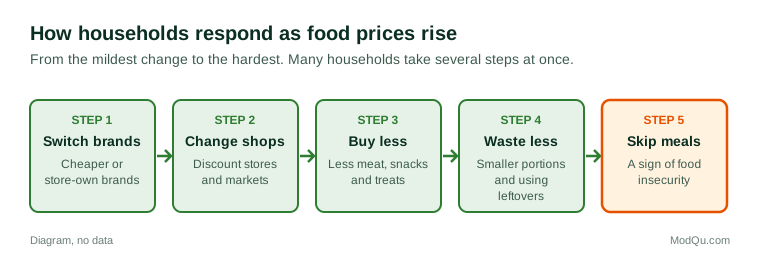
When food prices go up, households report a range of changes:
- switching to cheaper brands or store-own brands;
- buying more items on promotion;
- changing shops, often to discount stores or markets;
- buying less meat and fish, and more beans, grains and eggs;
- cutting back on snacks, treats and drinks;
- eating out less;
- throwing away less food;
- buying larger packs, or smaller ones if cash is short;
- skipping meals, in the hardest cases.
Example (hypothetical figures)
A household spent 120 a week on groceries, in local currency, a year ago. The same basket now costs 138, a rise of 15%. To stay near their budget, they switch to store brands, saving about 10, and replace two meat dinners with bean dishes, saving about 6. Their new weekly bill is 122.
Food insecurity
Food insecurity means not having reliable access to enough safe and nutritious food. It ranges from worrying about running out of food, to eating less varied or lower-quality food, to going without meals. International agencies and national statistics offices measure it using standard survey questions, such as the Food Insecurity Experience Scale used by the FAO.
People facing food insecurity may rely on food banks, charity meals, public food programs, school meals, help from family or informal credit from shops. Many describe feelings of stress and shame as well as hunger.
How food inflation is measured
Food inflation is the rate at which food prices rise over time. National statistics offices measure it as part of the consumer price index (CPI), by tracking the prices of a fixed basket of foods in many shops every month. The basket is updated from time to time to reflect what people actually buy.
Official figures describe the average household. A household that eats a lot of a food whose price has risen sharply, such as cooking oil or eggs, may feel a much bigger rise than the official figure. This is one reason people's sense of food inflation often differs from official numbers.
Example
A pensioner says food prices "have doubled". The official food inflation figure for the year is much lower. When asked, they explain that the specific items they buy most, such as butter, coffee and a favourite brand of bread, have risen far faster than average.
What people disagree about
People disagree about why food prices rise and who is responsible: farmers, processors, supermarkets, governments, global markets or weather. There are debates about whether governments should control prices, cut taxes on food, subsidize staples, or give money to low-income households instead. Views differ too on whether supermarkets' profits are fair during periods of rising prices.
Questions that food brands, grocers and policy groups want answered include how much households spend on food, how they have changed what they buy, which foods they have cut back on, and how worried they are about food costs.
Key terms
- Grocery budgetThe amount a household plans to spend on food and household goods.
- Food inflationThe rate at which food prices rise over time.
- Consumer price indexAn official measure of changes in the prices of a basket of goods and services.
- Store-own brandA product sold under a retailer's own name, often cheaper.
- Food insecurityNot having reliable access to enough safe and nutritious food.
- Staple foodA basic food eaten regularly that provides much of a diet, such as rice or bread.
- ShrinkflationReducing the size of a product while keeping its price the same.
- Food bankA charity that gives free food to people in need.
Full glossary: consumer packaged goods terms on EditingTests.com.
Food prices and grocery budgets vocabulary test
How well do you know the language of this topic? Try 8 quick questions. Your score is shown straight away and is not saved.
What the food prices and grocery budgets survey asks
This survey is part of ModQu's Food and Drink survey. The food prices and grocery budgets part takes about five minutes and covers:
- How much your household spends on food in a typical week.
- Whether that amount has changed in the past year.
- How you have changed what you buy because of prices.
- Which foods you have cut back on or switched.
- Where you shop for food, and whether that has changed.
- How worried you are about being able to afford food.
After that you can choose to continue with other short parts of the Food and Drink survey, such as eating habits or coffee, tea and beverages, or stop.
Ready to take part?
Your answers help show what people really think and do. Results are only ever reported as totals; no one can see your individual answers.
Start the surveyQuestions about this survey
Who can take part?
Adults who buy groceries.
Do I have to give my name?
No. You may be asked for your age group, region and similar details so results can be broken down, but not your name. ModQu never asks for passwords, card numbers or account numbers.
How are the results used?
Answers are combined into totals and percentages and published in ModQu reports. Individual answers are never shown.
Is the vocabulary test part of the survey?
No. It is optional and separate, and your score is not stored.
Why do prices in shops not fall when world prices fall?
Shop prices include transport, processing, packaging, wages, energy and retail costs, which may not fall at the same time. Contracts and stock bought earlier also slow changes.
Does the survey ask about public food support?
Yes, optionally. It asks whether you have used food banks, public food programs or school meals, so their role can be understood.
Should I include takeaway and eating out?
The survey asks about groceries and food bought away from home separately, so you can give each.
What if I do not know how much I spend?
An estimate or a range is fine, and you can skip questions about money.
Is the question about skipping meals required?
No. Every question about hardship is optional.