
Share your experience of disaster cover
Tell us whether your home is covered for natural hazards and whether you have had weather damage. Your answers are combined with other people's and reported only as totals.
Start the flood, storm and natural disaster cover surveyAbout 5 minutes. No account needed. You can stop at any time.
Natural hazards and home insurance
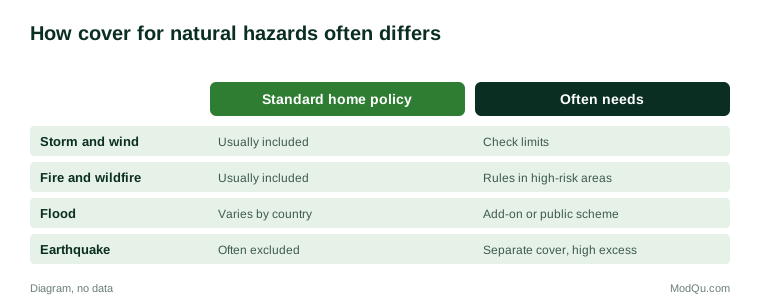
Home insurance policies list the events they cover, called perils. Many standard policies cover storm and wind damage and fire, including wildfire. Other hazards are treated differently in different countries:
- Flood may be included, available only as an add-on, or provided through a separate public scheme.
- Earthquake cover is often a separate policy or endorsement, especially in high-risk regions.
- Subsidence and landslip may be covered with a higher excess.
- Storm surge and coastal flooding may be excluded or treated as flood.
- Hail, snow load and freezing pipes are often covered but with conditions.
Because these rules vary, two neighbours with policies from different insurers can have very different protection.
The figure below shows how cover for common hazards often differs.
Why flood cover is often treated separately
Floods affect many homes in the same area at once, and some properties flood repeatedly. This makes flood risk hard for private insurers to spread. In some countries, private flood cover is standard; in others, a government program or a shared scheme between insurers and government provides it; in still others, many homes have no flood cover at all.
Example
After heavy rain, water from an overflowing river enters a ground-floor flat. The owner's home policy covers storm damage but excludes flood. The damage is classed as flood, not storm, so the claim is refused. A neighbour with a separate flood policy is paid.
The difference between "storm" and "flood" damage is a common source of disputes after severe weather.
Earthquake and wildfire
In earthquake-prone areas, earthquake cover may carry a high excess, often set as a percentage of the home's insured value. Some homeowners choose not to buy it because of the cost.
Wildfire is usually covered under fire, but in high-risk areas insurers may raise prices, require brush clearance or decline to offer cover. Smoke damage and evacuation costs may or may not be included.
Example (hypothetical figures)
A home is insured for 400,000 and has an earthquake excess of 10% of that value. After an earthquake causes 60,000 of damage, the owner pays the first 40,000 and the insurer pays 20,000.
Gaps in cover
Even with insurance, households can face gaps:
- Underinsurance: the sum insured is lower than the real cost to rebuild, especially after building costs rise.
- Excesses that are much higher for natural hazards.
- Exclusions for damage that develops over time, such as damp after a flood.
- Contents that are not covered or not insured for enough.
- Temporary housing costs that exceed the policy limit when repairs take months.
- Renters who assume the landlord's insurance covers their belongings.
After a large disaster, repair costs often rise because builders and materials are in short supply, making underinsurance worse.
How claims work after a disaster
After a large event, insurers may receive thousands of claims at once. Steps usually include:
- reporting the damage as soon as possible;
- taking photos and videos before cleaning up;
- keeping receipts for emergency repairs and temporary accommodation;
- waiting for an assessor, which can take weeks;
- agreeing on a settlement, repair plan or cash payment.
Delays, disagreements about cause, and underinsurance are common complaints.
Public schemes and disaster relief
Governments respond to natural disasters in several ways: public insurance programs, shared schemes with private insurers, disaster relief grants, low-interest loans and building rules that reduce risk. Some countries rely mainly on public relief after an event; others encourage or require private insurance in advance. In many lower-income countries, few households have any insurance, and recovery depends on government, aid organizations, family and community support.
Preparing and reducing risk
Households and communities can reduce damage and sometimes premiums by:
- raising electrical sockets and boilers above likely flood levels;
- fitting flood barriers and non-return valves;
- clearing vegetation around homes in wildfire areas;
- securing roofs against high winds;
- strengthening buildings in earthquake zones;
- signing up for local warnings and having an emergency plan.
Example
A family in a flood-prone town installs removable flood barriers and moves their boiler upstairs. When they renew, their insurer lowers the flood excess because of the changes, and they feel more confident during the next heavy rain.
Disasters and mortgages
Natural hazards also affect home buying. Lenders usually require buildings insurance before they will approve a mortgage. If insurance becomes unavailable or very expensive in an area, buyers may struggle to borrow and homes can become harder to sell. Some buyers now check flood maps, wildfire risk and past claims before making an offer, and in some countries sellers must disclose past flooding. This link between insurance and property values is one reason governments step in with shared schemes.
Example
A buyer finds a house they like near the coast. Before making an offer, they check the official flood map and ask for an insurance quote. The quote is much higher than for similar homes inland, so they lower their offer to reflect the extra yearly cost.
What people disagree about
Debates focus on who should pay for disaster losses: individual homeowners, all insurance customers, or taxpayers. Some argue that people who live in high-risk areas should pay prices that reflect the risk, which encourages safer building. Others say this is unfair to long-standing residents and lower-income households, and that risk should be shared. There is also debate about whether governments should allow new building in high-risk areas.
Questions that businesses want answered include whether households know what their policy covers, how many have flood or earthquake cover, how many have experienced weather damage, how claims went, and what households are willing to pay for disaster cover.
Key terms
- PerilAn event a policy covers, such as fire, storm or flood.
- Flood coverInsurance for damage caused by rising or overflowing water.
- Storm damageDamage caused by high winds, heavy rain or hail.
- UnderinsuranceHaving a sum insured lower than the real cost of rebuilding or replacing.
- Sum insuredThe maximum amount a policy will pay.
- Percentage excessAn excess set as a share of the insured value, common for earthquakes.
- Loss assessorA person who inspects damage and estimates the cost of a claim.
- SubsidenceGround moving downward under a building, which can cause cracks.
Full glossary: disaster risk modeling terms on EditingTests.com.
Flood, storm and natural disaster cover vocabulary test
How well do you know the language of this topic? Try 8 quick questions. Your score is shown straight away and is not saved.
What the flood, storm and natural disaster cover survey asks
This survey is part of ModQu's Insurance survey. The flood, storm and natural disaster cover part takes about five minutes and covers:
- Whether your home is insured for flood, storm, earthquake or wildfire.
- Whether you know your excess and limits for these hazards.
- Whether your home has been damaged by weather or a natural disaster.
- How a claim went, if you made one.
- What you have done to prepare your home.
- How much more you would pay for fuller disaster cover.
After that you can choose to continue with other short parts of the Insurance survey, such as car insurance or home and tenant insurance, or stop.
Ready to take part?
Your answers help show what people really think and do. Results are only ever reported as totals; no one can see your individual answers.
Start the surveyQuestions about this survey
Who can take part?
Homeowners and renters.
Do I have to give my name?
No. You may be asked for your age group, region and similar details so results can be broken down, but not your name. ModQu never asks for passwords, card numbers or account numbers.
How are the results used?
Answers are combined into totals and percentages and published in ModQu reports. Individual answers are never shown.
Is the vocabulary test part of the survey?
No. It is optional and separate, and your score is not stored.
Is flood damage covered by standard home insurance?
It depends on the country and the policy. Some include it, some offer it as an extra, and some leave it to public schemes.
Does renters' insurance cover natural disasters?
It may cover belongings for some hazards. Check which perils are listed.