
Tell us how you stay active
Tell us how often you exercise, where and how, and what helps or stops you. Your answers are combined with other people's and reported only as totals.
Start the fitness and exercise surveyAbout 5 minutes. No account needed. You can stop at any time.
How much activity is recommended
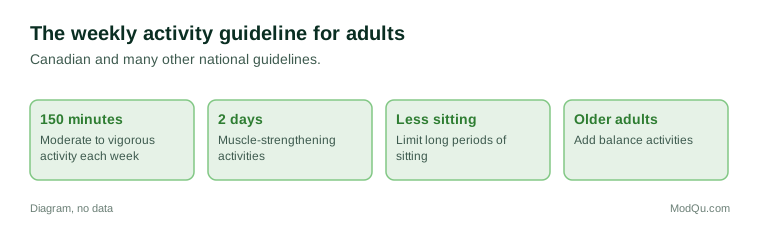
Public health guidelines in Canada and many other countries recommend that adults get at least 150 minutes of moderate to vigorous physical activity a week, plus muscle-strengthening activities at least twice a week, and that they limit long periods of sitting. Guidelines for children and older adults differ, with older adults encouraged to include balance activities.
Moderate activity raises the heart rate and makes breathing faster, such as brisk walking or cycling on flat ground. Vigorous activity makes it hard to talk, such as running or fast swimming.
Many adults do not meet these guidelines. Surveys that rely on people's own reports tend to show higher activity than surveys that use activity monitors, because people often overestimate how much they move.
The activities people choose
Popular forms of exercise include:
- walking, hiking and running;
- cycling, outdoors or on a stationary bike;
- gym workouts using weights and cardio machines;
- group fitness classes such as spin, yoga, Pilates and high-intensity interval training;
- swimming;
- team and racquet sports, including pickleball, which has grown quickly;
- home workouts using videos, apps or simple equipment;
- active commuting, such as walking or cycling to work.
Choices change with age, season, budget and what is available nearby.
Example
A 45-year-old who stopped playing hockey after a knee injury tries several activities. Running hurts the knee, and gyms feel crowded. A friend invites him to pickleball at a community centre. He now plays three evenings a week and says the social side keeps him coming back.
Gyms, studios and community centres
People can exercise at:
- large gym chains, often with low monthly fees and long hours;
- boutique studios offering one type of class at higher prices;
- community and recreation centres run by municipalities, often with drop-in fees;
- workplace gyms and employer-sponsored memberships;
- clubs for specific sports.
People choose based on cost, distance, hours, crowding, the atmosphere and whether friends go too. Cancelling a membership can be harder than joining, and many people keep paying for memberships they rarely use.
Example (hypothetical figures)
A gym member pays $45 a month, or $540 a year. They visit 30 times in the year, so each visit costs $18. Their local recreation centre charges $7 per drop-in, which would have cost $210 for the same visits. They switch, but find they go less often without the commitment of a monthly fee.
Home workouts and fitness apps
Home exercise grew sharply when gyms closed during the pandemic and has remained popular. People use free online videos, paid subscription apps, connected bikes and treadmills, and simple equipment such as dumbbells and resistance bands. Home workouts save time and money but require self-motivation and space.
Wearables and tracking
Fitness trackers and smartwatches record steps, heart rate, sleep and workouts. Many users say tracking motivates them, especially through daily goals and reminders. Others stop wearing them after a few months, find the numbers stressful, or worry about data privacy. Some health and insurance programs offer rewards for meeting activity goals.
What motivates people
People exercise for many reasons:
- health, including heart health, weight and blood sugar;
- mental health and stress relief;
- appearance;
- strength and mobility as they age;
- enjoyment and social connection;
- training for an event, such as a race or charity ride;
- advice from a doctor after a health scare.
Social support, routines and enjoyment tend to keep people going longer than willpower alone.
Barriers to being active
Common barriers include:
- lack of time, especially for parents and shift workers;
- cost of memberships, classes and equipment;
- injuries, pain and health conditions;
- low energy and fatigue;
- weather and darkness in winter;
- lack of safe places to walk, run or cycle;
- feeling self-conscious in gyms;
- not knowing where to start.
Example
A single parent of two young children wants to exercise but has no time on weekdays. She starts doing 20-minute workouts in the living room after the children are in bed, and walks with them to school instead of driving. Small changes add up to most of the recommended weekly activity.
Getting started and staying safe
People returning to exercise after a long break often start too hard and get injured or discouraged. Common advice from fitness professionals includes starting with short sessions, increasing time or intensity gradually, warming up and cooling down, and choosing activities that feel enjoyable rather than punishing. People with heart conditions, diabetes, recent surgery or other health concerns are usually advised to check with a health professional first. Personal trainers, physiotherapists and kinesiologists can help design a safe program, and some benefit plans cover part of the cost.
Activity across the life course
Young adults often move away from team sports after school. Parents of young children report the least free time. Older adults increasingly take up walking groups, swimming, yoga and strength training to stay independent. Programs for seniors, such as falls prevention and chair exercise classes, have grown in community centres.
Exercise and work
Long hours of sitting at work have led some employers to offer standing desks, walking meetings, on-site classes, fitness subsidies and active commuting incentives. Remote workers may move less without a commute, or may have more flexibility to exercise during the day.
What fitness businesses and health planners want to know
Gyms, studios, app makers, equipment brands, municipalities and health agencies want to understand how active people are, which activities they choose, what they pay, what motivates them and what would help them do more.
Key terms
- Moderate activityExercise that raises heart rate and breathing, such as brisk walking.
- Vigorous activityExercise that makes it hard to talk, such as running.
- Strength trainingExercise using resistance to build muscle.
- High-intensity interval trainingShort bursts of hard effort alternated with rest.
- CardioExercise that raises heart rate for a sustained period.
- Fitness trackerA wearable device that records steps, heart rate and activity.
- Resting heart rateThe number of heartbeats per minute at rest.
- Sedentary behaviourLong periods of sitting or lying down while awake.
Full glossary: fitness terms on EditingTests.com.
Fitness and exercise vocabulary test
How well do you know the language of this topic? Try 8 quick questions. Your score is shown straight away and is not saved.
What the fitness and exercise survey asks
This survey is part of ModQu's Health and Wellness survey. The fitness and exercise part takes about five minutes and covers:
- How many days a week you are physically active, and for how long.
- Which activities you do, and where.
- Whether you pay for a gym, studio, class or fitness app, and how much.
- Whether you use a fitness tracker or smartwatch, and what for.
- What motivates you to stay active.
- What stops you from being more active.
After that you can choose to continue with other short parts of the Health and Wellness survey, such as access to family doctors or virtual care and telehealth, or stop.
Ready to take part?
Your answers help show what people really think and do. Results are only ever reported as totals; no one can see your individual answers.
Start the surveyQuestions about this survey
Who can take part?
Adults.
Do I have to give my name?
No. You may be asked for your age group, region and similar details so results can be broken down, but not your name. ModQu never asks for passwords, card numbers or account numbers.
How are the results used?
Answers are combined into totals and percentages and published in ModQu reports. Individual answers are never shown.
Is the vocabulary test part of the survey?
No. It is optional and separate, and your score is not stored.
Do I need to be fit to take part?
No. The survey is for everyone, including people who do little or no exercise. Their answers are just as important.