
Tell us about your dental care
Tell us when you last saw a dentist, how you pay and what keeps you from going more often. Your answers are combined with other people's and reported only as totals.
Start the dental care surveyAbout 5 minutes. No account needed. You can stop at any time.
What dental care includes
Dental care covers a range of services:
- preventive care: check-ups, cleanings by a dental hygienist, X-rays, fluoride and sealants;
- basic restorative care: fillings and simple extractions;
- major restorative care: crowns, bridges, dentures and implants;
- endodontics: root canal treatment;
- periodontics: treatment of gum disease;
- orthodontics: braces and clear aligners;
- oral surgery: wisdom tooth removal and other surgery;
- cosmetic dentistry: whitening and veneers.
Dentists, dental hygienists, denturists and dental specialists all provide care. In several provinces, dental hygienists can run their own clinics.
How often people visit
Many dental offices recommend check-ups and cleanings once or twice a year, though the right interval depends on the person's oral health. In practice, visit patterns vary:
- some people go every six months without fail;
- some go once a year or less;
- some go only when something hurts;
- some have not been in years.
Income and dental coverage are strongly linked to how often people go. People with coverage tend to visit more regularly than people without it.
Who pays for dental care
In Canada, dental care is mostly paid for privately:
- workplace dental plans cover many employees and their families, usually paying a percentage of costs up to yearly limits;
- individual dental plans can be bought, often with waiting periods for major work;
- public programs cover some groups, such as children in low-income families and people on social assistance, varying by province;
- the federal Canadian Dental Care Plan helps eligible uninsured residents with lower family incomes;
- out-of-pocket payment for everyone else.
Example (hypothetical figures)
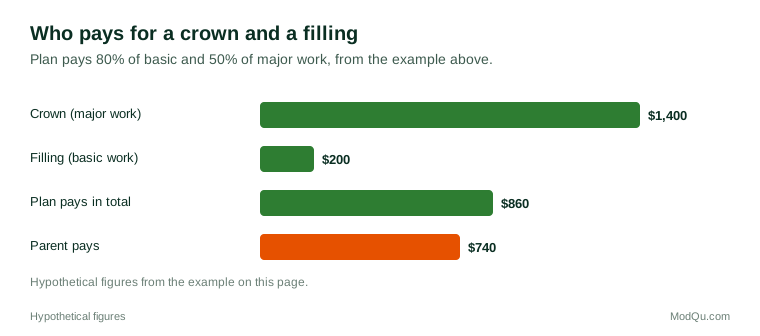
A family's dental plan pays 80% of basic services and 50% of major services, up to $1,500 per person each year. One parent needs a crown costing $1,400 and a filling costing $200. The plan pays 50% of the crown ($700) and 80% of the filling ($160), a total of $860. The parent pays the remaining $740.
Cost as a barrier
Cost is the most common reason people give for not going to the dentist or for delaying treatment. People without coverage may skip cleanings, put off fillings until a tooth hurts, or choose extraction over a more expensive root canal and crown.
Delaying care can make problems more costly later: a small cavity can become a root canal, and untreated gum disease can lead to tooth loss.
Example
A retail worker without dental coverage notices a sensitive tooth but waits a year because of cost. When the pain becomes severe, the dentist finds the decay has reached the nerve. The choice is now a root canal and crown or an extraction. The worker chooses extraction because it costs less upfront.
Fear and anxiety
Many adults feel anxious about dental visits. Some avoid care entirely. Common fears include pain, needles, the sound of drills, feeling out of control and embarrassment about the state of their teeth. Clinics respond with clear explanations, numbing, breaks during treatment and in some cases sedation.
How people choose a dentist
Reasons people give for choosing a clinic include:
- location close to home or work;
- recommendations from family and friends;
- online reviews;
- whether the clinic accepts their dental plan and bills the insurer directly;
- evening and weekend hours;
- a dentist who explains treatment and costs clearly;
- children's dentistry or specialist services under one roof.
Many people stay with the same dentist for years. Reasons for switching include moving, a dentist retiring, feeling pressured into treatment and disagreements about costs.
Treatment plans and second opinions
Dentists often recommend treatment plans that include several procedures over time. Patients sometimes feel unsure whether all the work is necessary, especially for cosmetic or optional treatment. Some ask for a written estimate, a predetermination from their insurer, or a second opinion.
Example
A patient moves cities and visits a new dentist, who recommends replacing four old fillings. The patient's previous dentist had said the fillings were fine. They ask for X-rays and an explanation of each recommendation, then decide to replace one now and monitor the others.
Daily habits at home
Dental visits are only part of oral health. Dental associations recommend brushing twice a day with fluoride toothpaste, cleaning between teeth daily, limiting sugary food and drinks, and not smoking. Surveys often find a gap between what people know and what they do: many people say flossing is important but few floss every day. Electric toothbrushes, water flossers and whitening products are popular purchases, and people often ask their hygienist which products are worth buying.
Children's dental care
Parents are often advised to take children for a first dental visit around their first birthday. Many provinces have school screening programs and public coverage for children in lower-income families. Parents weigh costs, children's anxiety and advice about fluoride, sealants and orthodontics.
Dental care for older adults
Older adults may have more fillings, crowns, bridges and dentures to maintain, and may lose workplace coverage at retirement. People in long-term care can find it hard to get dental care at all. Dentures and implants are major expenses that many retirees plan for.
Emergencies and after-hours care
Dental emergencies, such as a broken tooth, severe toothache or swelling, often happen outside office hours. Some cities have emergency dental clinics, and some offices keep slots for urgent cases. People without a regular dentist sometimes go to hospital emergency departments, which can treat pain and infection but usually cannot fix the tooth itself.
What dental providers and planners want to know
Clinics, insurers and governments want to know how often people visit, what stops them, how they choose a clinic, how they pay and what they think of new public programs.
Key terms
- Dental hygienistA licensed professional who cleans teeth and provides preventive care.
- FillingMaterial used to repair a tooth damaged by decay.
- Root canalTreatment to remove infected tissue inside a tooth.
- CrownA cap placed over a damaged tooth to restore its shape and strength.
- Periodontal diseaseInfection and inflammation of the gums and supporting bone.
- PredeterminationAn estimate from an insurer of how much it will pay for planned treatment.
- Fee guideA provincial list of suggested fees for dental procedures.
- OrthodonticsTreatment to straighten teeth and correct bites, such as braces.
Full glossary: dental practices terms on EditingTests.com.
Dental care vocabulary test
How well do you know the language of this topic? Try 8 quick questions. Your score is shown straight away and is not saved.
What the dental care survey asks
This survey is part of ModQu's Health and Wellness survey. The dental care part takes about five minutes and covers:
- When you last saw a dentist or dental hygienist, and how often you usually go.
- How you pay for dental care: workplace plan, individual plan, public program or out of pocket.
- Whether cost has stopped or delayed any dental treatment for you or your family.
- How you chose your current dentist.
- How anxious you feel about dental visits.
- What would make you go more often, or switch clinic.
After that you can choose to continue with other short parts of the Health and Wellness survey, such as access to family doctors or virtual care and telehealth, or stop.
Ready to take part?
Your answers help show what people really think and do. Results are only ever reported as totals; no one can see your individual answers.
Start the surveyQuestions about this survey
Who can take part?
Adults.
Do I have to give my name?
No. You may be asked for your age group, region and similar details so results can be broken down, but not your name. ModQu never asks for passwords, card numbers or account numbers.
How are the results used?
Answers are combined into totals and percentages and published in ModQu reports. Individual answers are never shown.
Is the vocabulary test part of the survey?
No. It is optional and separate, and your score is not stored.
Will you ask about the condition of my teeth?
Only in general terms, such as how you rate your oral health. You can skip any question.