
Share your view of corruption
Tell us how common you think corruption is where you live, whether you have been asked for a bribe and who holds officials to account. Your answers are combined with other people's and reported only as totals.
Start the corruption and accountability surveyAbout 5 minutes. No account needed. You can stop at any time.
What corruption is
A widely used definition, from the anti-corruption organization Transparency International, describes corruption as the abuse of entrusted power for private gain. It can happen in government, business, sport, charities and any organization where people hold power on behalf of others.
Common forms include:
- bribery: offering or accepting money or favours to influence a decision;
- embezzlement: stealing money or property entrusted to someone;
- nepotism and cronyism: giving jobs or contracts to family or friends regardless of merit;
- extortion: demanding payment under threat;
- fraud in public contracts and procurement;
- conflicts of interest: officials making decisions that benefit themselves;
- influence peddling: selling access to decision-makers;
- vote buying and electoral fraud.
Petty and grand corruption
Corruption is often divided by scale:
- Petty corruption involves small payments or favours in everyday dealings with officials, such as a bribe to a traffic officer, a clerk to speed up a permit, or a hospital worker for faster treatment.
- Grand corruption involves high-level officials and large sums, such as theft from national budgets or bribes for major contracts.
- Political corruption involves manipulating policies, institutions and rules by those who make decisions, to keep power or wealth.
Petty corruption affects people's daily lives directly, while grand corruption can drain public resources needed for schools, hospitals and roads.
Example
A small business owner applies for a trading licence. The clerk says the process will take three months but could be done "faster" for an extra payment. The owner refuses and waits. A neighbour who paid received their licence in a week.
How corruption is measured
Corruption is hidden by nature, so measuring it is difficult. Common approaches include:
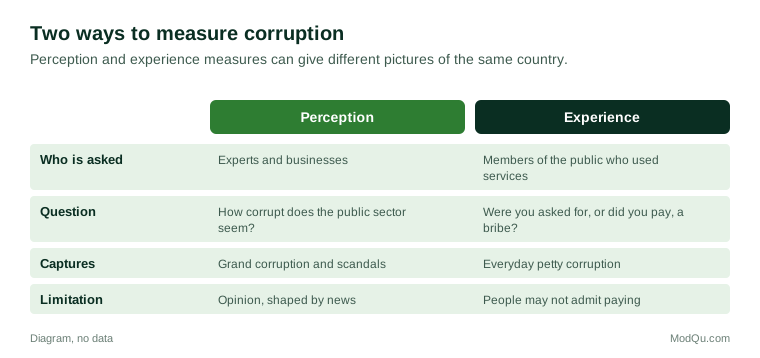
- Perception indices, such as Transparency International's Corruption Perceptions Index, which ranks countries using expert and business assessments of public-sector corruption.
- Experience surveys, such as the Global Corruption Barometer, which ask members of the public whether they have paid a bribe when using public services.
- Enterprise surveys, such as those run by the World Bank, asking businesses about bribes and informal payments.
- Audit findings, court cases and investigations.
- Indicators of risk, such as single-bidder contracts in public procurement.
Perception and experience can differ. A country may be perceived as corrupt because of high-profile scandals while few ordinary people report paying bribes, or the reverse.
Asking about bribes in surveys
Bribery is a sensitive topic. People may not admit paying bribes because it is illegal, embarrassing or risky. Survey researchers use methods to reduce this, including:
- guaranteeing anonymity;
- asking about specific services and time periods;
- asking whether a bribe was requested, rather than whether one was paid;
- indirect questioning techniques, such as randomized response.
Example (hypothetical figures)
A survey asks 1,000 people who used a public service in the past year whether they were asked for an unofficial payment. 180 say yes. Of those, 110 say they paid, 50 say they refused and 20 prefer not to say. Of the 160 who answered, about 69% paid.
Who holds officials to account
Accountability means officials must explain their actions and face consequences for wrongdoing. It depends on many institutions:
- parliaments and legislatures that question governments and approve budgets;
- courts and prosecutors that try corruption cases;
- supreme audit institutions that check public spending;
- anti-corruption agencies with powers to investigate;
- ombudsmen who handle complaints about public bodies;
- a free press and investigative journalists;
- civil society organizations and watchdog groups;
- whistleblowers who report wrongdoing from inside;
- voters at elections.
Tools such as asset declarations by officials, open budgets, open contracting data and freedom of information laws help citizens and journalists see how decisions are made and money is spent.
The United Nations Convention against Corruption, adopted in 2003, is the main global treaty on corruption and has been ratified by most countries.
Example
A journalist uses open procurement data to find that a city has awarded several road contracts to a company owned by a councillor's relative. After the story is published, the city's audit office opens an investigation and the contracts are suspended.
Effects of corruption
Corruption raises costs for citizens and businesses, reduces the quality of public services, discourages investment, and weakens trust in government. It often hits poorer people hardest, because they rely more on public services and cannot afford to pay bribes. It can also undermine elections and the rule of law.
Reporting corruption
Many countries have hotlines, websites or agencies for reporting corruption, and laws to protect whistleblowers. People often say they do not report because they think nothing will happen, fear retaliation or do not know where to go.
What people disagree about
People disagree about how widespread corruption is, whether small gifts and favours are corruption or courtesy, how much power anti-corruption bodies should have, and whether some measures, such as heavy rules on procurement, slow government down. Views also differ on whether corruption is mainly a problem of individuals or of systems.
Questions that governments, public agencies and policy groups want answered include how common people think corruption is, how often they are asked for bribes, whether they would report it, and who they trust to hold officials to account.
Corruption in daily life
For many people, corruption is not an abstract idea but part of daily dealings with officials. Studies using experience surveys have found that the services where people most often report requests for unofficial payments include police, courts, permits and licences, utilities, and in some countries health care and schools. The pattern differs widely between countries. People may also use personal connections to get services faster, which some see as normal and others see as a form of corruption.
Key terms
- CorruptionThe abuse of entrusted power for private gain.
- BriberyOffering or accepting something of value to influence a decision.
- EmbezzlementStealing money or property entrusted to someone's care.
- NepotismFavouring relatives in jobs or contracts.
- WhistleblowerA person who reports wrongdoing inside an organization.
- OmbudsmanAn official who investigates complaints about public bodies.
- Asset declarationA statement by an official of what they own and earn.
- ProcurementThe process by which public bodies buy goods and services.
Full glossary: government accountability terms on EditingTests.com.
Corruption and accountability vocabulary test
How well do you know the language of this topic? Try 8 quick questions. Your score is shown straight away and is not saved.
What the corruption and accountability survey asks
This survey is part of ModQu's Government and Public Services survey. The corruption and accountability part takes about five minutes and covers:
- How common you think corruption is in your area and your country.
- Whether you have been asked for an unofficial payment, and for which service.
- What you did if you were asked.
- Whether you would report corruption, and to whom.
- Who you think holds officials to account most effectively.
- How much you trust anti-corruption bodies, courts and the media.
After that you can choose to continue with other short parts of the Government and Public Services survey, such as local services or trust in government, or stop.
Ready to take part?
Your answers help show what people really think and do. Results are only ever reported as totals; no one can see your individual answers.
Start the surveyQuestions about this survey
Who can take part?
Adults.
Do I have to give my name?
No. You may be asked for your age group, region and similar details so results can be broken down, but not your name. ModQu never asks for passwords, card numbers or account numbers.
How are the results used?
Answers are combined into totals and percentages and published in ModQu reports. Individual answers are never shown.
Is the vocabulary test part of the survey?
No. It is optional and separate, and your score is not stored.
Is it safe to answer questions about bribes?
ModQu does not ask for your name or details of officials, and answers are reported only for groups. You can skip any question.
Does the survey investigate specific cases?
No. It asks about general experience and views, not about particular people.
Where can I report corruption?
Many countries have an anti-corruption agency, ombudsman or hotline. ModQu cannot take reports.
Can people in any country take part?
Yes. The questions are written for all countries.