
Share your experience of voting
Tell us whether you voted in the last national election, how you voted and what would make voting easier. Your answers are combined with other people's and reported only as totals.
Start the elections and voting surveyAbout 5 minutes. No account needed. You can stop at any time.
What elections are for
An election is a formal process in which eligible people choose representatives or decide questions by voting. Countries hold elections for national parliaments and presidents, regional assemblies, city and local councils, and sometimes judges, mayors and other officials. Many also hold referendums, where voters decide a specific question directly.
The right to take part in government through genuine periodic elections with universal and equal suffrage is set out in Article 21 of the Universal Declaration of Human Rights. In practice, how free and fair elections are differs greatly between countries.
Who can vote
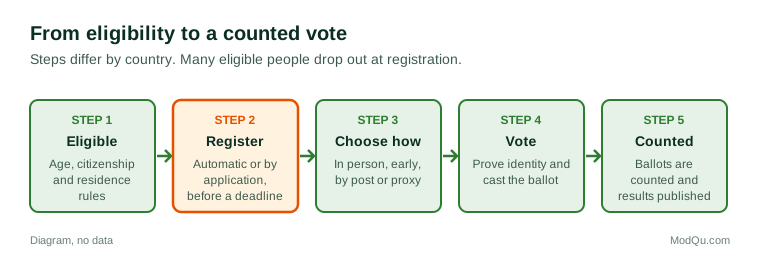
Rules on who can vote differ, but common requirements include:
- citizenship, although some countries allow some foreign residents to vote in local elections;
- minimum age, most often 18, though some countries use 16 or 17 for some or all elections;
- registration, either automatic or by application;
- residence in the area where the vote is cast.
Some countries restrict voting by people in prison or under certain court orders. Citizens living abroad can vote in many countries' national elections, by post, at embassies or online.
A small number of countries, including Australia, Belgium and Brazil, have compulsory voting, where eligible citizens must vote or face a penalty, usually a small fine. In most countries, voting is voluntary.
How people vote
The main ways to cast a vote are:
- In person at a polling station on election day, using a paper ballot or a voting machine.
- Early voting at a polling place in the days before election day.
- Postal or mail voting, where a ballot is sent to the voter and returned by post or drop-off.
- Proxy voting, where a voter appoints someone to vote on their behalf.
- Mobile polling for people in hospitals, care homes or remote areas.
- Internet voting, used nationally in a few countries such as Estonia, and in limited trials elsewhere.
Most voters must prove their identity, and rules on what counts as proof vary widely, from no document to a specific photo ID.
Electoral systems
How votes are turned into seats affects how people vote and how results look:
- First-past-the-post: the candidate with the most votes in each area wins.
- Two-round systems: if no one gets a majority, the top candidates face a run-off.
- Proportional representation: seats are shared according to each party's share of the vote.
- Ranked or preferential voting: voters rank candidates in order of preference.
- Mixed systems combining local seats and proportional seats.
People often vote differently depending on the system. In first-past-the-post systems, some vote tactically for a candidate who can win rather than their first choice.
Why people vote, and why some do not
People who vote often say they see it as a duty, want to influence decisions, support a party or candidate, or feel strongly about an issue. Habit matters: people who voted before are more likely to vote again.
Reasons people give for not voting include:
- feeling their vote will not make a difference;
- not liking any of the choices;
- not trusting politicians or the process;
- not knowing enough about candidates;
- not being registered, or missing a deadline;
- being busy, ill, away or unable to get to a polling station;
- difficulties with identification requirements;
- language or disability barriers.
Example
A young adult in their first election moves to a new city a month before polling day. They assume they are still registered at their parents' address. On election day they find they are registered there, two hours away, and they do not vote. At the next election they register online at their new address.
Turnout differs widely between countries and types of election. Local and regional elections usually have lower turnout than national ones. Older people tend to vote more than younger people in many countries.
Making voting easier
Measures used in different countries to make voting more accessible include:
- automatic voter registration;
- registration on election day;
- early voting and longer polling hours;
- postal voting available to everyone;
- holding elections on weekends or public holidays;
- accessible polling stations and voting equipment for people with disabilities;
- ballots and information in several languages;
- mobile polling stations.
Example (hypothetical figures)
A town has 40,000 registered voters. In the last local election 14,000 voted, a turnout of 35%. After the council introduces two weeks of early voting and a mobile polling station for care homes, 17,200 vote at the next election, a turnout of 43%. Other factors, such as a close contest, may also have played a part.
Trust and security
Trust in elections depends on how they are run and how people perceive them. Independent election commissions, observers from parties and civil society, transparent counting, paper records that can be recounted and timely publication of results all help. International observer missions monitor elections in many countries.
Concerns include misinformation about how and when to vote, foreign interference, voter intimidation, vote buying, and claims of fraud. Election officials in many places now publish information to counter false claims.
Example
Before an election, false messages spread online saying voters for one party should vote a day later. The election commission posts corrections on its website and social media, and polling station staff are told to watch for confused voters.
What people disagree about
People disagree about voter ID requirements, postal and internet voting, the voting age, compulsory voting, electoral systems and how constituencies are drawn. Each choice involves trade-offs between access, security and fairness, and views often split along political lines.
Questions that election bodies, governments and policy groups want answered include who votes and who does not, how people prefer to vote, what barriers they face and what would make voting easier.
Key terms
- ElectionA formal process in which people choose representatives or decide questions by voting.
- ReferendumA vote on a single question put directly to voters.
- TurnoutThe share of eligible or registered voters who vote.
- BallotThe paper or electronic form used to record a vote.
- Polling stationA place where people go to vote in person.
- Postal voteA vote sent and returned by post.
- Compulsory votingA rule requiring eligible citizens to vote.
- Proportional representationA system in which seats match each party's share of the vote.
Full glossary: public opinion research terms on EditingTests.com.
Elections and voting vocabulary test
How well do you know the language of this topic? Try 8 quick questions. Your score is shown straight away and is not saved.
What the elections and voting survey asks
This survey is part of ModQu's Government and Public Services survey. The elections and voting part takes about five minutes and covers:
- Whether you voted in the last national election, and in local elections.
- How you voted: in person, early, by post or another way.
- Why you voted, or why you did not.
- Any problems you had registering or voting.
- How much you trust the election process where you live.
- What would make voting easier for you.
After that you can choose to continue with other short parts of the Government and Public Services survey, such as local services or trust in government, or stop.
Ready to take part?
Your answers help show what people really think and do. Results are only ever reported as totals; no one can see your individual answers.
Start the surveyQuestions about this survey
Who can take part?
Adults eligible to vote.
Do I have to give my name?
No. You may be asked for your age group, region and similar details so results can be broken down, but not your name. ModQu never asks for passwords, card numbers or account numbers.
How are the results used?
Answers are combined into totals and percentages and published in ModQu reports. Individual answers are never shown.
Is the vocabulary test part of the survey?
No. It is optional and separate, and your score is not stored.
Will I be asked who I voted for?
No. The survey asks whether and how you voted, not which party or candidate you chose.
Can people who are not eligible to vote take part?
Yes. Some questions ask non-voters and residents who cannot vote about their views on elections.
Does the survey cover local elections?
Yes. It asks about national and local elections separately, because turnout and experience often differ.
Is this survey run by an election authority?
No. ModQu is independent, and your answers are not shared with election authorities in a way that identifies you.