
Surveys · Types and applications
Exit Polls: How They Work and Why They Sometimes Fail
Exit polls interview voters as they leave polling stations on election day. This article explains how exit polls are designed, how they are used to project results and explain elections, and why they sometimes go wrong.
An exit poll is a survey of voters taken as they leave polling stations on election day. Unlike pre-election polls, which ask people how they intend to vote, an exit poll asks people who have just voted how they voted. Exit polls serve two main purposes: projecting the result soon after polls close, and explaining the result by showing how different groups voted and why.
Origins
Exit polls were developed by television networks in the United States in the late 1960s and early 1970s. Warren Mitofsky, working for CBS News, is credited with designing the methods that became standard: choosing a sample of polling places and interviewing a systematic sample of voters at each (Mitofsky, 1991). Since the 1970s, exit polls have become a regular part of election coverage in many countries, and their data form a long-running record of how different groups vote (Best & Krueger, 2012).
How exit polls work
Exit polls use a two-stage cluster sample. First, a sample of polling stations is selected, usually with probabilities related to their size and often stratified by region and past voting patterns. Second, interviewers at each station approach every nth voter leaving, for example every fifth, so that the interviewer does not choose whom to approach. Voters fill in a short, confidential paper or tablet questionnaire, which reduces the pressure to give a socially acceptable answer. Bishop and Fisher (1995) found that this secret-ballot method produced more accurate reports of vote choice than interviews conducted face to face. The steps from sample to projection are shown in Figure 1.
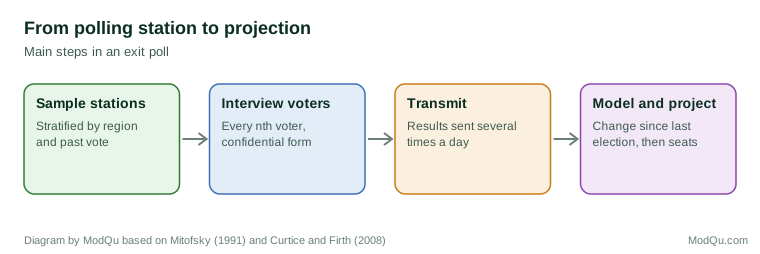
Results are sent to a central team several times during the day. Analysts combine them with past results for the same polling stations, which allows them to estimate the change in each party's vote since the previous election rather than its level. In Britain, this approach, which compares the same polling stations at successive elections, has produced accurate projections of seats in the House of Commons (Curtice & Firth, 2008).
Uses
Exit polls are used to:
- Project the result when polls close, before official counts are available.
- Explain the result, by showing how voters of different ages, incomes, ethnic groups and education levels voted.
- Check the integrity of elections in some countries, where large differences between exit polls and official results can raise questions.
Limitations
Exit polls face several sources of error. Some voters refuse to take part, and if refusal is more common among supporters of one party, the poll will be biased. Interviewers may find it easier to approach some kinds of voters than others. Voters who vote by post or early in person are missed unless they are surveyed separately, which has become a major issue as early voting has grown. Sampling a limited number of polling stations can also under-represent minority groups who are concentrated in a few areas; Barreto et al. (2006) proposed adding stratified samples of such areas to measure their vote more accurately.
High-profile errors have led to changes in method. In the 2004 presidential election in the United States, early exit poll results overstated support for one candidate, and the error was traced mainly to differences in response rates between supporters of the two candidates (Edison Media Research & Mitofsky International, 2005; Traugott & Lavrakas, 2008). The evaluation also found that the error was larger where interviewers were younger and where they had to stand farther from the polling place, which suggests that the conditions of interviewing affected who agreed to take part.
Early and postal voting
In many countries a growing share of votes is cast before election day, by post or at early voting centres. These voters never pass an exit poll interviewer. To cover them, exit poll organisations now combine interviews at polling stations with telephone or online surveys of early and postal voters, conducted in the days before the election. The two parts are weighted together according to the expected share of each type of vote. This makes exit polls more like conventional surveys and adds the errors of those surveys to the errors of the polling-station sample.
Reading exit polls
Projections are most reliable when they are based on the full day's results and adjusted to actual counts as they come in. Estimates for small groups carry large margins of error.
An example
At 10 p.m., when polls close, a broadcaster projects that the governing party will lose 20 seats. The projection is based on interviews with about 20,000 voters at 140 polling stations, compared with the results at the same stations at the previous election. As official counts arrive overnight, the projection is updated; the final result is within five seats of the first projection (illustrative example).
Conclusion
Exit polls give the first reliable picture of an election result and a detailed account of how different groups voted. Their accuracy depends on careful sampling of polling stations, systematic selection of voters, confidential questionnaires and modelling against past results.
References
Barreto, M. A., Guerra, F., Marks, M., Nuño, S. A., & Woods, N. D. (2006). Controversies in exit polling: Implementing a racially stratified homogenous precinct approach. PS: Political Science & Politics, 39(3), 477–483. https://doi.org/10.1017/S1049096506060914
Best, S. J., & Krueger, B. S. (2012). Exit polls: Surveying the American electorate, 1972–2010. CQ Press.
Bishop, G. F., & Fisher, B. S. (1995). "Secret ballots" and self-reports in an exit-poll experiment. Public Opinion Quarterly, 59(4), 568–588. https://doi.org/10.1086/269494
Curtice, J., & Firth, D. (2008). Exit polling in a cold climate: The BBC–ITV experience in Britain in 2005. Journal of the Royal Statistical Society: Series A (Statistics in Society), 171(3), 509–539. https://doi.org/10.1111/j.1467-985X.2007.00536.x
Edison Media Research & Mitofsky International. (2005). Evaluation of Edison/Mitofsky election system 2004. National Election Pool.
Mitofsky, W. J. (1991). A short history of exit polls. In P. J. Lavrakas & J. K. Holley (Eds.), Polling and presidential election coverage (pp. 83–99). SAGE.
Traugott, M. W., & Lavrakas, P. J. (2008). The voter's guide to election polls (4th ed.). Rowman & Littlefield.