
Share your views on community safety
Tell us how safe you feel where you live, how much you trust local police and whether you have reported a crime. Your answers are combined with other people's and reported only as totals.
Start the policing and community safety surveyAbout 5 minutes. No account needed. You can stop at any time.
How policing is organized in Canada
Policing in Canada is organized at several levels:
- Municipal police services serve many cities and towns.
- Provincial police serve some provinces directly: the Ontario Provincial Police, the Sûreté du Québec and the Royal Newfoundland Constabulary in parts of Newfoundland and Labrador.
- The Royal Canadian Mounted Police (RCMP) is the federal police. It also serves, under contract, as the provincial or territorial police in most provinces and all three territories, and as the local police in many municipalities.
- First Nations police services serve some First Nations communities.
- Specialized bodies police areas such as transit systems and some ports.
Police are overseen by civilian bodies such as police boards and commissions, and in most provinces independent agencies investigate incidents where police use of force causes serious injury or death. In the United States, policing is even more local, with thousands of city, county, state and federal agencies.
What makes people feel safe or unsafe
Feelings of safety do not always match crime rates. People's sense of safety is shaped by:
- Personal experience of crime, or crime against family and friends.
- What they see: litter, graffiti, vacant buildings, poor lighting and visible drug use can make an area feel less safe.
- Who they are: women, older adults, people with disabilities, members of racialized and 2SLGBTQI+ communities and others may face different risks and worries.
- Time and place: walking alone at night, using transit late or being in unfamiliar areas.
- News and social media, which can make crime feel more common or closer than it is.
- Knowing neighbours, which tends to make people feel safer.
Statistics Canada's General Social Survey on Canadians' Safety asks people about their experiences of crime and how safe they feel, including whether they feel safe walking alone in their area after dark.
Example
A woman who moved to a new apartment avoids walking home from the bus stop after dark because the path through a park has no lighting. Her neighbours raise the issue at a community association meeting. The city adds lights along the path the next year, and she starts taking the bus home from evening classes again.
Trust and confidence in police
Trust in police varies widely between people and communities. Factors linked to higher or lower trust include:
- personal contact with police, and whether the person felt treated fairly and with respect;
- experiences of friends, family and community members;
- high-profile incidents, including those shown in videos online;
- whether people see police as responsive to local problems;
- history, including the experiences of Indigenous peoples and Black Canadians with police.
Research on procedural justice suggests that how people are treated in an encounter, such as being listened to and given reasons, affects trust as much as the result.
Reporting crime
Many crimes are never reported to police. Victimization surveys, which ask people directly about crimes they have experienced, consistently find that a large share of incidents do not appear in police statistics. Reasons people give for not reporting include:
- thinking the incident was too minor;
- believing police could not or would not do anything;
- handling it another way, such as through an insurer or a landlord;
- fear of retaliation, embarrassment or not being believed;
- distrust of police;
- the incident being personal or involving someone they know.
Sexual assault and family violence are among the least reported crimes.
Example
A household's bicycle is stolen from their garage. They decide not to report it, thinking nothing will come of it. When they later learn that their insurer needs a police report number to process a claim, they file a report online through the local police service's non-emergency system.
Calling police and other services
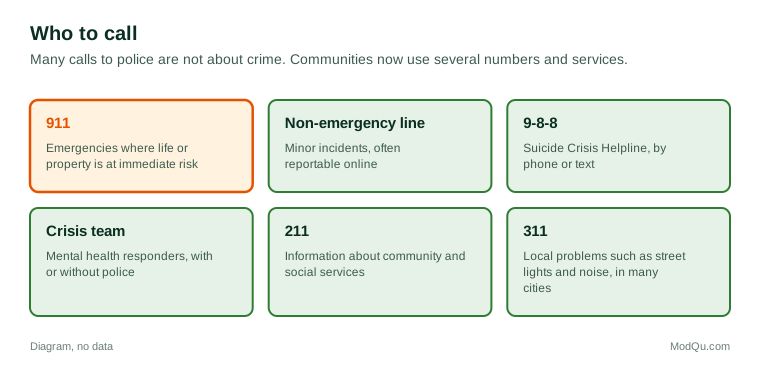
Police receive many calls that are not about crime: people in mental health crisis, wellness checks, noise complaints, missing persons and traffic problems. Many communities now use other options for some of these calls:
- 911 for emergencies where life or property is at immediate risk.
- Non-emergency police lines and online reporting for minor incidents that do not need a quick response.
- Mental health crisis teams, sometimes pairing a nurse or social worker with an officer, or working without police.
- The 9-8-8 Suicide Crisis Helpline, launched in Canada in 2023.
- 211 for information about community and social services.
Example (hypothetical figures)
A police service reviews 10,000 calls received in a month. It classifies 1,800 as criminal incidents in progress, 2,600 as traffic or collisions, 1,400 as mental health or wellness calls, 1,700 as disputes and disturbances, and 2,500 as other matters. The mental health and wellness calls make up 14% of the total, which the service uses to make the case for a civilian crisis team.
Community safety programs
Community safety is not only a police matter. Programs that communities use include:
- Neighbourhood watch and block parent programs.
- Crime prevention through environmental design (CPTED), such as better lighting, clear sightlines and well-kept public spaces.
- Youth programs, sports and after-school activities.
- Victim services, which support people after a crime.
- Restorative justice programs, which bring together those harmed and those responsible to repair harm.
- Safety audits of neighbourhoods, often led by women's groups or community associations.
Example
A housing co-operative carries out a night-time safety walk with residents, police and a city planner. They note broken lights, overgrown hedges and a locked gate that forces residents to walk through a dark laneway. Within six months most of the fixes are done, and residents report feeling safer in a follow-up survey.
What people disagree about
People disagree about how much money should go to police compared with social services, mental health and housing, about the role of police in schools, the use of tools such as body-worn cameras and facial recognition, how police should handle protests, and how to balance safety with civil liberties. Questions that governments and public agencies want answered include how safe people feel walking at night where they live, how much they trust local police and whether they reported a crime in the last year.
Key terms
- Victimization surveyA survey that asks people directly about crimes they have experienced, reported or not.
- Procedural justiceFair and respectful treatment by authorities during an encounter.
- Police boardA civilian body that oversees a police service.
- Non-emergency lineA phone number for reporting police matters that do not need an urgent response.
- Restorative justiceA process that brings together people harmed and people responsible to repair harm.
- CPTEDCrime prevention through environmental design: using the design of places to reduce crime.
- Crisis teamResponders trained to help people in mental health crisis.
- Fear of crimeWorry about becoming a victim, which may differ from the actual risk.
Full glossary: law enforcement administration terms on EditingTests.com.
Policing and community safety vocabulary test
How well do you know the language of this topic? Try 8 quick questions. Your score is shown straight away and is not saved.
What the policing and community safety survey asks
This survey is part of ModQu's Government and Public Services survey. The policing and community safety part takes about five minutes and covers:
- How safe you feel walking alone at night and using transit where you live.
- How much you trust your local police service, and why.
- Whether you have been a victim of crime in the last year, and whether you reported it.
- Your experience of contact with police, if any.
- Which community safety measures you think would help most in your area.
- Who you think should respond to mental health and wellness calls.
After that you can choose to continue with other short parts of the Government and Public Services survey, such as local services or trust in government, or stop.
Ready to take part?
Your answers help show what people really think and do. Results are only ever reported as totals; no one can see your individual answers.
Start the surveyQuestions about this survey
Who can take part?
Residents.
Do I have to give my name?
No. You may be asked for your age group, region and similar details so results can be broken down, but not your name. ModQu never asks for passwords, card numbers or account numbers.
How are the results used?
Answers are combined into totals and percentages and published in ModQu reports. Individual answers are never shown.
Is the vocabulary test part of the survey?
No. It is optional and separate, and your score is not stored.