
Share your views on government
Tell us how much you trust each level of government, where you get information and how your contact with government has gone. Your answers are combined with other people's and reported only as totals.
Start the trust in government surveyAbout 5 minutes. No account needed. You can stop at any time.
What trust in government means
Trust in government is the confidence people have that government will act competently, honestly and in the public interest. It is not one single thing. People can trust some parts of government and not others:
- Levels of government: in Canada, federal, provincial or territorial, municipal, and Indigenous governments.
- Elected officials and parties, such as the prime minister, premiers, mayors and members of legislatures.
- The public service: the departments and agencies that deliver programs and enforce rules.
- Independent institutions, such as courts, elections agencies, central banks, auditors general and statistical agencies.
- Specific services, such as passports, tax returns, benefits or health care.
Many people say they distrust "the government" in general but rate their own recent experience with a particular service quite highly. Researchers often find that trust in institutions such as courts and statistical agencies is higher than trust in politicians and parties.
The parts of trust
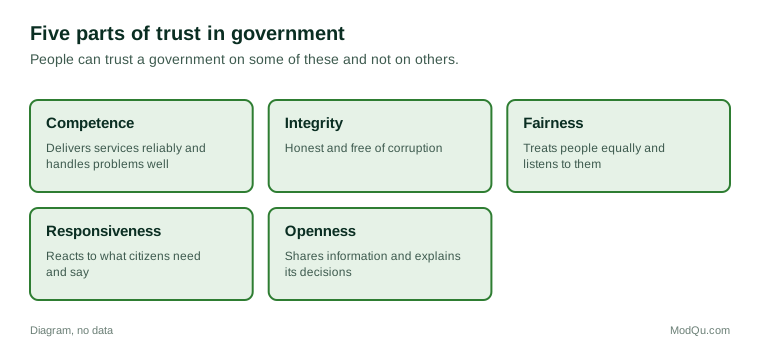
Researchers often break trust into several parts:
- Competence: does government deliver services reliably and handle problems well?
- Integrity: is it honest, free of corruption and open about what it does?
- Fairness: does it treat people equally and listen to them?
- Responsiveness: does it react to what citizens need and say?
- Openness: does it share information and explain its decisions?
The Organisation for Economic Co-operation and Development (OECD) runs a survey on the drivers of trust in public institutions across member countries, including Canada, using a framework of this kind.
What raises and lowers trust
Factors linked to changes in trust include:
- Personal experience with services: a quick, fair interaction tends to raise trust; a long wait or a mistake tends to lower it.
- Scandals, such as misuse of public money or conflicts of interest.
- Economic conditions, including jobs, prices and housing costs.
- Crises, such as pandemics and disasters, which can raise trust at first and lower it later.
- Political leanings: people often trust a government more when the party they support is in power.
- Information sources, including news, social media and what friends and family say.
- History and identity: some communities have strong historical reasons for distrust, for example Indigenous peoples in Canada because of residential schools and broken agreements.
Example
A newcomer to Canada applies for a work permit extension and waits many months without a clear answer. They tell friends they have lost faith in the system. A year later, their citizenship application goes smoothly and they receive clear updates. When asked in a survey how much they trust the federal government, they say "somewhat", reflecting both experiences.
How people deal with government
Most people's direct contact with government is through services: filing taxes, renewing a driver's licence or health card, applying for a passport or benefit, getting a building permit, or calling about a problem. Common ways to reach government include:
- online portals and accounts;
- phone lines and call centres;
- in-person service centres, such as Service Canada offices and provincial registry offices;
- contacting an elected official's constituency office for help with a case.
Example
A small business owner calls a tax agency three times about the same notice and gets three different answers. Frustrated, they contact their member of Parliament's constituency office, which gets the file reviewed within two weeks. The owner says the experience lowered their trust in the agency but raised their view of their local representative's office.
Where people get information about government
People learn about government through:
- official websites and social media accounts;
- news organizations, including public broadcasters;
- social media, video sites and messaging groups;
- friends, family and community organizations;
- direct mail, such as benefit notices and tax statements.
Misinformation and disinformation about government programs, elections and public health have become a major concern. People who rely mostly on social media for news tend to report different levels of trust from those who rely on traditional news sources, though the direction varies by country and topic.
How trust is measured
Surveys measure trust in several ways:
- General questions, such as "How much do you trust the federal government to do what is right?"
- Institution-by-institution questions, asking about each body separately.
- Experience-based questions, asking about a recent contact with a service.
- Specific expectations, such as "If you complained about a public service, how likely is it that it would be fixed?"
Answers can change with question wording, the order of questions, and recent news. That is why trust surveys are most useful when the same questions are asked in the same way over time.
Example (hypothetical figures)
A survey of 2,000 adults asks about trust in five institutions. On a scale where 0 means "no trust" and 10 means "complete trust", the average scores are: courts 6.1, the statistical agency 6.4, the public service 5.3, the federal government 4.2 and political parties 3.1. The 3.3-point gap between the highest and lowest scores shows how much trust differs between institutions.
Why trust matters
Trust in government affects how well public programs work. When trust is higher, people are more likely to follow public health advice, comply with taxes, report problems, take part in surveys such as the census, and accept decisions they disagree with. When trust is low, governments may find it harder to act in a crisis.
Too much uncritical trust is not the goal either. Healthy democracies rely on independent media, courts, auditors and citizens who question government.
Example
A city wants residents to sign up for a new emergency alert system. Neighbourhoods with high trust in the city sign up quickly. In a neighbourhood where many residents distrust city hall after a disputed development, sign-ups are low until the city works with a local community association and holds a meeting at the neighbourhood school.
What people disagree about
People disagree about whether low trust reflects poor government performance or unfair public perceptions, how much transparency is enough, whether governments should be larger or smaller, and how to respond to misinformation without limiting free expression. Questions that governments and public agencies want answered include how much people trust their national government, whether they have contacted a government office this year and where they get information about government services.
Key terms
- Public serviceThe departments and agencies that deliver government programs, staffed by non-political employees.
- TransparencyOpenness about what government does and why.
- AccountabilityThe duty of officials to explain their decisions and accept responsibility for results.
- Auditor GeneralAn independent officer who checks how public money is spent and reports to the legislature.
- MisinformationFalse or misleading information shared without intent to deceive.
- DisinformationFalse information spread deliberately to deceive.
- Constituency officeA local office of an elected representative that helps residents with government matters.
- Access to informationA legal right to request records held by government.
Full glossary: government accountability terms on EditingTests.com.
Trust in government vocabulary test
How well do you know the language of this topic? Try 8 quick questions. Your score is shown straight away and is not saved.
What the trust in government survey asks
This survey is part of ModQu's Government and Public Services survey. The trust in government part takes about five minutes and covers:
- How much you trust each level of government: federal, provincial or territorial, and local.
- How much you trust specific institutions, such as courts, the public service and elections agencies.
- Whether you have contacted a government office this year, and how it went.
- Where you get information about government and government services.
- What would raise or lower your trust in government.
- How often you feel government listens to people like you.
After that you can choose to continue with other short parts of the Government and Public Services survey, such as local services or online government services, or stop.
Ready to take part?
Your answers help show what people really think and do. Results are only ever reported as totals; no one can see your individual answers.
Start the surveyQuestions about this survey
Who can take part?
Adults.
Do I have to give my name?
No. You may be asked for your age group, region and similar details so results can be broken down, but not your name. ModQu never asks for passwords, card numbers or account numbers.
How are the results used?
Answers are combined into totals and percentages and published in ModQu reports. Individual answers are never shown.
Is the vocabulary test part of the survey?
No. It is optional and separate, and your score is not stored.