
Share your views on taxes and spending
Tell us whether you think you pay a fair amount of tax and which public services should get more or less money. Your answers are combined with other people's and reported only as totals.
Start the taxes and public spending surveyAbout 5 minutes. No account needed. You can stop at any time.
This page describes how taxes and public spending work in general terms. It is not tax or financial advice.
The main taxes people pay
In Canada, individuals pay taxes to all three main levels of government. The main ones are:
- Personal income tax, paid to the federal government and to the province or territory, on employment, business, investment and other income. Both use progressive rates, meaning higher rates apply to higher portions of income.
- Sales taxes: the federal Goods and Services Tax (GST), and either a provincial sales tax, a combined Harmonized Sales Tax (HST), or in Quebec the Quebec Sales Tax. Alberta and the territories have no provincial or territorial sales tax.
- Payroll contributions, such as Canada Pension Plan (or Quebec Pension Plan) contributions and Employment Insurance premiums, deducted from pay.
- Property tax, paid to municipalities and, in many provinces, partly to fund schools.
- Excise taxes on items such as fuel, alcohol and tobacco.
Businesses pay corporate income tax and other taxes, part of which is passed on to customers, workers and owners. In Canada, the Canada Revenue Agency (CRA) collects federal taxes and, under agreements, most provincial income taxes outside Quebec. Quebec collects its own provincial income tax through Revenu Québec.
Marginal and average tax rates
People often confuse two kinds of tax rate:
- The marginal tax rate is the rate paid on the next dollar of income.
- The average tax rate is total tax divided by total income.
Because income tax is progressive, a person's average rate is lower than their top marginal rate. Moving into a higher tax bracket only raises the rate on the income above the bracket threshold, not on all income.
Example (hypothetical figures)
Imagine a simple tax system with a rate of 15% on the first $50,000 of income and 25% on income above that. A person earning $70,000 pays $7,500 on the first $50,000 and $5,000 on the next $20,000, for $12,500 in total. Their marginal rate is 25%, but their average rate is $12,500 ÷ $70,000, about 17.9%.
Tax credits, deductions and benefits
The tax system is also used to give money back. Common features include:
- Deductions, which reduce taxable income, such as contributions to a Registered Retirement Savings Plan (RRSP) or child care expenses.
- Non-refundable credits, which reduce tax owed but cannot go below zero.
- Refundable credits and benefits, which can be paid even to people who owe no tax, such as the Canada Child Benefit and the GST/HST credit.
Filing a tax return each year is how many people receive benefits, even if they have little or no income. Free tax clinics run by volunteers help people with modest incomes file returns.
Example
A student with a part-time job earns too little to owe income tax and does not plan to file a return. A friend tells them that filing could qualify them for the GST/HST credit and lets them carry forward tuition credits for later. They file through a free community tax clinic at their campus and receive quarterly credit payments.
Where public money goes
Each level of government spends on different things:
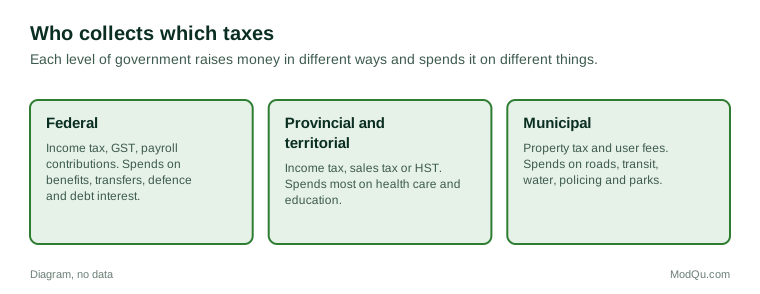
- Federal: payments to individuals, such as Old Age Security, Employment Insurance and the Canada Child Benefit; transfers to provinces for health and social programs; national defence; Indigenous services; and interest on the federal debt.
- Provincial and territorial: health care, which is usually the largest single area of spending, education, social services, justice, highways and transfers to municipalities.
- Municipal: roads, transit, water, waste, policing, fire services, parks, libraries and recreation.
Many people underestimate how much is spent on some areas, such as health care and pensions, and overestimate others, such as foreign aid.
Budgets, deficits and debt
Each year governments publish a budget setting out expected revenue and spending.
- A deficit is when spending is more than revenue in a year.
- A surplus is when revenue is more than spending.
- The debt is the total amount owed from past deficits, minus surpluses.
People often judge government finances by comparing debt to the size of the economy, measured by gross domestic product (GDP). Independent bodies such as the Parliamentary Budget Officer analyse federal budgets and costs.
Example
A city resident reads that the province has a large deficit and assumes it means the province spent more than ever. A news explainer points out that revenue had also fallen during a slowdown. The resident realizes that a deficit can result from lower revenue as well as higher spending.
What people see as fair
Views on whether taxes are fair depend on several things:
- How much people pay compared with what they think others pay.
- What they get back, such as health care, schools, roads and benefits.
- Visibility: sales taxes at the till and property tax bills are more visible than income tax deducted from pay.
- Trust that money is spent well and not wasted.
- Views on who should pay more, such as high-income earners, wealthy individuals or large corporations.
- Tax avoidance and evasion: the sense that some people or companies do not pay their share.
Survey questions on taxes are sensitive to wording. Many people say taxes are too high in general but support more spending on specific services such as health care. Asking people to choose between more spending, lower taxes and lower deficits forces trade-offs that general questions do not.
Example
A survey asks respondents to divide a hypothetical $100 of new provincial revenue between health care, education, housing, roads, tax cuts and paying down debt. Many of the same respondents who said taxes are too high put most of the money into health care and housing rather than tax cuts.
What people disagree about
People disagree about how much tax people with high incomes and corporations should pay, whether sales taxes are fair to people on low incomes, how large government should be, whether deficits are acceptable during downturns and how to set priorities among health care, education, housing, defence and debt reduction. Questions that governments and public agencies want answered include whether people think they pay a fair amount of tax, which public service should get more money and which should get less.
Key terms
- Progressive taxA tax where higher rates apply to higher portions of income.
- Marginal tax rateThe rate of tax on the next dollar of income.
- Average tax rateTotal tax divided by total income.
- Refundable tax creditA credit paid even to people who owe no tax.
- DeficitThe amount by which spending exceeds revenue in a year.
- Public debtThe total amount a government owes from past borrowing.
- Transfer paymentMoney paid by one level of government to another, or by government to individuals.
- Tax bracketA range of income taxed at a particular rate.
Full glossary: public budgeting terms on EditingTests.com.
Taxes and public spending vocabulary test
How well do you know the language of this topic? Try 8 quick questions. Your score is shown straight away and is not saved.
What the taxes and public spending survey asks
This survey is part of ModQu's Government and Public Services survey. The taxes and public spending part takes about five minutes and covers:
- Whether you think you pay a fair amount of tax, and which taxes feel heaviest.
- How well you think governments spend public money.
- Which public services you think should get more money.
- Which should get less, or whether taxes should be lower instead.
- Your views on deficits, debt and how governments should balance budgets.
- Who you think should pay more or less tax.
After that you can choose to continue with other short parts of the Government and Public Services survey, such as local services or trust in government, or stop.
Ready to take part?
Your answers help show what people really think and do. Results are only ever reported as totals; no one can see your individual answers.
Start the surveyQuestions about this survey
Who can take part?
Adults.
Do I have to give my name?
No. You may be asked for your age group, region and similar details so results can be broken down, but not your name. ModQu never asks for passwords, card numbers or account numbers.
How are the results used?
Answers are combined into totals and percentages and published in ModQu reports. Individual answers are never shown.
Is the vocabulary test part of the survey?
No. It is optional and separate, and your score is not stored.