
Share your views on the courts
Tell us how much confidence you have in the courts, whether you have served on a jury and whether you have been to court. Your answers are combined with other people's and reported only as totals.
Start the courts and the justice system surveyAbout 5 minutes. No account needed. You can stop at any time.
This page describes how courts work in general terms. It is not legal advice. For advice about a legal matter, contact a lawyer, a legal aid office or a public legal information service in your province or territory.
How courts are organized in Canada
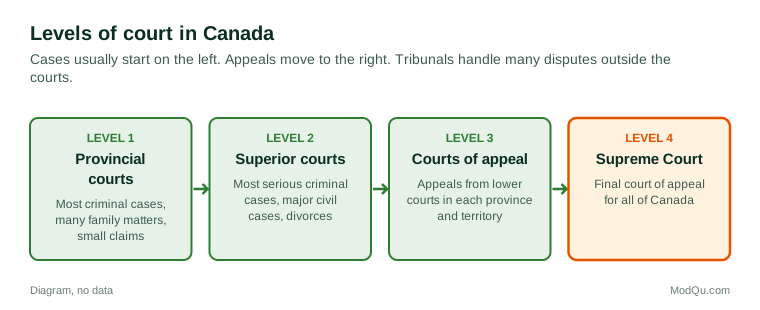
Canada's court system has several levels:
- Provincial and territorial courts hear most criminal cases, many family matters, youth cases, traffic and bylaw offences and, in most provinces, small claims.
- Superior courts of each province and territory hear the most serious criminal cases, major civil cases, divorces and appeals from lower courts. They have the broadest powers.
- Courts of appeal in each province and territory hear appeals from superior and provincial courts.
- The Supreme Court of Canada is the final court of appeal for all areas of law. It hears a limited number of cases each year, mostly with its permission.
- Federal courts, including the Federal Court, the Federal Court of Appeal and the Tax Court of Canada, hear matters such as immigration, intellectual property and tax disputes.
Many disputes are also handled by administrative tribunals, such as landlord and tenant boards, human rights tribunals and immigration and refugee boards, which are less formal than courts.
Canada has two legal traditions: common law in most of the country and civil law for private matters in Quebec. The United States has separate federal and state court systems.
Criminal and civil cases
Courts hear two main kinds of cases:
- Criminal cases, where the state prosecutes a person accused of breaking criminal law. The Crown must prove guilt beyond a reasonable doubt, and the accused is presumed innocent until proven guilty.
- Civil cases, which are disputes between people or organizations, such as contract disputes, injury claims, property disputes and family matters. The person bringing the case usually has to prove it on a balance of probabilities, meaning it is more likely than not.
Most criminal cases end without a full trial, often through a guilty plea or because charges are withdrawn or stayed. Most civil cases settle before trial.
Small claims and everyday legal problems
Many people's only time in court is for an everyday dispute. Small claims court handles money claims up to a limit set by each province, with simpler rules so that people can represent themselves. Common cases include unpaid bills, damaged property, disputes with contractors and deposits not returned.
Research on everyday legal problems has found that many people face problems with a legal side, such as debt, housing, employment or family issues, without seeing them as legal problems or getting legal help.
Example
A homeowner pays a contractor a deposit for a deck that is never built. After several unanswered messages, they file a claim in small claims court. They use the court's online guides and a free legal information clinic to prepare. At a settlement conference the contractor agrees to repay most of the deposit in instalments, and the case does not go to trial.
Family court
Family law covers separation and divorce, child custody and parenting time, child and spousal support, and division of property. Family cases are often stressful and long. Many provinces encourage or require mediation or other dispute resolution before a court hearing, and some have unified family courts where one court handles all family matters.
Jury duty
In Canada, juries are used in some criminal trials and, in a few provinces, in some civil trials. Jury selection is managed by each province or territory. People are chosen at random from lists such as voter or health card records and receive a summons. Not everyone summoned ends up serving.
Common questions people have about jury duty include whether employers must give time off (provincial employment laws generally protect jobs, though pay rules vary), how much jurors are paid, how long a trial will last and what happens if they cannot serve. Jurors in Canada are not allowed to disclose what was said during deliberations.
Example
A self-employed graphic designer receives a jury summons. They worry about losing income during a long trial. At jury selection, they explain the hardship to the judge, who excuses them from that trial. A retired teacher in the same group is selected and later says serving on the jury gave them a much better understanding of how trials work.
Delays and costs
Two of the most common concerns about the justice system are delay and cost.
Delay: In 2016, in a decision known as R. v. Jordan, the Supreme Court of Canada set presumptive time limits for criminal cases to reach trial, after which charges can be stayed for unreasonable delay. Since then, some serious cases have been stayed for delay, which has drawn public attention.
Cost: Hiring a lawyer for a trial can be expensive, and many people who do not qualify for legal aid cannot afford one either. As a result, a large number of people in family and civil courts represent themselves.
Options that help with cost include legal aid for people with low incomes, duty counsel at court, law school legal clinics, pro bono services, public legal education organizations, limited-scope retainers where a lawyer handles only part of a case, and in some provinces online dispute resolution, such as British Columbia's Civil Resolution Tribunal.
Example (hypothetical figures)
A person in a family dispute is quoted a lawyer's rate of $300 an hour and an estimate of 40 hours to reach a trial, which comes to $12,000 before taxes and disbursements. Instead, they hire the lawyer under a limited-scope retainer for 8 hours of advice and document review, costing $2,400, and represent themselves at the hearing.
Confidence in the courts
Surveys often find that people have more confidence in the courts than in elected bodies, but confidence varies. Factors that affect it include:
- views on whether sentences are too lenient or too harsh;
- high-profile cases and how they are reported;
- personal experience of court as a party, witness, juror or victim;
- whether people feel the system treats everyone equally, regardless of income, race or background;
- the overrepresentation of Indigenous people and Black Canadians in the criminal justice system, which has been recognized by courts and governments.
Many people know little about how courts work, and confidence tends to be higher among people who understand the process.
Example
A victim of a break-in attends the sentencing of the person responsible and is upset by what seems a short sentence. A victim services worker explains how the judge considered the offender's guilty plea, lack of record and the time already spent in custody. The victim still disagrees with the sentence but says they understand the decision better.
What people disagree about
People disagree about sentencing, bail rules, the use of juries, how much to spend on legal aid, whether cameras should be allowed in courtrooms, and how to reduce delays. Questions that governments and public agencies want answered include how much confidence people have in the courts, whether they have served on a jury and whether they have been to court for any reason.
Key terms
- Beyond a reasonable doubtThe standard of proof in criminal cases.
- Balance of probabilitiesThe standard of proof in civil cases: more likely than not.
- Small claims courtA court for money disputes up to a set limit, with simpler procedures.
- Legal aidPublicly funded legal help for people with low incomes.
- TribunalA body outside the regular courts that decides disputes in a specialized area.
- MediationA process where a neutral person helps the parties reach their own agreement.
- SummonsAn official notice requiring a person to appear, for example for jury duty.
- Stay of proceedingsA halt to a court case, for example because of unreasonable delay.
Full glossary: court technology terms on EditingTests.com.
Courts and the justice system vocabulary test
How well do you know the language of this topic? Try 8 quick questions. Your score is shown straight away and is not saved.
What the courts and the justice system survey asks
This survey is part of ModQu's Government and Public Services survey. The courts and the justice system part takes about five minutes and covers:
- How much confidence you have in the courts and the justice system.
- Whether you have been summoned for or served on a jury, and what it was like.
- Whether you have been to court or a tribunal for any reason, and how it went.
- Whether you have had an everyday legal problem and where you looked for help.
- What you think about court delays and the cost of legal help.
- How fair you think the justice system is to different groups.
After that you can choose to continue with other short parts of the Government and Public Services survey, such as local services or trust in government, or stop.
Ready to take part?
Your answers help show what people really think and do. Results are only ever reported as totals; no one can see your individual answers.
Start the surveyQuestions about this survey
Who can take part?
Adults.
Do I have to give my name?
No. You may be asked for your age group, region and similar details so results can be broken down, but not your name. ModQu never asks for passwords, card numbers or account numbers.
How are the results used?
Answers are combined into totals and percentages and published in ModQu reports. Individual answers are never shown.
Is the vocabulary test part of the survey?
No. It is optional and separate, and your score is not stored.