
Investigation · Journalism and public investigation
Investigative Journalism: Methods and Public Value
Investigative journalism uncovers what powerful people and institutions want to keep hidden. This article explains what distinguishes it from everyday reporting, the methods investigative journalists use, the evidence on its effects, and the economic and ethical pressures it faces.
Some of the most consequential knowledge in public life has come not from governments or universities but from journalists: the abuse of children concealed by church authorities, the offshore companies used by politicians and business leaders to hide wealth, the dangerous conditions in workplaces and the misconduct of officials. Investigative journalism is the branch of journalism that sets out to discover such matters through original, sustained inquiry. It is expensive, slow and often legally risky, and its practitioners are frequently threatened. It is also widely regarded as one of journalism's most valuable contributions to democratic society.
This article explains what investigative journalism is, how investigations are carried out, what evidence exists about their effects, and the pressures on the practice today.
What makes journalism investigative
All journalism involves gathering and checking information, so what makes some of it investigative? Most definitions combine three features. First, the work is original: the journalist uncovers information through their own inquiry rather than reporting what others have announced. Second, the subject is something that someone with power wants to keep secret or has failed to address. Third, the matter is of public importance, usually involving wrongdoing, harm or failure by institutions that the public relies on (de Burgh, 2008; Hunter et al., 2011).
Ettema and Glasser (1998) describe investigative journalists as "custodians of conscience". Their stories do more than report facts; they make moral claims, inviting readers to recognise that something is wrong and that someone should be held responsible. That gives the work its public force, and it also places a heavy burden on the journalist to be right.
Investigative journalism is sometimes described as the "watchdog" function of the press. Kovach and Rosenstiel (2014) list independent monitoring of power as one of the core elements of journalism, and argue that it must be exercised with discipline, through verification, rather than as sensationalism or campaigning. Schudson (2008) argues that democracies need a press willing to be disliked by those in power precisely because it performs this role.
A short history
Investigative reporting has a long history. Feldstein (2006) identifies recurring cycles in American history in which investigative journalism flourished, linked to both demand from an engaged public and the supply provided by new and competitive media. The first great wave came with the "muckrakers" of the early twentieth century, such as Ida Tarbell, whose detailed history of the Standard Oil Company documented the business practices of John D. Rockefeller's monopoly, drawing heavily on court records and public documents (Tarbell, 1904).
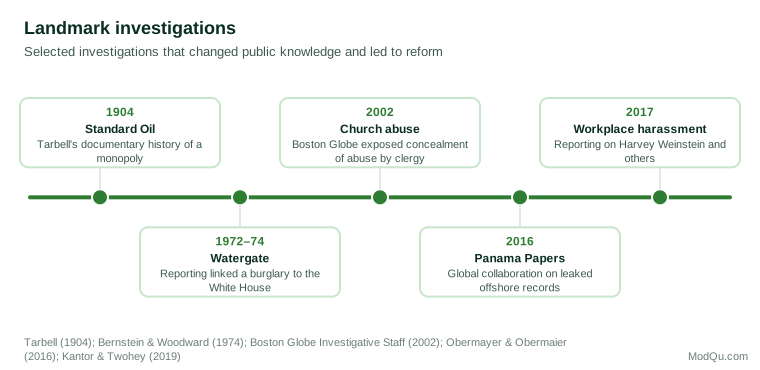
The second great wave came in the 1960s and 1970s. The Washington Post's reporting on the Watergate burglary, by Bob Woodward and Carl Bernstein, traced connections between the break-in at the Democratic Party's offices and President Nixon's re-election committee and White House, contributing to the investigations that led to his resignation (Bernstein & Woodward, 1974). The success of Watergate encouraged news organisations to create dedicated investigative teams and led to the founding of professional networks for investigative reporters.
How investigations are done
Investigative methods vary with the subject, but several elements are common.
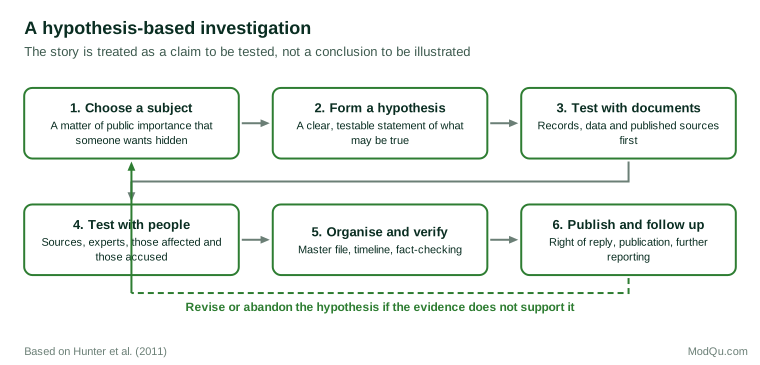
Starting with a hypothesis. Hunter et al. (2011), in a manual published by UNESCO, recommend that investigations begin by stating a hypothesis: a clear claim about what might be true that the investigation will test. A hypothesis focuses the work, helps editors decide whether the investigation is worth the cost, and can be revised or abandoned if the evidence does not support it. The danger, which the method addresses explicitly, is that journalists look only for evidence that confirms what they expected.
Documents first. Experienced investigators work from documents before people. Public records such as company registries, court files, property records, procurement contracts, regulatory filings and government budgets provide verifiable facts and show what questions to ask. Freedom of information laws allow journalists to obtain records held by public bodies. Documents are less likely than people to change their story, and they protect the journalist when a story is challenged.
Human sources. Most investigations ultimately depend on people: insiders and whistleblowers who know what happened, victims and witnesses, experts who can interpret technical material, and the subjects themselves. Building trust with sources, protecting their identity where necessary, and testing their accounts against documents and other sources are central skills. The Boston Globe's 2002 investigation into the Catholic Archdiocese of Boston combined interviews with survivors, legal documents obtained through court action, and church directories that showed priests being moved between parishes (Boston Globe Investigative Staff, 2002).
Data. Large datasets increasingly support investigations, from analyses of government spending to the records of police stops. Houston (2010) describes how computer-assisted reporting, which began with journalists analysing government databases in the 1960s and 1970s, became central to investigative work as data became more available.
Collaboration. Some investigations are too large for any single newsroom. The Panama Papers, a leak of 11.5 million documents from a Panamanian law firm, were shared by two journalists at the German newspaper Süddeutsche Zeitung with the International Consortium of Investigative Journalists, which coordinated more than 370 journalists in around 80 countries working on the material in secret for a year before simultaneous publication (Obermayer & Obermaier, 2016). Collaboration allowed local expertise, shared verification and protection from legal pressure in any one country.
Verification and the right of reply. Before publication, investigative stories are checked line by line against the evidence, reviewed by editors and often by lawyers, and put to the people accused, who are given a fair opportunity to respond. Kantor and Twohey (2019) describe how their reporting on Harvey Weinstein for The New York Times rested on documents such as settlement agreements and internal memos, as well as on women willing to be named, and how they gave Weinstein's representatives detailed allegations to answer before publication.
Public value: what difference does it make?
The public value of investigative journalism is easy to assert but harder to measure. Studies have approached it in several ways.
Agenda setting and policy change. Protess et al. (1991) followed several investigative stories in the United States and measured their effects on public opinion, on the views of policy makers and on policy itself. They found that investigations often produced policy changes, but that these came less through mass public outrage than through direct interaction between journalists and officials, who sometimes acted before or soon after publication. Their findings suggest that the influence of investigative journalism depends on the institutions that respond to it.
Economic return. Hamilton (2016) analysed investigative stories and estimated their benefits to society, such as lives saved, money recovered and policies changed. Using case studies, he estimated that a single investigative story could generate benefits many times greater than its cost, sometimes hundreds of dollars in social benefit for each dollar spent. Because news organisations capture only a small share of these benefits through sales and advertising, he argued, the market tends to produce less investigative journalism than society would value.
Corruption and accountability. Cross-national studies have found that countries with greater press freedom tend to have lower levels of corruption (Brunetti & Weder, 2003), though the direction of cause is hard to establish. Coronel (2010) reviews evidence that watchdog reporting has exposed corruption and forced the resignation of officials in many countries, while noting that its effect depends on whether courts, legislatures and voters act on what is reported. Besley and Prat (2006) show theoretically that the press can hold governments accountable only when it is not captured by those in power, and that the number and independence of media outlets matter. Snyder and Strömberg (2010) found that United States members of Congress whose constituents received more local news coverage of them worked harder for those constituents, which suggests that coverage strengthens accountability.
Limits of the evidence. These studies share some limitations. Investigations that succeed are more visible and better documented than those that fail or have no effect, so case studies may overstate typical impact. Many effects, such as officials behaving better because they expect scrutiny, are deterrent effects that are difficult to observe directly. And the effect of a story often depends on events outside the journalist's control, such as an election, a court case or the actions of a regulator. The overall pattern of evidence nonetheless points in the same direction: where investigative journalism is strong and independent, institutions face more pressure to explain and correct their conduct, and where it is weak, wrongdoing is more likely to continue unnoticed.
Failure as evidence. The value of investigative journalism is also shown by its absence. Starkman (2014) argues that the business press largely failed to investigate the mortgage lending practices that led to the financial crisis of 2007–2008, having moved away from adversarial reporting toward coverage that served investors and companies. Waisbord (2000) found that in South America, investigative reporting contributed to accountability in several notable cases but was constrained by media ownership, political pressures and weak institutions.
The digital turn
Digital technology has changed investigative journalism in several ways at once. It has made vast amounts of information available: company registries, court records, satellite imagery, social media posts and leaked databases can now be searched from a desk. It has made collaboration across borders practical, as the Panama Papers showed, with secure platforms allowing hundreds of journalists to search the same documents. It has given rise to open source investigation, in which journalists and researchers use publicly available material such as videos, photographs and flight-tracking data to establish what happened in conflicts and disasters. And it has allowed audiences to contribute, for example by sharing documents or experiences in response to a published call.
The same changes bring risks. Leaked datasets must be authenticated before they are used, because forged or altered documents can be planted to discredit a news organisation. Digital communication exposes sources to surveillance, so investigative journalists increasingly use encrypted messaging and secure document submission systems. And the speed of online publishing creates pressure to publish before verification is complete, which is the opposite of what investigative work requires. Houston (2010) argued that the future of investigative journalism would depend on combining traditional reporting skills with data analysis and new forms of collaboration, a prediction that has largely been borne out.
Skills and safety
Investigative journalists need a wide range of skills: the ability to read financial statements, contracts and court files; knowledge of the laws that govern access to information and publication; basic data analysis; interviewing; and the judgement to know when a story is strong enough to publish. Many learn through mentoring within newsrooms, and professional networks and training organisations offer courses and manuals, such as the UNESCO manual by Hunter et al. (2011), which has been translated into many languages.
Safety is part of the method. Journalists who investigate organised crime, corruption or armed groups face threats, surveillance and violence, and some are killed for their work. Newsrooms that undertake such investigations need risk assessments, secure communications, legal support and plans for what to do if a journalist is threatened. Collaboration across organisations also offers a measure of protection, because a story published simultaneously by many outlets is harder to suppress than one carried by a single reporter.
Economic pressures
Investigative journalism is costly. A single investigation may occupy several reporters for months, with legal review, travel and records costs, and no guarantee that it will produce a publishable story. The decline of advertising revenue for newspapers since the early 2000s has reduced the resources available, and many local newspapers that once employed investigative reporters have closed or shrunk. Carson (2019) found, in a study of Australian newspapers, that investigative reporting had remained a valued part of journalism but was under pressure from falling resources, and that new forms of collaboration and funding were emerging.
New models have partly filled the gap. Non-profit newsrooms funded by donations and foundations, such as ProPublica in the United States and similar organisations elsewhere, focus on investigative work. University-based centres, collaborations between newsrooms, and international networks share costs and expertise. Hamilton (2016) notes that philanthropic funding has become an important source of support but cannot match the scale of what was lost.
Ethics and legal risk
Investigative journalists face ethical choices that are sharper than in routine reporting. They may need to use undercover methods, hidden cameras or documents obtained by others without permission. Professional codes generally permit such methods only when the information is of significant public interest and cannot be obtained in other ways (Society of Professional Journalists [SPJ], 2014). Journalists must also protect confidential sources, minimise harm to people who are not the subject of the story, and correct errors promptly.
When journalists cross ethical and legal boundaries, the consequences can be severe. In the United Kingdom, the revelation that journalists at the News of the World had intercepted the voicemail messages of crime victims, celebrities and others led to criminal prosecutions, the closure of the newspaper and a public inquiry into press culture and ethics. Leveson (2012) concluded that parts of the press had acted with disregard for the people affected, while also emphasising the importance of a free press able to investigate those in power.
Legal risk is constant. Investigations may lead to defamation claims, injunctions and demands to reveal sources. In some countries, the risks include imprisonment and violence. These pressures make careful verification, legal review and documentation of every claim essential, not only as good practice but as protection.
A short example
The following hypothetical case illustrates the method. A regional newspaper receives a tip that a city's contracts for road repairs are going repeatedly to one company at prices above those paid by neighbouring cities. A reporter forms a hypothesis: the city's procurement process is being manipulated in favour of a company with links to a city official.
The reporter starts with documents. Procurement records obtained through a freedom of information request show that the company won 14 of 16 contracts over three years, often as the only bidder. Company registry records show that the company's director is the brother-in-law of the official who manages road contracts. A comparison with published contract prices in five neighbouring cities shows that the city paid, on average, 30 per cent more per kilometre of repair.
The reporter then tests the hypothesis with people. Two former employees of rival companies say they stopped bidding after being told by city staff that their bids would not succeed. An independent engineer reviews the contract specifications and finds requirements that only the favoured company could easily meet. The reporter interviews the official and the company director, presents the evidence, and publishes their responses. Some parts of the original tip, such as a claim of cash payments, cannot be confirmed and are left out. After publication, the city suspends the official and commissions an independent audit, and the newspaper continues to report on the outcome.
Conclusion
Investigative journalism generates public knowledge that would otherwise remain hidden, through original inquiry into matters that the powerful prefer to conceal. Its methods, starting from a testable hypothesis, working from documents, testing accounts with human sources, analysing data, collaborating across newsrooms and verifying every claim before publication, make it a disciplined form of investigation. Evidence suggests that it can change policy, expose corruption and strengthen accountability, and that its benefits to society far exceed its costs. It is also fragile: expensive, legally exposed and dependent on institutions willing to act on what it reveals. Sustaining it is a matter of public as well as commercial interest.
References
Bernstein, C., & Woodward, B. (1974). All the president's men. Simon & Schuster.
Besley, T., & Prat, A. (2006). Handcuffs for the grabbing hand? Media capture and government accountability. American Economic Review, 96(3), 720–736. https://doi.org/10.1257/aer.96.3.720
Boston Globe Investigative Staff. (2002). Betrayal: The crisis in the Catholic Church. Little, Brown.
Brunetti, A., & Weder, B. (2003). A free press is bad news for corruption. Journal of Public Economics, 87(7–8), 1801–1824. https://doi.org/10.1016/S0047-2727(01)00186-4
Carson, A. (2019). Investigative journalism, democracy and the digital age. Routledge.
Coronel, S. S. (2010). Corruption and the watchdog role of the news media. In P. Norris (Ed.), Public sentinel: News media and governance reform (pp. 111–136). World Bank.
de Burgh, H. (Ed.). (2008). Investigative journalism (2nd ed.). Routledge.
Ettema, J. S., & Glasser, T. L. (1998). Custodians of conscience: Investigative journalism and public virtue. Columbia University Press.
Feldstein, M. (2006). A muckraking model: Investigative reporting cycles in American history. Harvard International Journal of Press/Politics, 11(2), 105–120. https://doi.org/10.1177/1081180X06286780
Hamilton, J. T. (2016). Democracy's detectives: The economics of investigative journalism. Harvard University Press.
Houston, B. (2010). The future of investigative journalism. Daedalus, 139(2), 45–56. https://doi.org/10.1162/daed.2010.139.2.45
Hunter, M. L., Hanson, N., Sabbagh, R., Sengers, L., Sullivan, D., & Svith, F. T. (2011). Story-based inquiry: A manual for investigative journalists. UNESCO.
Kantor, J., & Twohey, M. (2019). She said: Breaking the sexual harassment story that helped ignite a movement. Penguin Press.
Kovach, B., & Rosenstiel, T. (2014). The elements of journalism: What newspeople should know and the public should expect (3rd ed.). Three Rivers Press.
Leveson, B. (2012). An inquiry into the culture, practices and ethics of the press (HC 780). The Stationery Office.
Obermayer, B., & Obermaier, F. (2016). The Panama Papers: Breaking the story of how the rich and powerful hide their money. Oneworld.
Protess, D. L., Cook, F. L., Doppelt, J. C., Ettema, J. S., Gordon, M. T., Leff, D. R., & Miller, P. (1991). The journalism of outrage: Investigative reporting and agenda building in America. Guilford Press.
Schudson, M. (2008). Why democracies need an unlovable press. Polity.
Snyder, J. M., Jr., & Strömberg, D. (2010). Press coverage and political accountability. Journal of Political Economy, 118(2), 355–408. https://doi.org/10.1086/652903
Society of Professional Journalists. (2014). SPJ code of ethics.
Starkman, D. (2014). The watchdog that didn't bark: The financial crisis and the disappearance of investigative journalism. Columbia University Press.
Tarbell, I. M. (1904). The history of the Standard Oil Company. McClure, Phillips.
Waisbord, S. (2000). Watchdog journalism in South America: News, accountability, and democracy. Columbia University Press.