
Investigation · Journalism and public investigation
Source Protection and Ethics in Investigative Reporting
Investigative reporting depends on people who take risks to share what they know. This article explains why confidential sources matter, how the law protects them, the agreements journalists make with sources, the digital threats to confidentiality, and the wider ethical choices that investigative reporters face.
Many of the most important investigations would never have happened without someone on the inside deciding to speak. An official who sees wrongdoing, an employee who keeps copies of documents, or a witness who fears retaliation may share information only if the journalist promises not to reveal their identity. The Watergate investigation relied on a senior official known as "Deep Throat", whose identity was kept secret for more than thirty years (Bernstein & Woodward, 1974). The reporting that exposed Harvey Weinstein relied on women and former employees who first spoke confidentially, and only later, in some cases, agreed to be named (Kantor & Twohey, 2019).
Protecting such sources is both an ethical obligation and a practical necessity. If sources believe that their identities will be revealed, they will stop coming forward, and the public will lose access to information about matters that those in power want hidden. This article explains the principles, laws and practices of source protection, and the broader ethical choices that investigative journalists must make.
Why confidential sources matter
Investigative reporting often concerns information that its holders want to suppress. The people who can provide it, such as employees, officials and witnesses, may face dismissal, prosecution, lawsuits or violence if they are identified. Confidentiality allows them to share what they know without facing those consequences.
Confidential sourcing also carries costs. Readers cannot judge the reliability of a source they cannot identify, and anonymous sources can be used to spread unchecked claims or to settle scores. Carlson (2011) traces debates in American journalism about unnamed sources, showing how newsrooms have repeatedly tightened rules after scandals in which anonymous claims proved false. Sternadori and Thorson (2009) found in an experiment that readers judged stories relying on anonymous sources as less credible. For these reasons, most professional codes treat anonymity as an exception that must be justified, not a routine practice. The Society of Professional Journalists (SPJ, 2014) code asks journalists to consider sources' motives before promising anonymity, to reserve anonymity for sources who may face danger, retribution or other harm, and to explain why anonymity was granted.
Agreements with sources
Journalists and sources use several terms to describe how information may be used, although their meanings vary between countries and newsrooms.
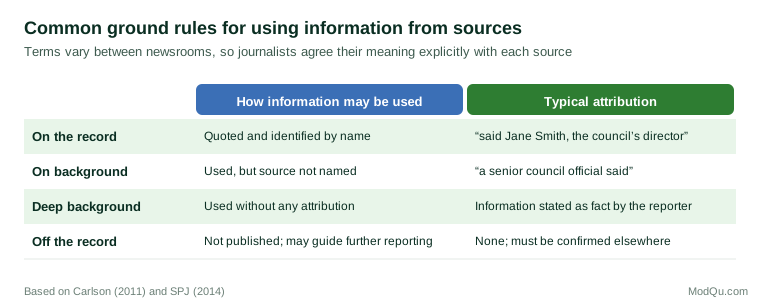
Whatever terms are used, the essential points are that the agreement is made clearly, ideally before the information is given; that both parties understand it in the same way; and that the journalist keeps it. A promise of confidentiality is a serious commitment that journalists have gone to prison to honour. Editors usually need to know the identity of a confidential source in order to judge reliability, and sources should be told this before they agree.
Confidential information should be corroborated wherever possible. A single anonymous claim is weak evidence; documents, other sources and the subject's own response can confirm or refute it. Hunter et al. (2011) recommend that investigators treat sources' claims as hypotheses to be tested against documents, rather than as conclusions.
Difficult cases arise when a source turns out to have lied or misled the journalist deliberately. Some newsroom policies state that a promise of confidentiality does not protect a source who has knowingly provided false information to deceive the public, although many journalists are reluctant to break a promise in any circumstances. Making such conditions clear at the outset avoids disputes later. Journalists should also consider whether a source is acting from personal grievance or for a third party, since motive does not make information false but does affect how carefully it must be checked. Finally, sources who are inexperienced with the media may not understand the consequences of speaking, and a responsible journalist explains the risks to them honestly, even at the cost of losing the story.
Legal protection
Many legal systems give journalists some protection against being forced to reveal their sources, but the protection is rarely absolute.
In Europe, the European Court of Human Rights has held that the protection of journalistic sources is a basic condition of press freedom under Article 10 of the European Convention on Human Rights. In Goodwin v. United Kingdom (1996), the Court found that an order requiring a journalist to reveal the source of leaked company information violated his right to freedom of expression, observing that without such protection sources may be deterred from assisting the press. The Court has since applied this principle in other cases, holding that the disclosure of sources may be ordered only where it is justified by an overriding requirement in the public interest and subject to proper legal safeguards (Financial Times Ltd v. United Kingdom, 2009; Sanoma Uitgevers B.V. v. the Netherlands, 2010). The Council of Europe has recommended that member states protect journalists' right not to disclose their sources (Council of Europe Committee of Ministers, 2000). In the United Kingdom, section 10 of the Contempt of Court Act 1981 provides that courts may not require disclosure of a source unless it is necessary in the interests of justice, national security or the prevention of disorder or crime.
In the United States, the Supreme Court held in Branzburg v. Hayes (1972) that the First Amendment does not give journalists a general privilege to refuse to testify before a grand jury. Many states have since passed "shield laws", and some federal courts recognise a limited privilege, but there is no federal shield law. In 2005, the New York Times reporter Judith Miller spent 85 days in jail for refusing to testify about a confidential source in an investigation into the disclosure of a CIA officer's identity (In re Grand Jury Subpoena, Judith Miller, 2006).
Whistleblower laws offer protection from the other side. The United Kingdom's Public Interest Disclosure Act 1998 protects workers who disclose certain kinds of wrongdoing from dismissal and other detriment, and the European Union's whistleblower directive requires member states to protect people who report breaches of EU law, including, under certain conditions, those who make disclosures to the media (Directive (EU) 2019/1937, 2019). These protections are often conditional, for example on the person first reporting internally or to a regulator, and journalists should not assume that sources are protected.
Digital threats to confidentiality
Digital communication has made source protection much harder. Telephone records, emails, messaging metadata, location data and access logs can reveal who has been in contact with a journalist, even when the content of communications is protected. In several countries, authorities have obtained journalists' telephone records to identify their sources without the journalists' knowledge.
The revelations by Edward Snowden in 2013 about mass surveillance by the United States National Security Agency and its partners showed how much communications data governments could collect (Greenwald, 2014). Lashmar (2017) interviewed investigative journalists in several countries and found that the revelations had led many to change how they communicated with sources, and that some sources had become more reluctant to come forward. Posetti (2017), in a study for UNESCO covering more than 100 countries, found that legal protections for sources were being eroded by surveillance, data retention and national security laws, and recommended that protection be extended to cover digital information and metadata.
Practical measures include using end-to-end encrypted messaging, meeting in person, avoiding devices and accounts linked to the source's workplace, using secure document submission systems, limiting how much identifying information is recorded, and training sources as well as journalists in basic security. Journalists must also be careful that published documents do not themselves reveal a source, for example through hidden metadata, tracked changes, printer codes or details that only a few people could know.
Wider ethical choices
Source protection is one part of a broader set of ethical questions in investigative reporting.
Deception and undercover methods. Investigations sometimes use hidden cameras, false identities or undercover employment to expose wrongdoing that could not otherwise be documented. Professional codes generally permit such methods only when the information is of vital public interest and cannot be obtained by open means (SPJ, 2014). The legal risks can be significant. In Food Lion, Inc. v. Capital Cities/ABC, Inc. (1999), journalists who obtained jobs at a supermarket chain to film food handling practices were found liable for breach of loyalty and trespass, though the large damages originally awarded were overturned.
Privacy and harm. Investigations can harm people who are not their main subject, such as family members, junior employees or victims. Kovach and Rosenstiel (2014) emphasise that journalists owe their first loyalty to citizens, which includes considering the harm their reporting may cause. Plaisance (2014) presents principles such as minimising harm and respecting human dignity as central to responsible practice. In the United Kingdom, the Leveson Inquiry found that some newspapers had used unlawful methods, such as phone hacking, to intrude on the privacy of victims of crime and others, with serious consequences for those affected (Leveson, 2012). The editors' code administered by the Independent Press Standards Organisation (IPSO, 2021) requires that intrusions into privacy be justified by the public interest.
Fairness to the subject. People accused of wrongdoing should be given a fair opportunity to respond before publication, with enough detail and time to answer the allegations meaningfully.
Independence. Ward (2015) traces how journalism ethics developed around ideals of independence and truth-seeking. Investigative journalists must avoid conflicts of interest, be wary of sources who seek to use them for their own ends, and be transparent with readers about how information was obtained, as far as source protection allows.
A short example
The following hypothetical case illustrates the principles. An employee of a pharmaceutical company contacts a reporter, saying that the company suppressed unfavourable results from a clinical trial. The employee fears dismissal and asks for anonymity.
Before receiving any documents, the reporter explains the ground rules: the source's identity will not be published, but the editor will need to know it; the information will be checked independently; and the reporter will not lie to protect the source but will refuse to name them. They agree to communicate only through an encrypted messaging application on the employee's personal phone.
The employee provides internal reports. The reporter removes metadata from copies, confirms the trial's existence through a public registry, and finds that its results were never published. Two independent scientists review the reports and confirm their significance. A second former employee, contacted separately, confirms the decision to withhold the results. The company is given the findings and two weeks to respond. The published story describes the documents, quotes the scientists and the company, refers to "two people with knowledge of the trial" and explains why they were not named. When the company later seeks a court order to identify the source, the newspaper resists, relying on the legal protection for journalistic sources.
Conclusion
Confidential sources make much investigative reporting possible, and protecting them is essential to the public's ability to learn what powerful institutions want to conceal. Good practice requires clear agreements, careful corroboration, an understanding of legal protections and their limits, and strong digital security. Source protection sits within a wider set of ethical commitments, to minimise harm, to use deception only when the public interest demands it, to treat subjects fairly and to remain independent. These commitments protect not only sources and subjects but the credibility on which investigative journalism depends.
References
Bernstein, C., & Woodward, B. (1974). All the president's men. Simon & Schuster.
Branzburg v. Hayes, 408 U.S. 665 (1972).
Carlson, M. (2011). On the condition of anonymity: Unnamed sources and the battle for journalism. University of Illinois Press.
Contempt of Court Act 1981, c. 49 (UK).
Council of Europe Committee of Ministers. (2000). Recommendation No. R (2000) 7 on the right of journalists not to disclose their sources of information. Council of Europe.
Directive (EU) 2019/1937 of the European Parliament and of the Council of 23 October 2019 on the protection of persons who report breaches of Union law. (2019). Official Journal of the European Union, L 305, 17–56.
Financial Times Ltd v. United Kingdom, no. 821/03 (Eur. Ct. H.R. 15 December 2009).
Food Lion, Inc. v. Capital Cities/ABC, Inc., 194 F.3d 505 (4th Cir. 1999).
Goodwin v. United Kingdom, no. 17488/90, 22 E.H.R.R. 123 (Eur. Ct. H.R. 1996).
Greenwald, G. (2014). No place to hide: Edward Snowden, the NSA, and the U.S. surveillance state. Metropolitan Books.
Hunter, M. L., Hanson, N., Sabbagh, R., Sengers, L., Sullivan, D., & Svith, F. T. (2011). Story-based inquiry: A manual for investigative journalists. UNESCO.
Independent Press Standards Organisation. (2021). Editors' code of practice.
In re Grand Jury Subpoena, Judith Miller, 438 F.3d 1141 (D.C. Cir. 2006).
Kantor, J., & Twohey, M. (2019). She said: Breaking the sexual harassment story that helped ignite a movement. Penguin Press.
Kovach, B., & Rosenstiel, T. (2014). The elements of journalism: What newspeople should know and the public should expect (3rd ed.). Three Rivers Press.
Lashmar, P. (2017). No more sources? The impact of Snowden's revelations on journalists and their confidential sources. Journalism Practice, 11(6), 665–688. https://doi.org/10.1080/17512786.2016.1179587
Leveson, B. (2012). An inquiry into the culture, practices and ethics of the press (HC 780). The Stationery Office.
Plaisance, P. L. (2014). Media ethics: Key principles for responsible practice (2nd ed.). SAGE.
Posetti, J. (2017). Protecting journalism sources in the digital age. UNESCO.
Public Interest Disclosure Act 1998, c. 23 (UK).
Sanoma Uitgevers B.V. v. the Netherlands [GC], no. 38224/03 (Eur. Ct. H.R. 14 September 2010).
Society of Professional Journalists. (2014). SPJ code of ethics.
Sternadori, M. M., & Thorson, E. (2009). Anonymous sources harm credibility of all stories. Newspaper Research Journal, 30(4), 54–66. https://doi.org/10.1177/073953290903000405
Ward, S. J. A. (2015). The invention of journalism ethics: The path to objectivity and beyond (2nd ed.). McGill-Queen's University Press.