
Share your view of official statistics
Tell us whether you took part in the last census, how much you trust official figures and which ones you follow. Your answers are combined with other people's and reported only as totals.
Start the census and official statistics surveyAbout 5 minutes. No account needed. You can stop at any time.
What a census is
A population and housing census is an official count of all the people and homes in a country at a set time. The United Nations recommends that countries hold a census at least once every ten years. Censuses collect information such as:
- age and sex;
- household and family relationships;
- place of birth, citizenship and migration;
- language and, in some countries, religion or ethnicity;
- education and work;
- disability;
- housing type, ownership and facilities.
Census results are published for the whole country and for small areas such as neighbourhoods, which most other surveys cannot do.
How a census is taken
Countries use different methods:
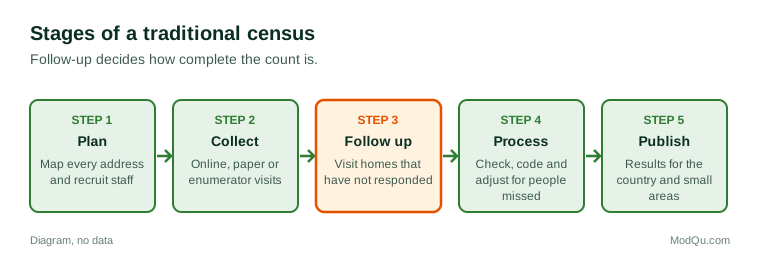
- Traditional censuses: every household fills in a form, on paper, online or with an enumerator who visits.
- Register-based censuses: some countries, such as Denmark, Finland and other Nordic countries, produce census results mainly from existing government registers of population, addresses and jobs, with little or no direct questioning.
- Combined methods: registers plus surveys of a sample of the population.
- Rolling censuses: counting part of the population each year, as France does.
Many countries have moved to online forms. Enumerators still visit homes that do not respond and areas where online completion is difficult.
Example
A household receives a letter with a code to complete the census online. They forget. Two weeks later an enumerator knocks on their door and helps them complete it on a tablet in ten minutes. The enumerator explains that answers are confidential and used only for statistics.
Who gets missed
No census counts everyone perfectly. Groups that are often undercounted include young children, young men, people who move often, people experiencing homelessness, people in remote areas, recent migrants and people who distrust government. Census offices run follow-up surveys to estimate how many people were missed and adjust the results.
Undercounting matters because census figures are used to allocate money and representation. An area that is undercounted may receive less funding or fewer seats than it should.
Example (hypothetical figures)
A census counts 95,000 people in a district. A follow-up survey estimates that 4% of residents were missed. The adjusted population is about 99,000, since 95,000 divided by 0.96 is about 98,960. If government funding is 100 per resident a year, the adjustment adds about 396,000 to the district's annual allocation.
What official statistics cover
Beyond the census, national statistics offices and other agencies produce regular official statistics on:
- population, births, deaths and migration;
- the economy, including gross domestic product (GDP);
- prices and inflation, through consumer price indices;
- jobs, unemployment and earnings, often through labour force surveys;
- household income, spending and poverty;
- health, education, crime and housing;
- trade, agriculture and industry;
- the environment.
Many of these come from large household surveys, business surveys and administrative records such as tax and benefit data.
How the figures are used
Official statistics are used by:
- governments to plan schools, hospitals, roads and services, and to allocate funding;
- parliaments to draw electoral boundaries;
- central banks to set interest rates;
- businesses to decide where to open shops or invest;
- researchers, journalists and the public to understand trends;
- international bodies to compare countries and track goals.
Independence and trust
For official statistics to be trusted, they need to be produced professionally and free from political interference. The United Nations Fundamental Principles of Official Statistics, endorsed by the UN General Assembly in 2014, set out principles including professional independence, scientific methods, confidentiality of individual data and equal access to results.
Trust can be damaged when governments are seen to change or delay figures for political reasons, when methods change without explanation, or when figures do not match people's experience. For example, people often feel that prices are rising faster than official inflation figures show, partly because official figures average across all households.
Example
A person sees an official report that unemployment has fallen. Several friends in their town have recently lost jobs. They wonder whether the figure is wrong. The statistics office's website explains that the national figure is an average and publishes separate figures by region, which show a rise in their area.
Confidentiality
Census and survey answers are protected by law in most countries. Statistics offices may only publish results that do not identify individuals, and staff are bound by confidentiality rules. Some countries keep census forms closed to the public for many decades before releasing them for historical research.
What people disagree about
People disagree about which questions a census should ask, such as questions on religion, ethnicity, sexual orientation or gender identity. There are debates about whether to replace traditional censuses with registers, which costs less but relies on government data sharing. Views also differ on whether participation should be compulsory, and on how far governments should use administrative data.
Questions that governments, statistics offices and policy groups want answered include whether people took part in the last census, how much they trust official statistics, which figures they follow and what would increase their trust.
Census and privacy concerns
Some people worry about giving personal information to the government in a census, especially about religion, ethnicity, income or immigration status. Census offices respond by explaining legal protections, keeping individual data separate from other government uses, and making some questions voluntary. Trust in these protections affects how many people take part. In some countries, participation in the census is required by law, with fines for refusing; in others, it is voluntary.
Key terms
- CensusAn official count of all people and homes in a country at a set time.
- EnumeratorA person who collects census information, often by visiting homes.
- Register-based censusA census produced mainly from existing government records.
- UndercountPeople missed by a census.
- Official statisticsStatistics produced by government agencies following professional standards.
- National statistics officeThe government agency responsible for official statistics.
- ConfidentialityThe protection of individual answers from disclosure.
- Labour force surveyA regular survey measuring employment and unemployment.
Full glossary: economic statistics terms on EditingTests.com.
Census and official statistics vocabulary test
How well do you know the language of this topic? Try 8 quick questions. Your score is shown straight away and is not saved.
What the census and official statistics survey asks
This survey is part of ModQu's Government and Public Services survey. The census and official statistics part takes about five minutes and covers:
- Whether you took part in the last census, and how.
- Whether you know anyone who was missed, and why.
- How much you trust official statistics in your country.
- Which official figures you follow, such as inflation, jobs or population.
- Whether official figures match your own experience.
- What would increase your trust in official statistics.
After that you can choose to continue with other short parts of the Government and Public Services survey, such as local services or trust in government, or stop.
Ready to take part?
Your answers help show what people really think and do. Results are only ever reported as totals; no one can see your individual answers.
Start the surveyQuestions about this survey
Who can take part?
Adults.
Do I have to give my name?
No. You may be asked for your age group, region and similar details so results can be broken down, but not your name. ModQu never asks for passwords, card numbers or account numbers.
How are the results used?
Answers are combined into totals and percentages and published in ModQu reports. Individual answers are never shown.
Is the vocabulary test part of the survey?
No. It is optional and separate, and your score is not stored.
Why does the survey ask which figures I follow?
Statistics offices want to know which figures people use and understand, so they can explain them better.
Is ModQu part of a national statistics office?
No. ModQu is independent. This survey asks about your views of official statistics.
Will my answers be used in the census?
No. Answers to this survey are separate and are not shared with census or statistics offices in a way that identifies you.
Can I answer if I do not remember the last census?
Yes. You can say you are not sure, and other questions still apply.
Does the survey ask census-style questions about my household?
Only a few general questions, such as age group and region, to compare results between groups.