
Share your experience of public benefits
Tell us whether you have received a government benefit, how easy it was to apply and whether the system is fair. Your answers are combined with other people's and reported only as totals.
Start the social welfare and benefits surveyAbout 5 minutes. No account needed. You can stop at any time.
What social welfare covers
Social welfare, also called social protection or social security, is the set of public programs that support people's income and wellbeing. The International Labour Organization describes social protection as covering needs across the life cycle, including:
- child and family benefits;
- maternity and parental benefits;
- unemployment benefits;
- sickness and disability benefits;
- work injury benefits;
- old-age pensions;
- survivors' benefits for widows, widowers and orphans;
- income support for people on low incomes;
- housing support;
- health care, often counted separately.
Support may be cash, such as monthly payments, or in kind, such as food, housing, free school meals or subsidized care.
Main types of benefits
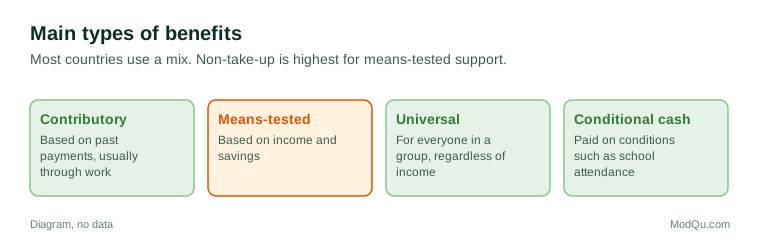
Benefits differ in who qualifies and how they are funded:
- Contributory benefits depend on past payments into a social insurance system, usually through work. Pensions and unemployment insurance are common examples.
- Means-tested benefits depend on income and savings, and go to people below set thresholds.
- Universal benefits go to everyone in a group, such as all children or all people over a certain age, regardless of income.
- Categorical benefits go to people in a defined group, such as people with a disability or carers.
- Conditional cash transfers, used widely in Latin America and elsewhere, pay families on conditions such as school attendance or health check-ups.
- Tax credits reduce tax or pay money through the tax system to working families on low incomes.
Many countries combine several types. In some lower-income countries, coverage is limited and many people, especially informal workers, have no access to social protection.
Applying for benefits
Applying for benefits usually involves:
- finding out what is available and whether you qualify;
- completing a form, online, by phone or in person;
- providing proof of identity, income, address, family situation, health or work history;
- interviews or assessments, such as work capability or disability assessments;
- waiting for a decision;
- reporting changes in circumstances once payments start.
Many systems have moved online, which is faster for some people and harder for others, such as those without internet access, digital skills or documents.
Example
A worker loses their job and applies for unemployment benefit online. They need their former employer's letter, bank details and an identity document. The first payment arrives five weeks later. In between, they borrow from a sibling and delay paying a utility bill.
Why some eligible people do not claim
Many people who qualify for benefits do not receive them. This is called non-take-up. Reasons include:
- not knowing a benefit exists or that they qualify;
- complicated forms and rules;
- lack of documents;
- language or literacy barriers;
- stigma or embarrassment about claiming;
- believing the amount is too small to be worth the effort;
- previous bad experiences or fear of sanctions;
- difficulty using online systems.
Non-take-up tends to be higher for means-tested benefits than for universal ones. Some governments use automatic enrolment or data sharing between agencies to reach people who qualify.
Example (hypothetical figures)
An agency estimates that 50,000 households in a region are eligible for a housing benefit, but only 32,000 receive it, a take-up rate of 64%. After it sends letters to households identified through tax records and simplifies the form, 38,000 households claim, a take-up rate of 76%.
Conditions and sanctions
Many benefits come with conditions, such as looking for work, attending appointments or taking part in training. If conditions are not met, payments may be reduced or stopped, which is called a sanction. Supporters say conditions encourage work and fairness to taxpayers. Critics say sanctions can cause hardship and do not always help people find work.
Views on fairness
People's views on welfare systems differ widely and often depend on their own experience, values and politics. Common questions include:
- whether benefits are generous enough to live on;
- whether support goes to the people who need it most;
- whether some people claim benefits they are not entitled to;
- whether the system encourages or discourages work;
- whether people are treated with respect when they apply.
Research in several countries suggests that public estimates of benefit fraud are often much higher than official estimates, while errors by agencies and unclaimed benefits receive less attention.
Example
A person who has never claimed benefits believes that many claimants are cheating. After their own partner becomes ill and they apply for disability support, they find the process long and strict, and their view changes.
Changes and new ideas
Welfare systems change often, through reforms to simplify benefits, digital systems, changes to pension ages and new programs. Some governments and researchers have tested universal basic income, a regular payment to everyone without conditions, in pilot programs in several countries. Results and views on it are mixed.
What people disagree about
People disagree about how generous benefits should be, whether support should be universal or targeted, how strict conditions should be, how welfare should be funded, and whether the state, families, charities or employers should provide support. Views on immigration and welfare are also closely linked in many countries.
Questions that governments, public agencies and policy groups want answered include who receives benefits, how easy it is to apply, why some people do not claim, and whether people see the system as fair.
Support from outside the state
In many countries, families, religious groups, community organizations and charities provide much of the support that welfare systems do not. Remittances from relatives working abroad are a major source of income for many households in lower-income countries. Food banks, mutual aid groups and community savings schemes also help people manage when public support is limited or slow.
Key terms
- Social protectionPublic programs that support income and wellbeing across life.
- Contributory benefitA benefit based on past contributions, usually through work.
- Means-tested benefitA benefit based on income and savings.
- Universal benefitA benefit paid to everyone in a group regardless of income.
- Non-take-upWhen eligible people do not receive a benefit.
- SanctionA cut or stop in benefit payments for not meeting conditions.
- Tax creditSupport paid or given through the tax system.
- Universal basic incomeA regular payment to everyone, without conditions.
Full glossary: social services administration terms on EditingTests.com.
Social welfare and benefits vocabulary test
How well do you know the language of this topic? Try 8 quick questions. Your score is shown straight away and is not saved.
What the social welfare and benefits survey asks
This survey is part of ModQu's Government and Public Services survey. The social welfare and benefits part takes about five minutes and covers:
- Whether you have received any government benefit in the last year, and which kind.
- How easy it was to find out about and apply for it.
- How long it took to receive a decision and payment.
- Whether you have chosen not to claim a benefit you might qualify for, and why.
- How fairly you were treated during the process.
- Whether you think the system is fair, and what you would change.
After that you can choose to continue with other short parts of the Government and Public Services survey, such as local services or trust in government, or stop.
Ready to take part?
Your answers help show what people really think and do. Results are only ever reported as totals; no one can see your individual answers.
Start the surveyQuestions about this survey
Who can take part?
Adults.
Do I have to give my name?
No. You may be asked for your age group, region and similar details so results can be broken down, but not your name. ModQu never asks for passwords, card numbers or account numbers.
How are the results used?
Answers are combined into totals and percentages and published in ModQu reports. Individual answers are never shown.
Is the vocabulary test part of the survey?
No. It is optional and separate, and your score is not stored.
Do I have to say which benefits I receive?
No. Questions about benefits you receive are optional.
Does the survey check whether I am entitled?
No. ModQu does not check entitlement or give advice. Contact your local agency or an advice service for that.
Can people who have never claimed take part?
Yes. Views from people who have never claimed are an important part of the results.
Are pensions included?
Yes. Public pensions are one of the benefit types in the survey.