
Share your experience of sizes and fit
Tell us how often clothes do not fit, whether sizes vary too much and whether you return clothes because of fit. Your answers are combined with other people's and reported only as totals.
Start the clothing sizes and fit surveyAbout 5 minutes. No account needed. You can stop at any time.
How clothing sizes work
A clothing size is a short label that stands for a set of body measurements. A shirt marked "M" or "40" is meant to fit someone with a certain chest, waist or neck size. Behind each size is a size chart, and behind the chart is a fit model: a real person, or a set of measurements, that the brand uses to test its patterns.
Several sizing systems are in use around the world:
- Letter sizes (XS, S, M, L, XL) used widely for casual clothing.
- Number sizes that differ by region, for example UK, US, European, Italian, Japanese and Australian women's sizes, which use different numbers for the same body.
- Measurement-based sizes, such as waist and leg length in inches or centimetres for trousers, collar size for shirts, or height for children's clothes.
- International standards: the International Organization for Standardization (ISO) and European standards describe ways to label sizes by body measurements, but brands are not required to follow them in most countries.
Because so many systems exist, conversion charts between them are only approximate.
Why sizes differ between brands
Shoppers often find they are a different size in different shops. Reasons include:
- Different fit models. Each brand designs for the body shape of its target customer, so a "medium" in one brand may be cut for a taller, slimmer or curvier body than in another.
- Different cuts and styles. Slim, regular, relaxed and oversized fits change how a garment sits even at the same size.
- Fabric. Stretch fabrics fit differently from rigid ones, and some fabrics shrink after washing.
- Manufacturing variation. Garments made in different factories, or in different production runs, can differ by a centimetre or more.
- Vanity sizing. Some brands have gradually labelled larger garments with smaller sizes, possibly because shoppers prefer to buy a smaller number. The extent of this varies and is debated.
Example
A shopper buys three pairs of jeans labelled with the same waist size from three shops. One fits well, one is too tight at the hips, and one is loose at the waist but tight at the thighs. They keep the first pair and return the other two, then write down which size fits them in each shop.
Body shape and the limits of a single number
A single size cannot describe a whole body. Two people with the same waist measurement can differ in height, hip size, shoulder width, arm length and posture. Standard sizes are usually built from a limited set of proportions, so people whose bodies differ from those proportions, such as very tall or short people, people with broad shoulders or larger busts, and people with disabilities, often find off-the-rack clothes do not fit well.
To address this some brands offer petite, tall, plus-size, maternity and adaptive ranges, and some sell trousers by both waist and length. Others offer made-to-measure or custom sizing online.
Fit and online shopping
Fit is the single largest reason given for returning clothes bought online in many markets. Shoppers cannot try clothes on, so they rely on size charts, product photos, reviews and sometimes a model's measurements. Common habits include:
- Bracketing: ordering the same item in two or more sizes and returning the ones that do not fit.
- Reading reviews for comments such as "runs small" or "size up".
- Measuring at home and comparing with the brand's size chart.
- Sticking with known brands whose sizing the shopper already knows.
Retailers try to reduce fit-related returns with detailed size charts, fit-finder tools that ask about height, weight and preferred fit, virtual try-on, and notes on how a model's measurements compare with the size they wear.
Example (hypothetical figures)
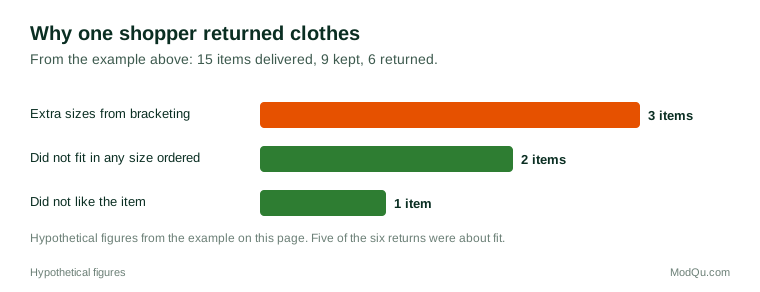
An online shopper orders 12 clothing items in a year, including 3 items bracketed in two sizes. That makes 15 items delivered. They keep 9 and return 6: 3 extra sizes from bracketing, 2 items that did not fit in any size ordered, and 1 they did not like. Five of the 6 returns (about 83%) were about fit.
The cost of poor fit
Poor fit costs shoppers time, money and frustration. Return postage, trips to the post office and waiting for refunds add up, and some people keep clothes that do not fit because returning them is too much trouble. For retailers, returns mean shipping, handling, repackaging, and sometimes items that cannot be resold. Returns also have an environmental cost, as goods travel back and forth and some returned items are discarded.
How shoppers cope
People handle sizing problems in many ways:
- trying clothes on in shops and then buying online in the known size;
- keeping a personal record of sizes in favourite brands;
- choosing stretch fabrics or adjustable items;
- having clothes altered by a tailor, for example hemming trousers or taking in a waist;
- buying from brands that offer petite, tall or other specialist ranges;
- avoiding online clothes shopping altogether.
Example
A tall shopper struggles to find trousers long enough in mainstream shops. They now buy two brands that sell long-leg lengths online and take regular-length trousers to a tailor to have the hem let down where there is enough fabric.
Debates and what may change
- Standard sizing. Some people argue for compulsory size standards; others say different brands serve different body shapes and standard sizes would not fit everyone better.
- Body measurement data. National sizing surveys that measure thousands of people have been run in several countries to update size charts as populations change. Body scanning has made these surveys faster.
- Free returns. Some retailers have started charging for returns to reduce costs and bracketing; shoppers disagree about whether this is fair.
- Inclusive sizing. Wider size ranges are welcomed by many shoppers, though some feel extended sizes are limited to a few styles or sold only online.
Key terms
- Size chartA table showing the body measurements each size is meant to fit.
- Fit modelA person whose measurements a brand uses to test how its clothes fit.
- Vanity sizingLabelling larger garments with smaller size numbers.
- BracketingOrdering an item in more than one size and returning those that do not fit.
- Petite rangeClothing cut for shorter people, typically with shorter legs and sleeves.
- InseamThe length of a trouser leg measured from the crotch to the hem.
- AlterationA change made to a garment by a tailor so it fits better.
- Off the rackReady-made clothing sold in standard sizes, also called off the peg.
Full glossary: clothing retail operations terms on EditingTests.com.
Clothing sizes and fit vocabulary test
How well do you know the language of this topic? Try 8 quick questions. Your score is shown straight away and is not saved.
What the clothing sizes and fit survey asks
This survey is part of ModQu's Fashion and Style survey. The clothing sizes and fit part takes about five minutes and covers:
- How often clothes do not fit when you buy them, in shops and online.
- Whether sizes vary too much between brands, and which items are hardest to fit.
- Whether you have returned clothes because of fit in the last year.
- Whether you order more than one size when shopping online.
- Which tools you use: size charts, reviews, fit finders or measuring yourself.
- Whether you have clothes altered, and what would make buying clothes easier.
After that you can choose to continue with other short parts of the Fashion and Style survey, such as footwear or sportswear and athleisure, or stop.
Ready to take part?
Your answers help show what people really think and do. Results are only ever reported as totals; no one can see your individual answers.
Start the surveyQuestions about this survey
Who can take part?
Adults who buy clothes.
Do I have to give my name?
No. You may be asked for your age group, region and similar details so results can be broken down, but not your name. ModQu never asks for passwords, card numbers or account numbers.
How are the results used?
Answers are combined into totals and percentages and published in ModQu reports. Individual answers are never shown.
Is the vocabulary test part of the survey?
No. It is optional and separate, and your score is not stored.