
Share your experience of modest fashion
Tell us how easy it is to find modest clothing, where you buy it and what is missing. Your answers are combined with other people's and reported only as totals.
Start the modest fashion surveyAbout 5 minutes. No account needed. You can stop at any time.
What modest fashion means
Modest fashion is a broad term for clothes that cover more of the body than many mainstream styles. What counts as modest differs between people, faiths and cultures, but common features include:
- longer sleeves, often to the wrist or elbow;
- longer hemlines, such as skirts and dresses to the ankle or below the knee;
- higher necklines;
- looser fits that do not cling to the body;
- fabrics that are not see-through, or layers worn underneath;
- head coverings, for some wearers.
Modest fashion is not one style. It includes everyday wear, office clothes, sportswear, swimwear, evening wear and wedding clothes. Some people dress modestly every day; others do so only on particular occasions, such as visits to places of worship or family events.
Who dresses modestly and why
People dress modestly for many reasons, and often for more than one:
- Religious practice. Many Muslim, Jewish, Christian, Sikh, Hindu and other religious communities have teachings or traditions about modest dress. The details vary within each faith as well as between them.
- Culture and family. In many places modest dress is simply the local norm or a family expectation.
- Work and setting. Some workplaces, schools and public buildings have dress codes that require covered shoulders or knees.
- Personal preference. Some people prefer covered, loose clothing for comfort, confidence, sun protection or style.
- Age and life stage. Some people choose more covering clothes as they get older or during pregnancy.
Because the reasons differ, the "rules" people follow differ too. One person may want ankle-length skirts and a headscarf; another may only want tops that cover the shoulders. Researchers who study modest fashion stress that it is shaped by individual choice as well as by tradition.
Main kinds of modest clothing
Common items include:
- Maxi dresses and skirts, reaching the ankle.
- Tunics worn over trousers or skirts.
- Long cardigans, kimonos and dusters used as layers.
- Abayas, jilbabs and kaftans, loose full-length garments worn in many Muslim communities.
- Headscarves and head coverings, such as the hijab, the tichel and other scarves and wraps, worn in different ways by women of several faiths; some men also wear head coverings such as turbans or caps for religious reasons.
- Modest swimwear, often a long-sleeved top with leggings and sometimes a hood.
- Modest sportswear, including sports hijabs and long-sleeved, loose training tops.
- Layering basics, such as slips, long-sleeved undershirts and inner caps worn under scarves.
Example
A university student who wears a headscarf buys plain long-sleeved tops in several colours to wear under short-sleeved dresses and T-shirts from mainstream shops. Layering lets them follow trends while keeping their arms covered.
How people find suitable clothes
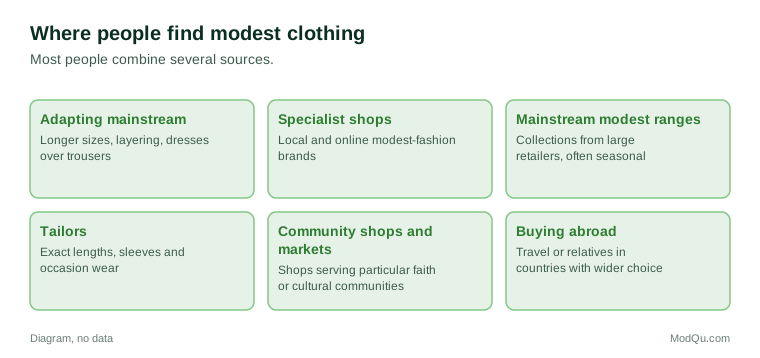
Many people who dress modestly describe shopping as harder than it needs to be. Common strategies include:
- Adapting mainstream fashion: buying longer sizes, layering, and wearing dresses over trousers.
- Specialist modest fashion shops, both local and online, many founded by people who dress modestly themselves.
- Mainstream brands' modest ranges, which some large retailers have introduced, often timed around religious festivals.
- Tailors and dressmakers, especially for occasion wear or for exact lengths.
- Markets and community shops that serve particular cultural or faith communities.
- Buying while travelling, or from relatives abroad, where modest clothing is more widely sold.
Example (hypothetical figures)
A shopper buys a mainstream maxi dress for 45, then pays 15 for a long-sleeved layer to wear under it because the dress has short sleeves. A similar dress from a modest-fashion shop costs 65 with sleeves already included. The mainstream option costs 60 in total, which is 5 less than the specialist dress, but they spend extra time finding a matching layer.
What shoppers say is missing
When people who dress modestly are asked about gaps, common answers include:
- Sleeves, especially on formal and evening wear.
- Length, particularly for tall shoppers, since many "maxi" items do not reach the ankle.
- Fabrics that are opaque yet breathable for hot weather.
- Workwear and uniforms that meet both professional and modest requirements.
- Sportswear and swimwear in more sizes and styles.
- Affordable options, since specialist pieces can cost more than mainstream ones.
- Representation in advertising and shop displays.
Example
A nurse who wears long sleeves for religious reasons finds that their hospital's uniform tunic is short-sleeved. They work with their manager to find disposable sleeve covers that meet infection-control rules, an approach some health services have adopted.
Costs and value
Modest clothing does not have to cost more, but many shoppers say it often does. Specialist brands work in smaller volumes, longer garments use more fabric, and layering means buying extra pieces such as undershirts, slips and inner caps. Headscarves range from very cheap to designer prices, and many people own a large collection to match different outfits. Questions that businesses want answered include how much people spend on modest clothing compared with mainstream clothing, and which items they would buy more of if they were easier to find.
Modest fashion in the wider fashion world
Modest fashion has become more visible in the mainstream. Fashion weeks dedicated to it are held in several cities, designers and influencers who dress modestly have large followings, and some sports bodies have changed their rules to allow head coverings and fuller kits in competition. Online shopping has also helped: small modest brands can now sell to customers in many countries.
At the same time, modest fashion raises debates. Some people welcome mainstream brands' modest collections; others feel these ranges are small, seasonal or do not understand their needs. There are also wider public debates about head coverings in schools, workplaces and sport in some countries, where laws and rules differ. People hold strong and differing views, and a survey can record those views without taking a side.
Modest dress across seasons and occasions
Climate shapes modest dress. In hot countries loose, light fabrics such as cotton, linen and viscose help keep covered clothing cool. In cold climates layering under coats is easier, but finding modest outdoor sportswear and swimwear can still be hard. Occasion wear is another challenge. Weddings, festivals such as Eid, Christmas or Diwali, and graduations often bring a rush of shopping for modest dresses and outfits, and many people turn to tailors or specialist shops at those times.
Key terms
- Modest fashionClothing that covers more of the body, often with longer sleeves and hemlines and looser fits.
- MaxiA dress or skirt that reaches the ankle.
- AbayaA loose, full-length robe worn by some Muslim women.
- HijabA headscarf worn by some Muslim women; also used for modest dress more generally.
- TichelA headscarf worn by some married Jewish women.
- LayeringWearing one garment under or over another, for example a long-sleeved top under a dress.
- OpaqueNot see-through.
- Modest swimwearSwimwear that covers the arms, legs and sometimes the head.
Full glossary: fashion design terms on EditingTests.com.
Modest fashion vocabulary test
How well do you know the language of this topic? Try 8 quick questions. Your score is shown straight away and is not saved.
What the modest fashion survey asks
This survey is part of ModQu's Fashion and Style survey. The modest fashion part takes about five minutes and covers:
- Whether you dress modestly every day or on certain occasions, and why.
- How easy it is to find clothing that meets your needs.
- Where you buy modest clothing: mainstream shops, specialist shops, online, tailors or abroad.
- Which items are hardest to find: workwear, sportswear, swimwear, occasion wear or others.
- How much you spend compared with mainstream clothing.
- What you would most like shops and brands to offer.
After that you can choose to continue with other short parts of the Fashion and Style survey, such as footwear or sportswear and athleisure, or stop.
Ready to take part?
Your answers help show what people really think and do. Results are only ever reported as totals; no one can see your individual answers.
Start the surveyQuestions about this survey
Who can take part?
Adults who dress modestly for faith or personal reasons.
Do I have to give my name?
No. You may be asked for your age group, region and similar details so results can be broken down, but not your name. ModQu never asks for passwords, card numbers or account numbers.
How are the results used?
Answers are combined into totals and percentages and published in ModQu reports. Individual answers are never shown.
Is the vocabulary test part of the survey?
No. It is optional and separate, and your score is not stored.