
Share your view of luxury goods
Tell us whether you have bought a luxury item, what it was and whether you would buy second-hand. Your answers are combined with other people's and reported only as totals.
Start the luxury goods surveyAbout 5 minutes. No account needed. You can stop at any time.
What counts as a luxury good
A luxury good is an item whose price is well above what is needed for its basic function, where the extra cost pays for craftsmanship, rare materials, design, brand heritage or exclusivity. A handbag carries things and a watch tells the time, but a luxury handbag or watch is bought for much more than that.
Common categories include:
- Fashion and leather goods: designer clothing, handbags, wallets, belts and shoes.
- Watches and jewellery: mechanical watches, fine jewellery, gold and precious stones.
- Beauty and fragrance: high-end perfumes and skincare, often the most affordable way into a luxury brand.
- Accessories: scarves, sunglasses, pens and small leather goods.
- Home and lifestyle: designer furniture, fine tableware, art and collectable items.
- Experiences: luxury hotels, fine dining and first-class travel, which are services rather than goods but are often discussed alongside them.
What counts as luxury also depends on the buyer. An item that is an everyday purchase for a high earner may be a once-in-a-lifetime treat for someone else, and what is seen as luxury differs between countries and cultures.
Why people buy luxury items
People give many reasons for buying luxury goods, and often more than one at once:
- Quality and craftsmanship: a belief that the item is better made and will last longer.
- Self-reward: marking a promotion, graduation, birthday or other milestone.
- Status and identity: signalling success, taste or belonging to a group.
- Design and beauty: enjoying the look and feel of a well-designed object.
- Investment or resale value: some watches, bags and jewellery hold or increase their value, although many do not.
- Gifting: luxury items are common gifts for weddings, anniversaries and major celebrations in many cultures.
- Heritage: pieces passed down in families, such as watches or jewellery.
Researchers who study consumer behaviour often separate "conspicuous" luxury, bought partly to be seen, from "quiet" or "inconspicuous" luxury, where quality matters more than visible logos. Many buyers move between the two.
Example
A nurse saves for a year to buy a mechanical watch after finishing a postgraduate qualification. They choose a model without a large logo because they want something they will wear every day for decades and possibly pass on to their child.
How the luxury market works
Luxury brands usually control their supply and pricing closely. Common practices include:
- selling through their own boutiques and selected stores rather than discount outlets;
- limiting production of certain models, which can create waiting lists;
- raising prices regularly, sometimes several times a year;
- offering entry-level items such as fragrances, cosmetics and small accessories that reach far more buyers than the core products.
Prices for the same item can differ noticeably between countries because of taxes, import duties and exchange rates. Some travellers buy luxury goods abroad or in airport duty-free shops for that reason, subject to their home country's customs allowances.
Second-hand and resale luxury
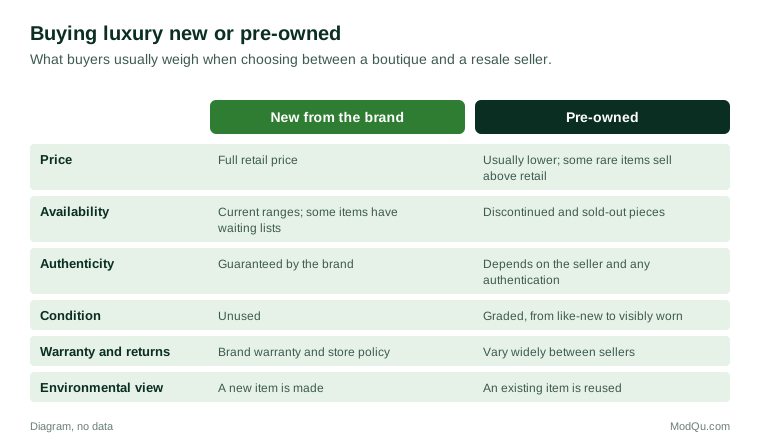
Buying pre-owned luxury has grown in many countries. Second-hand items are sold through consignment shops, specialist resale websites, auction houses, pawnbrokers and person-to-person sales.
Reasons buyers give include lower prices, access to discontinued or sold-out pieces, and the environmental benefit of reusing an item. Sellers use resale to free up money or space, or to change their collection.
Example (hypothetical figures)
A buyer compares a handbag that costs 2,400 new with a pre-owned one of the same model in very good condition for 1,500 at a resale shop that offers authentication. The saving is 900, or 37.5% of the new price (900 ÷ 2,400). They choose the pre-owned bag and keep the authentication certificate in case they resell it.
Condition grading, authentication and returns policies vary widely between sellers, and buyers often ask about all three before paying.
Who buys luxury and how first purchases happen
Luxury buyers are a varied group. They include high earners who buy often, people on middle incomes who buy one special item every few years, younger buyers who start with a fragrance, wallet or pair of trainers, and collectors who focus on one category such as watches. Tourists are an important group in many cities, and gifts make up a large share of purchases around major holidays.
A first luxury purchase is often tied to an event: a graduation, a first job, a wedding or a significant birthday. Many people describe it as a considered decision, made after months of looking, saving and comparing. Later purchases may be more frequent and less planned. Questions that businesses want answered include what people buy first, how long they save, and whether they shop in a boutique, online or abroad.
Counterfeits and authentication
Luxury goods are among the most copied products in the world. Counterfeits range from obvious fakes to close copies that are hard to tell from the real item. Buying or selling counterfeits is illegal in many countries, and customs authorities seize fake goods at borders. Some buyers knowingly buy copies; others are misled into paying near-full prices for fakes, especially online.
Ways people check authenticity include:
- buying from the brand or an authorised retailer;
- asking for original receipts, boxes and documents for second-hand items;
- using resale platforms or independent experts that offer authentication;
- checking stitching, materials, hardware, serial numbers and logos;
- being wary of prices that seem far too low.
Example
A shopper finds a designer wallet on a social media marketplace for a fifth of the shop price. The seller has no receipt and asks for payment by bank transfer only. The shopper decides not to buy and later sees the account reported for selling copies.
Debates around luxury
Luxury goods attract strong and differing views:
- Value for money. Some people believe luxury items last longer and cost less per use over time; others think most of the price pays for marketing and the brand name.
- Price rises. Frequent price increases have led some buyers to question whether certain items are still worth it.
- Ethics and sustainability. Questions are raised about leather and fur, the sourcing of gold and gemstones, working conditions, and the destruction of unsold stock. Some brands have responded with new policies; buyers differ on how much they trust these.
- Social pressure. Social media can increase the pressure to own visible luxury items, and some people take on debt to buy them.
- Fakes and "inspired" products. Opinions differ on copies and on products designed to look similar without copying logos.
A survey of luxury buying can show who buys luxury items, what they buy first, how they feel about second-hand, and which concerns affect their decisions.
Key terms
- Luxury goodAn item priced well above its basic function because of quality, brand, design or exclusivity.
- Pre-ownedPreviously owned and resold; often used instead of "second-hand" for luxury items.
- ConsignmentA sale in which a shop sells an item for its owner and keeps a share of the price.
- AuthenticationChecking whether an item is genuine, often by an expert or specialist service.
- CounterfeitA fake product made to look like a genuine branded item.
- Entry-level itemA lower-priced product, such as a fragrance or small accessory, that introduces buyers to a brand.
- Limited editionA product made in a fixed, small quantity.
- Duty-freeShopping where certain taxes or import duties are not charged, typically for international travellers.
Full glossary: apparel luxury goods terms on EditingTests.com.
Luxury goods vocabulary test
How well do you know the language of this topic? Try 8 quick questions. Your score is shown straight away and is not saved.
What the luxury goods survey asks
This survey is part of ModQu's Fashion and Style survey. The luxury goods part takes about five minutes and covers:
- Whether you have bought a luxury item in the last year, and what it was.
- Why you bought it: quality, a milestone, a gift, investment or style.
- Where you bought it: a boutique, department store, online, abroad or second-hand.
- Whether you would buy pre-owned luxury goods, and what would reassure you.
- Whether you have ever been offered or bought a counterfeit.
- How you feel about the price, quality and ethics of luxury brands.
After that you can choose to continue with other short parts of the Fashion and Style survey, such as footwear or sportswear and athleisure, or stop.
Ready to take part?
Your answers help show what people really think and do. Results are only ever reported as totals; no one can see your individual answers.
Start the surveyQuestions about this survey
Who can take part?
Adults.
Do I have to give my name?
No. You may be asked for your age group, region and similar details so results can be broken down, but not your name. ModQu never asks for passwords, card numbers or account numbers.
How are the results used?
Answers are combined into totals and percentages and published in ModQu reports. Individual answers are never shown.
Is the vocabulary test part of the survey?
No. It is optional and separate, and your score is not stored.