
Share how you dress your children
Tell us what you spend on children's clothes, where you buy them and whether you use hand-me-downs. Your answers are combined with other people's and reported only as totals.
Start the children's clothing surveyAbout 5 minutes. No account needed. You can stop at any time.
What children's clothing covers
Children's clothing runs from baby wear for newborns to clothes for teenagers, who often move into adult sizes. It covers everyday clothes, sleepwear, outdoor and weather wear, shoes, school uniforms or school clothes, sportswear, and clothes for special occasions such as religious festivals, weddings and family celebrations.
Sizes are usually given by age (for example "3-4 years") or by height, and sometimes by weight for babies. Because children of the same age can differ a great deal in height and build, many parents learn to ignore the age on the label and check measurements instead.
Why children need new clothes so often
The main reason is growth. Young children can move up a size or more within a year, and growth spurts in later childhood and the early teens can leave clothes too short in a matter of months. Other reasons include:
- Wear and tear from playing, crawling, climbing and sport, especially at knees, elbows and shoe soles.
- Stains that do not wash out.
- Changing seasons and climates, needing different clothes for heat, rain or cold.
- School requirements, such as uniforms, sports kits or particular shoes.
- Children's own preferences, which grow stronger with age, including favourite colours, characters and what friends wear.
Example
A parent buys their four-year-old two pairs of trousers one size up at the start of autumn. By spring the trousers fit well, but both have holes at the knees from playground games. They buy reinforced-knee trousers for the next season.
Hand-me-downs, swaps and second-hand
Passing clothes on is one of the oldest ways families manage children's clothing. Older siblings' clothes go to younger ones, and bags of outgrown clothes are passed between cousins, neighbours and friends. Clothing swaps at schools, community centres and places of worship serve the same purpose.
Second-hand children's clothes are also sold in charity and thrift shops, at markets and car-boot sales, through online marketplaces and local social media groups, and at "nearly new" sales run by parent groups. Because children often outgrow clothes before they wear out, second-hand items can be in very good condition.
Reasons families give for using hand-me-downs and second-hand include saving money, reducing waste and passing on items with family meaning. Some parents prefer new clothes for babies or for items such as shoes, which mould to the first wearer's feet.
Example (hypothetical figures)
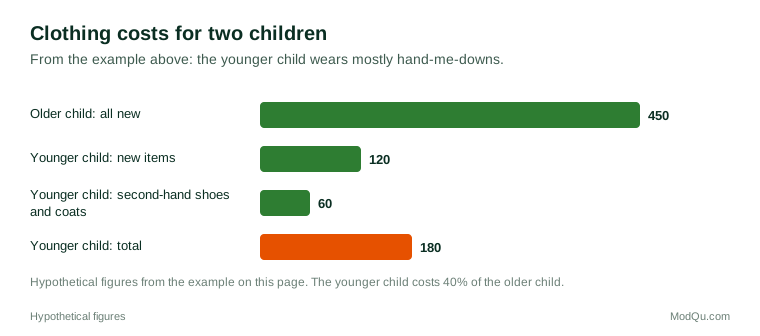
A family with two children estimates its yearly clothing costs. The older child's clothes cost 450, all bought new. Most of the younger child's clothes are hand-me-downs, plus 120 of new items and 60 of second-hand shoes and coats. The younger child's clothing costs 180 in total, which is 40% of the older child's cost (180 ÷ 450).
Where families buy children's clothes
Common places include:
- clothing chains and department stores with children's sections;
- supermarkets and discount stores, which sell large volumes of low-cost children's clothes in many countries;
- specialist children's shops and baby stores;
- school uniform suppliers;
- markets and local tailors, especially for occasion and traditional clothes;
- online shops and marketplaces;
- second-hand and charity shops and online resale.
Buying online is convenient for busy parents but fit is hard to judge, especially as sizes differ between makers. Some parents buy several sizes and return what does not fit.
What parents and carers look for
Surveys of parents often find a familiar list of priorities, though the order varies:
- Price, especially for clothes that may only fit for a season.
- Durability, so clothes survive play and washing and can be passed on.
- Comfort and ease: soft fabrics, no scratchy labels, and fastenings children can manage themselves.
- Room to grow: adjustable waistbands, roll-up cuffs and slightly larger sizes.
- Easy care: machine-washable, quick-drying and stain-resistant fabrics.
- Safety: no loose cords or small parts for young children, and flame-resistance rules for sleepwear in some countries.
- The child's own taste, which matters more as children get older.
Clothes for special occasions and cultural events
Many families buy or make special clothes for children for religious festivals, weddings, naming ceremonies, school events and national holidays. These clothes may be worn only once or twice before they are outgrown, so families handle them in different ways. Some buy low-cost outfits, some borrow or rent, some have clothes made by a tailor with generous seams that can be let out, and some keep special outfits to pass to younger relatives. In many cultures new clothes for children are an important part of a festival, and spending on them rises sharply in the weeks before.
Safety and standards
Many countries set safety rules for children's clothing. Common examples include limits on drawstrings and cords around the hood and neck of children's outerwear, rules on small parts such as buttons and decorations for very young children, limits on certain chemicals and dyes, and flammability rules for nightwear. The details differ by country and region. Parents who buy second-hand or handmade clothes sometimes check these points themselves, for example by removing hood drawstrings.
Example
A carer is given a bag of second-hand coats for a toddler. One coat has a long drawstring at the hood. They remove the cord before the child wears it, because they have read that cords at the neck can catch on play equipment.
Trends and what people disagree about
- Gender-neutral clothing. Some shops and parents prefer clothes that are not split into "boys'" and "girls'" sections, while others prefer the traditional split.
- Character and brand clothing. Clothes featuring cartoon characters and brands are popular with children, and some parents feel this adds pressure to buy.
- Fast fashion for children. Very cheap children's clothes are widely available. Some parents value the low cost; others worry about quality, waste and working conditions.
- Rental and subscriptions. Some services rent baby and children's clothes and swap them for larger sizes, though these remain small in most countries.
- School uniform costs. Families and schools disagree about whether uniforms save money by limiting fashion competition or cost more because items must come from particular suppliers.
Key terms
- Hand-me-downA garment passed from one child to another after it is outgrown.
- Growth spurtA period when a child grows faster than usual.
- Room to growFeatures such as adjustable waistbands that let clothes fit for longer.
- Age-based sizingClothing sizes labelled by a child's age rather than measurements.
- Nearly new saleA sale of second-hand children's items in good condition, often run by parent groups.
- DrawstringA cord threaded through a garment to tighten it, restricted on children's clothing in some countries.
- Flame-resistant fabricFabric treated or made to resist catching fire, required for some children's sleepwear.
- School uniformStandard clothing that pupils are required to wear at a school.
Full glossary: clothing retail operations terms on EditingTests.com.
Children's clothing vocabulary test
How well do you know the language of this topic? Try 8 quick questions. Your score is shown straight away and is not saved.
What the children's clothing survey asks
This survey is part of ModQu's Fashion and Style survey. The children's clothing part takes about five minutes and covers:
- How much you spend on children's clothes in a typical year.
- How many items are new, hand-me-downs, gifts or second-hand.
- Where you buy children's clothes: shops, supermarkets, online, markets or second-hand.
- What matters most: price, durability, comfort, safety or your child's choice.
- What you do with clothes your children have outgrown.
- How school uniform or school clothing costs affect your budget.
After that you can choose to continue with other short parts of the Fashion and Style survey, such as footwear or sportswear and athleisure, or stop.
Ready to take part?
Your answers help show what people really think and do. Results are only ever reported as totals; no one can see your individual answers.
Start the surveyQuestions about this survey
Who can take part?
Parents and carers.
Do I have to give my name?
No. You may be asked for your age group, region and similar details so results can be broken down, but not your name. ModQu never asks for passwords, card numbers or account numbers.
How are the results used?
Answers are combined into totals and percentages and published in ModQu reports. Individual answers are never shown.
Is the vocabulary test part of the survey?
No. It is optional and separate, and your score is not stored.